You sit down to write an RFQ for a thermal sensor cable. The temptation is to send a short email — model name, activation temperature, quantity, port of departure, please quote — and let the suppliers fill the gaps. They do; but each of them fills the gaps differently. Two weeks later three quotes arrive on the desk, priced against three different products, with three different documentation packages and three different delivery windows. The line items are not comparable; the prices are not comparable; the time you saved on the RFQ has come back as time spent reconciling supplier assumptions before any decision is possible.
This page is a buyer-side thermal sensor cable RFQ template — twelve fields, grouped into four blocks, each one written so that the supplier reading the RFQ understands what is being asked, the supplier reading the RFQ next door understands the same thing, and the quotes that come back describe the same product. It is not a marketing brochure asking you to value any feature in particular, and it is not a defence-procurement template designed to survive a contract court. It is the working RFQ structure a procurement engineer typically converges on after a few rounds of incomparable quotes — written down, with the conditions that make each field useful and the cost that surfaces if the field is left out.
Why an RFQ Decides Whether the Quotes You Get Back Are Comparable
An RFQ is not a request — it is a comparison fixture. Each field you write down forces every supplier you send the RFQ to to quote on the same product description; each field you leave open lets each supplier substitute their own assumption, which means the quotes you receive describe different cables at different price points. Comparability is the whole reason for writing an RFQ in the first place; without it, what comes back is closer to a survey of supplier preferences than a price comparison.
Two patterns show up in our experience again and again. The first: an RFQ that names only the activation temperature receives quotes for both metal-core and non-metal-core constructions side by side; the prices look comparable on the line item but the cables are different products and the quotes are not actually comparable. The second: an RFQ that omits the documentation set receives quotes that exclude the cost of producing the documentation; the supplier who priced the documentation in looks more expensive than the supplier who priced it out, and the cheaper quote loses again on the first audit, when the documents the project needs are missing from the shipment. Both patterns are avoidable — and both are avoided at the RFQ stage, not on the way back from quote review.
The condition under which a thin RFQ is acceptable: you are sourcing a stock cable from a known supplier, in a quantity small enough that the cost of a mismatch is one shipment. The condition under which a thin RFQ is expensive: anything else. The twelve fields below are the structure that tends to scale with project risk — the same field set, with depth on each field adjusted to the scope of the order.
Where the RFQ Sits on the Procurement Timeline
The RFQ is a hand-off document. It comes after a written specification — for the field-by-field reasoning behind the spec sheet, the thermal sensor cable specification guide walks the twelve spec fields and the engineering decision behind each one — and it precedes sample evaluation, document review and incoming inspection, which the thermal sensor cable supplier evaluation note breaks into four downstream stages. The RFQ inherits from the spec; the supplier evaluation inherits from the RFQ. Anything left ambiguous in the RFQ becomes a question carried into sample evaluation; anything left ambiguous in the spec compounds to a question that touches every supplier in the round.
The RFQ is step two. Steps one and three are the bookends that make it useful: a specification gives the RFQ the technical grammar it needs, and a quote-comparison protocol gives the RFQ a destination. Without either bookend, the RFQ is a self-contained exercise that produces little decision value.
The Twelve Fields That Belong on a Thermal Sensor Cable RFQ
The fields below are organised into four blocks: project context (three fields), cable specification (three fields, compressed from the spec sheet), compliance and documentation (three fields), commercial terms (three fields). Each field is presented as a card with four short sections — what the field actually asks, what it protects against if left open, one line of recommended wording you can adapt, and where the field shows up downstream after the quotes return. The recommended wording is sample text, not a regulated form; adapt it to the project, the standards regime and the supplier base.
Block A — Project Context (3 fields)
Project-context fields tell the supplier what the cable is for and how the order will land. They are short — typically one to three lines each — but they decide whether the supplier's quote is shaped around the project or pulled from a default catalogue line.
What the field asks. Name the cable family the supplier should quote against — typically linear heat detection (LHD) cable for fire-detection panel circuits, thermosensitive cable for OEM appliance and industrial over-temperature protection, or resistance-wire-based cable for high-temperature sensing. Then add one sentence on the end-use environment: indoor switchroom, outdoor cable tray, in-device on a battery pack, beside a cyclic-duty heater. The environment line is a context anchor, not a deployment specification — it signals to the supplier which of their reference projects the quote should be shaped around.
What it protects against. A supplier reading "thermal sensor cable" without a family modifier is free to quote whichever family their stock favours. Two suppliers quoting different families return prices that are not comparable — one is fire-detection grade, the other is OEM thermal protection grade, and the project belongs in only one of those two markets.
Recommended wording. Cable family: LHD (line-type heat detection cable, dry-contact short-circuit on activation, for fire-detection panel circuits in an indoor switchroom environment).
Where it shows up downstream. This field becomes the first filter when sample reels arrive. A reel labelled with the wrong family closes the conversation before the bench tests start. It also tells the supplier's engineering desk which of their product lines to involve in the quote — useful when the supplier covers more than one family.
What the field asks. Quantity in the unit that matches the supplier's reel format (metres of cable or number of standard reels), broken out by activation class if the project uses more than one. A short ramp-up note — first order quantity, expected forecast over the next twelve months, whether the order is one-off, repeat or a frame agreement. Suppliers price differently for a single first order, a repeat OEM line and a stocking commitment; the ramp-up note tells them which to assume.
What it protects against. A bare line-item quantity invites the supplier to quote at their default price band, which is sometimes the small-order band even on a quantity that should land in a tier discount. A vague forecast invites suppliers to over-quote or under-quote on lead time, depending on which assumption suits their stock.
Recommended wording. Quantity: 5,000 m at 88 °C activation class + 2,000 m at 105 °C activation class, supplied on standard 100 m reels. Order profile: first commercial order; non-binding indicative twelve-month forecast 30,000 m at the same class mix.
Where it shows up downstream. Quantity feeds the price-break ladder field (Field 10) and the sample reels field (Field 9). The ramp-up note feeds the lead-time discussion in Field 3 and signals to the supplier whether to allocate stock or schedule a production run.
What the field asks. The earliest delivery window the project can use, the port of departure preferred or accepted, and the Incoterm under which the supplier should price (EXW factory, FOB origin port, CIF destination port, or DDP destination warehouse). If the project has a hard date — an installation start, a project handover, an audit window — name it. If the project has a soft date, name a reasonable range and the cost of slipping each direction.
What it protects against. Two suppliers can quote the same line-item price and still produce very different landed costs once shipping, insurance and customs are folded in. Three different Incoterms in three different quotes are the most common reason a price comparison spreadsheet collapses on the second day of review.
Recommended wording. Delivery window: ready for despatch within 6–8 weeks of confirmed PO. Incoterm: please quote FOB Shanghai (primary) and DDP {destination warehouse} (secondary). Hard date: installation kick-off on {YYYY-MM-DD}; cost of a one-week slip is approximately {amount}.
Where it shows up downstream. This field decides whether the supplier's lead-time answer is the production lead time or the production-plus-shipping lead time. It also becomes the schedule that the project's logistics team needs to plan inbound receiving and the schedule that the supplier's production planning team needs to confirm an allocation.
Block B — Cable Specification (3 fields, compressed from the spec sheet)
The cable-specification block is a compressed reference to the full specification sheet. The three fields below carry just enough engineering detail for the supplier to recognise the cable; the deeper engineering decision behind each field — why ±5 K costs more than ±15 K, why metal-core changes the panel-side wiring, why silicone is rated against PTFE — sits in the thermal sensor cable specification guide, which the RFQ should reference rather than reproduce. The intent here is not to re-write the spec inside the RFQ; it is to ensure the RFQ is unambiguous on the three lines that suppliers most often re-interpret in their favour.
What the field asks. The activation temperature class in degrees Celsius, drawn either from the standard six classes used in fixed-temperature heat detection (68, 88, 105, 138, 170 and 185 °C) or from a custom set-point inside the supplier's make-to-order range. The tolerance band the project requires — typically expressed as ±5 K, ±10 K or ±15 K around the rated value. The working ambient temperature on the route, on a separate line; this is the temperature the cable will live at and must not be confused with the activation temperature it should fire at.
What it protects against. A class without a tolerance band invites the supplier to assume the loosest tolerance their process supports, which is rarely the tolerance the project needs. A class without a working ambient invites a cable that fires correctly on a bench but drifts into nuisance alarms on a route that sits at 60 °C steady state under an 88 °C activation class. How to establish that working-ambient figure — continuous and peak, surveyed rather than quoted — is walked through in the working ambient versus activation temperature note.
Recommended wording. Activation class: 88 °C, tolerance band ±10 K. Working ambient on the route: ≤ 50 °C continuous, ≤ 60 °C peak (15-minute excursion). Please confirm the activation tolerance band of your standard process and the cost adder, if any, to tighten to ±5 K.
Where it shows up downstream. This field becomes the bench-test target during sample evaluation — a 30 cm offcut held in a controlled-temperature oil bath, ramped at roughly 1 K per minute toward the rated activation point, with the conductor pair monitored on a multimeter for the resistance step. Sample evaluation can run on a shorter offcut because only two or three reels are in scope; once the first commercial batch arrives, the buyer-side incoming inspection SOP typically uses a 1 m offcut to align with the factory's three-sample spread test on the outgoing report. The reading is expected to fall inside the stated tolerance band; if the field on the RFQ was vague, the bench test has nothing specific to fail against. Whether to tighten that band at all, how tight is realistic, and what tightening costs is the subject of the custom activation tolerance note.
What the field asks. The internal architecture (metal-core or non-metal-core), the conductor alloy family the project will accept (tinned copper, nickel-plated copper, Ni80Cr20, Kanthal A1 or a nickel superalloy), and the insulation polymer family (silicone, fluoropolymer such as PTFE or FEP, fiberglass, low-smoke zero-halogen compound). Architecture and material families together decide most of the supplier's cost structure and most of the cable's failure modes; specifying them in the RFQ pins down the product before the price discussion begins.
What it protects against. Architecture is the field most often skipped on a thin RFQ. A supplier reading "thermal sensor cable, 105 °C, please quote" is free to quote a metal-core construction or a non-metal-core construction depending on stock; the prices look comparable on the line item but the cables are different products with different panel-side wiring and different sample-evaluation criteria.
Recommended wording. Architecture: metal-core (twin-conductor pair embedded in a thermosensitive compound, dry-contact short-circuit on activation). Conductor alloy family: tinned copper, ~1.0 mm² per conductor. Insulation family: silicone outer jacket; alternatives in this family acceptable if technically equivalent (please describe).
Where it shows up downstream. This field becomes the cross-section check during sample evaluation: one offcut per reel sectioned with a clean cut, photographed against a millimetre ruler, and matched against the architecture stated in the RFQ. It also feeds the panel-compatibility discussion — metal-core and non-metal-core cables behave differently at the panel termination, and the wiring drawing has to match the architecture being delivered.
What the field asks. Nominal outer diameter and tolerance — typically a few millimetres on the outer dimension, with a tolerance in the ±0.10 mm region for a nominal 4 mm jacket. Reel length per drum or per spool, in the unit the project will receive (100 m / 200 m / 500 m drums are common). Jacket marking content — model number, activation class, batch code, manufacturer initials, length marker — and the language and durability the marking should carry.
What it protects against. Outer diameter without a tolerance band is the field most often picked apart at incoming inspection — a caliper reading that lands a fraction of a millimetre over the nominal value is either inside spec or outside it depending on a tolerance the RFQ never named. Reel length without a tolerance feeds the same problem at length verification. Jacket marking without an explicit content list invites a cable that arrives with the supplier's own internal numbering and not the marking the installation crew or the panel commissioning engineer expects to read.
Recommended wording. Outer diameter: 4.0 mm nominal, tolerance ±0.10 mm at any cross-section, measured on a digital caliper. Reel length: 100 m per drum, tolerance ±0.5 %. Jacket marking: model number, activation class in °C, batch code and length-metre markers; printed in English; readable after 24 h water immersion.
Where it shows up downstream. Outer diameter and reel length feed the incoming-inspection caliper check and the length-verification re-spool. Jacket marking is the link the installation crew needs between the cable on the reel and the line item on the spec sheet — without legible marking, that link breaks at the first time a project audit asks which reel went where.
Block C — Compliance & Documentation (3 fields)
The compliance-and-documentation block is where most thin RFQs lose money. The standards the cable must comply with, the documentation set the supplier should ship with the cable, and the sample reels the project needs before the first commercial order — these three lines decide whether the price comparison is fair, whether the audit a year later has paper to fall back on, and whether the bench evaluation has anything to test against.
What the field asks. Name the standards the cable is required to comply with on this project, with one line on each — the standard reference (e.g. EN 54-22 for resettable line-type heat detectors, EN 54-28 for non-resettable line-type heat detectors, UL 521 for North-American heat detectors, FM 3210 for FM Global approval, IEC 60332-1-2 for vertical flame propagation on a single insulated cable, IEC 60754 parts 1 and 2 for halogen acid gas content and the pH and conductivity of combustion gases, IEC 60529 for IP rating on cable terminations rather than the cable itself, ISO 9001 for the supplier's quality-management system). For each standard, ask which body issued any current certificate, on which cable model, and on which date.
What it protects against. A standards line that names only the standard reference receives compliance statements that read as proof but are actually narrower in scope than the project needs. A statement against EN 54-22 on one cable model in 2019 does not cover a different model from the same supplier today; a statement against IEC 60332-1-2 does not cover the bundled-cable flame behaviour that IEC 60332-3 measures. The buyer's job at this field is not to replace the certifying body, it is to read each statement as evidence rather than as proof.
Recommended wording. Required standards: EN 54-22 (resettable LHD), IEC 60332-1-2 (single-cable flame propagation), IEC 60754-1 and -2 (halogen acid gas; combustion gas pH and conductivity), ISO 9001 (QMS at the manufacturing site). For each standard, please state the certifying body, the certificate reference, the cable model the certificate covers and the certificate date.
Where it shows up downstream. Each standards line becomes a row on the document-review checklist at the first commercial order. The reading framework — the buyer-side question for each standard, and what cannot be inferred from a single certificate — is the table in the supplier evaluation guide standards section. The RFQ does not need to reproduce that table; it needs to name the standards in a way that lets each compliance statement returned by the supplier map cleanly back to a row. The buyer-side reading of what each standard governs, and what a single certificate cannot tell you, is the EN 54-22 / UL 521 / FM 3210 compliance map.
What the field asks. Spell out the document set the supplier should ship with each commercial order. Four families cover most procurement and audit needs: the outgoing batch inspection report (typically a tabulated grid of measured parameters per reel — see the nine-parameter QC checklist for the underlying test methods), the conductor and insulation material datasheets, the compliance statements against the standards cited in Field 7, and the traceability record that ties reel serial numbers in the carton to the production batch and the raw-material lot.
What it protects against. A documentation line that says "documents on request" tells one supplier to price the documentation in and another supplier to price it out, which is the cleanest way to make the cheaper quote look cheaper than it actually is. Documents requested only after the cable arrives often do not exist in a useful form by then; the leverage to require them disappears at the moment the reel is on the dock.
Recommended wording. Documents required with each shipment: (1) outgoing batch inspection report, signed and dated, with measured value, spec value and pass/fail per reel; (2) material datasheet for conductor alloy and insulation polymer; (3) compliance statement against each standard listed in Field 7; (4) traceability record linking reel serial numbers to production batch and raw-material lot. Please confirm these are priced into the unit cost, not as an extra line item.
Where it shows up downstream. This field is what stage three of supplier evaluation tests — see the supplier evaluation guide's document-review section for the field-by-field reading. The annotated reading now sits in what a batch inspection report should look like. For what each document in this set proves and when to request it, see the document package every buyer should request.
What the field asks. The number of sample reels per activation class the supplier should ship for the buyer's bench evaluation, the length per sample reel, the lead-time the supplier expects for sample despatch, and the basis on which sample cost and freight are handled (paid by the buyer, paid by the supplier, credited against a confirmed PO). Two or three reels per activation class is a typical starting point — enough for sectioning, dimensional measurement, insulation resistance and an activation-point sample test, with one reel held in reserve.
What it protects against. A sample line that simply asks "please send samples" returns whatever the supplier has on the shelf, sometimes a stock cable from a different activation class than the project. A sample line that does not name the cost basis becomes the first awkward conversation in the supplier relationship — well before the relationship is mature enough to absorb it. Naming the cost basis upfront avoids that conversation; whether the answer is buyer-paid or supplier-paid is less important than having the answer on paper before the samples ship.
Recommended wording. Sample reels: 2 reels of 30 m at 88 °C and 2 reels of 30 m at 105 °C, each on a labelled spool with the same jacket marking spec as the production order, accompanied by an outgoing inspection report for the sample batch. Sample cost basis: buyer-paid against pro-forma; freight paid by buyer at cost. Sample lead-time: please confirm.
Where it shows up downstream. Sample reels feed the entire stage-two of supplier evaluation. The bench tests run against the samples — visual, caliper at three points per reel, four-wire conductor loop resistance against the conductor alloy datasheet, 500 V insulation resistance against the threshold on the written specification attached to the RFQ (a clean, dry, unaged sample at room temperature typically reads above 2000 MΩ), and an activation-point sample test in a controlled-temperature oil bath ramped at roughly 1 K per minute toward the rated activation point — largely overlap with the checks that will run again at incoming inspection on the first commercial batch, with the offcut length and the reference document shifting at stage four. The companion note on sample evaluation procedure — from reel arrival to go / no-go walks the threshold-by-threshold decision tree.
Block D — Commercial Terms (3 fields)
Commercial-terms fields close the transaction grammar. Three lines — quote validity together with the price-break ladder, payment terms together with currency, and the non-conformance position — keep the price comparison fair across suppliers and keep the conversation about a failed reel from happening at the worst moment.
What the field asks. The validity window the buyer expects on the returned quote — typically 30, 60 or 90 days — and a request that the supplier price not just the project quantity but a small ladder of quantity tiers around it (for example: project quantity, half the project quantity, double the project quantity). The ladder lets the buyer's internal stakeholders evaluate sensitivity to volume changes without re-issuing the RFQ.
What it protects against. A quote without a stated validity window can be re-priced by the supplier at any moment between quote and PO — usually upward — and the buyer has no contractual handle on the difference. A single-quantity quote forces a re-quote whenever the internal stakeholder discussion adjusts volume by 20 percent, which suppliers often re-price more aggressively than they would on the original ladder.
Recommended wording. Quote validity: please hold the quoted price for a minimum of 60 days from quote issue date. Price-break ladder: please quote unit price at three quantity tiers — 5,000 m, 10,000 m and 20,000 m — at each activation class listed in Field 2.
Where it shows up downstream. Quote validity is the date the procurement team works against during internal approval. The price-break ladder is the input the buyer's spreadsheet needs to model the cost-impact of common volume shifts; without it the spreadsheet has only one data point and one supplier-side assumption per tier.
What the field asks. The payment terms the buyer expects (T/T 30 % advance and 70 % against shipping documents is common in cross-border thermal sensor cable trade; L/C at sight is common on larger orders; net-30 or net-60 against invoice is common on a stable repeat relationship). The currency the supplier should price in — USD, EUR or RMB are the three most common, with the choice driven by the buyer's procurement currency and the supplier's banking arrangement.
What it protects against. Payment terms left open invite the supplier to quote on the terms most favourable to them, which is rarely the terms most favourable to the buyer's working capital. Currency left open lets each supplier quote in their preferred currency, which leaves the buyer's spreadsheet to do the conversion — not a comparison risk in itself, but the conversion rate on the day of the quote rarely matches the rate on the day of the PO and the difference is sometimes material.
Recommended wording. Payment terms: T/T 30 % deposit on PO confirmation, 70 % against shipping documents at port of loading. Currency: USD on FOB; please quote in USD even if internal book-keeping is RMB. If a counter-proposal on payment terms is submitted, please state it on a separate line for review.
Where it shows up downstream. The payment terms become a clause in the proforma invoice and a row on the buyer's cash-flow planning. The currency choice becomes the quoted price comparison axis on the buyer's spreadsheet; one currency for all suppliers is the simplest comparison; two or more currencies is workable but adds an FX-rate uncertainty to the comparison.
What the field asks. The buyer's expected position on non-conforming reels — what proportion of a shipment can fail incoming inspection before a replacement is required, on whose account the replacement and freight are handled, and the timeframe within which the replacement should ship. The field is short — one paragraph is usually enough — but it tells the supplier that the buyer expects the conversation about a failed reel to happen against an agreed framework rather than as an open dispute.
What it protects against. An RFQ that omits this field pushes the discussion to the moment the first reel fails on arrival, which is also the moment the buyer's leverage is at its lowest — the cable is sitting on the dock, the project schedule is moving, the supplier knows both. Naming the position upfront moves the discussion to a moment when both sides have time to negotiate it as part of the overall commercial package, where the supplier can price it in if their internal NCR cost is non-trivial and where the buyer can choose to accept a slightly higher unit price for a tighter NCR clause.
Recommended wording. Non-conformance position: any reel that fails incoming inspection against the spec sheet (Field 4–6) or against the outgoing inspection report (Field 8) is to be replaced at the supplier's cost, with replacement reels shipped within 4 weeks of a documented NCR notice. Freight on replacement reels: paid by the supplier. Please confirm acceptance, or propose an alternative position on a separate line.
Where it shows up downstream. The NCR clause becomes the language the buyer's QA team writes against when a reel fails. It also tells the buyer's internal approver that the procurement engineer has thought about the failure case before signing the PO, which is often the difference between an internal approval that lands the same week and one that loops for a few rounds of additional questions. The bench procedure that produces the evidence the clause runs against — sampling rules, reel-level measurements, the NCR tag and the photograph trail — is walked in our incoming inspection SOP for thermal sensor cable. The RFQ states a position; turning that position into binding non-conformance and warranty terms — the disposition path, the replacement window, and a warranty that covers a defect surfacing in service — sits in the NCR and warranty terms note.
A One-Page Thermal Sensor Cable RFQ Layout You Can Adapt
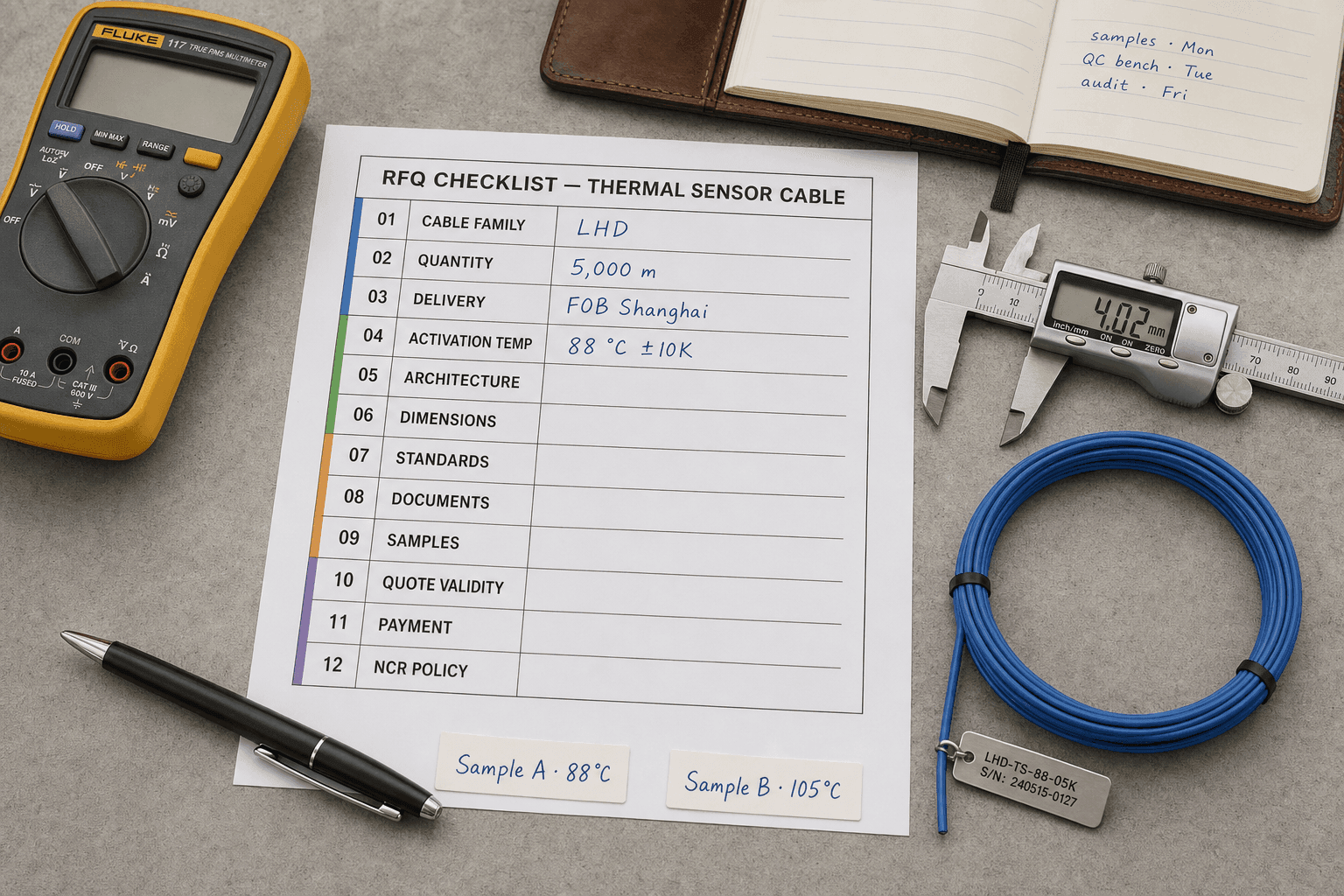
The twelve fields above can fit on one printed page when laid out as a structured form. Below is an example layout — copy it, edit the placeholders inside curly braces, and either send it as the body of the email or attach it as a PDF. The layout below is illustrative; the four-block grouping (project context, cable specification, compliance and documentation, commercial terms) is the structural part worth keeping. The exact wording is a starting point.
┌────────────────────────────────────────────────────────────────────────┐
│  REQUEST FOR QUOTATION — Thermal Sensor Cable                          │
│  RFQ No.: {RFQ-2026-NN}     Issue date: {YYYY-MM-DD}                   │
│  Buyer: {company / project ref}      Contact: {name / email / phone}   │
│  Response deadline: {YYYY-MM-DD}                                       │
└────────────────────────────────────────────────────────────────────────┘

  A · PROJECT CONTEXT
  ─────────────────────────────────────────────────────────────────────
  01  Cable family & end-use    : LHD / TS / resistance-wire — {one line}
  02  Quantity / classes / ramp  : {m at class} ; first-order vs forecast
  03  Delivery / port / Incoterm : {weeks} ; {origin port} ; FOB / DDP

  B · CABLE SPECIFICATION  (full spec sheet attached as Annex A)
  ─────────────────────────────────────────────────────────────────────
  04  Activation class & tol.   : {°C} ± {K} ; working ambient {°C}
  05  Architecture / cond. / ins.: metal-core / non-metal-core ;
                                   conductor family ; insulation family
  06  OD / reel length / marking : {mm} ± {mm} ; {m/reel} ; marking spec

  C · COMPLIANCE & DOCUMENTATION
  ─────────────────────────────────────────────────────────────────────
  07  Standards & certifying    : EN 54-22 / EN 54-28 / UL 521 / FM 3210
      bodies                       / IEC 60332-1-2 / IEC 60754 / ISO 9001
                                   (state body + cert ref + cable model)
  08  Documents per shipment     : batch inspection report ; material
                                   datasheet ; compliance statement ;
                                   traceability record  (priced in)
  09  Sample reels for pre-PO    : {n reels of {m}} per activation class ;
      evaluation                   cost basis ; sample lead-time

  D · COMMERCIAL TERMS
  ─────────────────────────────────────────────────────────────────────
  10  Quote validity & ladder    : valid {N} days ; price tiers at
                                   {q1} / {q2} / {q3} per class
  11  Payment terms / currency   : {T/T 30/70 ; L/C at sight ; net-N} ;
                                   {USD / EUR / RMB}
  12  NCR / replacement position : {threshold} ; supplier cost / freight ;
                                   replacement window {N weeks}

  E · RESPONSE FORMAT REQUESTED
  ─────────────────────────────────────────────────────────────────────
  •  Line-item unit price per activation class & quantity tier
  •  Total quoted price per Incoterm scenario
  •  Sample document set returned with the quote (not only with shipment)
  •  Any deviations from fields 04 – 12 listed on a separate line

  Issued by: {procurement engineer}      Signature / date: ___________
The layout is not regulated; the value of the one-page constraint is that every field on the page has had to earn the line it occupies. A two-page RFQ usually means the project has two layers of internal review feeding into it; it is workable but the trade-off is that the supplier has more to read before quoting, and a longer document tends to receive a slower response.
How RFQ Thickness Changes the Quotes You Get Back
RFQs come in three rough thicknesses in our experience. Each thickness has a place; none of them is universally the right answer. The grid below names the trade-off across the three.
Useful when: stock cable from a known supplier; quantity small enough that the cost of a mismatch is one shipment; the buyer is willing to absorb supplier-substitution risk in exchange for a fast quote.
Common cost: returned quotes describe different products at different price points; comparison is approximate.
Typical response time: same day to 48 hours.
Useful when: first commercial order with a new supplier; project is one of several in a portfolio; comparability across two or three quotes matters more than absolute speed.
Common cost: a few extra days for the supplier to compile the full quote; balanced against materially better comparability.
Typical response time: 5 – 10 working days for a complete response.
Useful when: the cable is part of a regulated project (fire-protection AHJ submission, OEM frame agreement) or the buyer's procurement function requires a tendering trail.
Common cost: extended supplier-side preparation; some suppliers may decline to quote if the response burden is high relative to the order size.
Typical response time: 2 – 4 weeks; document review on supplier side often paces the timeline.
The medium RFQ — the twelve-field one-page format described above — is the structure most thermal sensor cable procurement converges on for a first commercial order. The thin RFQ is appropriate for repeat orders against an existing relationship; the thick RFQ is appropriate for AHJ-driven projects where the tendering trail is itself part of the deliverable. Choosing the wrong thickness costs in either direction: a thin RFQ on a regulated project loses the tendering trail; a thick RFQ on a stock cable order from a known supplier slows the response without changing the answer.
Fields Most Often Skipped, and the Cost That Surfaces Later
Across the procurement engineers we have worked with on thermal sensor cable RFQs, four fields are skipped repeatedly. The cost surfaces later in predictable ways. The compact reference below is the one we suggest pinning above the desk during the first round of RFQs against a new supplier base.
| Skipped field | Where the cost surfaces | Approximate effort to add to the RFQ |
|---|---|---|
| Architecture line (Field 5) | Sample evaluation: reels arrive in the wrong architecture; either the project re-quotes or the buyer accepts a cable the panel-side wiring was not drawn against. | One line on the RFQ; one cross-reference back to the spec sheet. |
| Documentation set (Field 8) | First shipment: the document set the supplier prices in is not the document set the project audit needs; cheaper quote loses on the audit, not on the bench. | Three lines naming the four document families; explicit "priced in, not extra". |
| Standards-compliance scope (Field 7) | Document review: the compliance statement returned by the supplier is on a different cable model or for a narrower scope than the project needs; the review re-opens at the moment the AHJ submission is being prepared. | One line per standard naming body, certificate reference and cable model. |
| NCR position (Field 12) | First failed reel: the conversation about replacement happens at the moment the buyer's leverage is at its lowest, with the cable on the dock and the project schedule moving. | One paragraph; replacement timeframe and freight responsibility. |
None of these four fields is technically difficult to add to an RFQ; each is a few lines. The reason they are skipped repeatedly is that they sit at the boundary between the procurement engineer's responsibility and the QA / legal / project-engineering responsibilities, and at that boundary it is easy for each function to assume the other will pick the field up. The twelve-field RFQ structure is, in that sense, less a procurement template than a coordination contract — it pulls those four fields onto a single page so that no function has to chase them.
Two related notes are worth reading alongside this page. The five signs of a reliable thermal sensor cable supplier covers the screening band that sits before the RFQ — the heuristics for separating a manufacturer from a trader before either of them receives the RFQ. The one-shot or resettable thermal cutoff cable note covers a decision that often precedes the activation-class line in Field 4 — the choice between a fusible one-shot construction and a resettable PTC construction, with mechanism, hysteresis and cycle-life trade-offs that change which RFQ wording is appropriate.
From the Returned Quote to Sample Evaluation
The RFQ does its work over a window of about two weeks — a few days for the supplier to read the document, a few days to compile the response, a few days for the procurement engineer to compare the quotes when they land. After that window the RFQ is mostly a reference document; the real evaluation moves to the sample reels and the document set the suppliers send. The thermal sensor cable supplier evaluation note breaks the post-RFQ work into four stages — desk research (mostly behind you by the time the quotes return), sample evaluation (Field 9 of the RFQ feeds this), document review (Fields 7 and 8 feed this), incoming inspection on the first commercial order (Fields 4 – 6 and 8 feed this).
One pattern that helps the hand-off: when the quotes return, do a quick traceability pass — for each line of each quote, identify which field on the RFQ it answers, and flag any line that does not map back to a field. Lines that do not map back are usually the supplier's optional adders (an extended warranty, an extra round of testing, a freight upgrade); they are not unwelcome, but they should not be in the price comparison until they have been priced separately. Lines that should map back to a field but do not — a missing tolerance band, a missing standards reference, a missing document family — are the questions the procurement engineer carries into stage two of supplier evaluation.
Index — Where to Go Next, by RFQ Stage
This page is the procurement-side companion to the engineering-side specification work and to the post-RFQ evaluation work. The table below routes a stage-specific question to the deeper note that walks the answer.
| If the question on your desk is... | The answer sits in... |
|---|---|
| "How do I write the spec the RFQ should reference?" | Thermal sensor cable specification guide — the twelve fields a spec sheet should contain |
| "Should the cable be a one-shot fusible construction or a resettable PTC construction?" | One-shot or resettable thermal cutoff cable — the decision before the activation point |
| "Is this supplier even worth sending the RFQ to?" | Five signs of a reliable thermal sensor cable supplier |
| "The quotes are back — how do I evaluate the supplier behind them?" | Thermal sensor cable supplier evaluation — a buyer's decision path |
| "Which QC parameters underlie the documentation set in Field 8?" | Thermal sensor cable nine-parameter QC checklist |
| "Annotated sample — what should the batch inspection report actually look like?" | What a batch inspection report should look like — annotated sample |
| "How do I run the sample-evaluation tests Field 9 sets up?" | Sample evaluation procedure — from reel arrival to go / no-go |
| "Which standard activation class — 68, 88, 105, 138, 170 or 185 °C — fits the project?" | Activation temperature selection — standard six versus a custom set-point |
An RFQ is the contract before the contract. Its purpose is not to lock the supplier in; it is to pin the cable in. Twelve fields, written down on one page, turn a quote-comparison spreadsheet from a reconciliation exercise into a decision instrument — and that is the difference between a procurement decision the buyer's engineering team trusts and one they re-open three weeks later when the first sample reel is sectioned on the bench.
FAQ — Thermal Sensor Cable RFQ Template
What twelve fields belong on a thermal sensor cable RFQ?
A thermal sensor cable RFQ that returns comparable quotes covers twelve fields grouped into four blocks. Block A — project context: cable family and end-use environment, quantity and activation classes needed, delivery window and Incoterm. Block B — cable specification (a compressed reference to the spec sheet): activation temperature class and tolerance band, architecture together with conductor and insulation material families, outer diameter together with reel length and jacket marking. Block C — compliance and documentation: standards the cable must comply with, the documentation set required with each shipment, sample reels for pre-PO evaluation. Block D — commercial terms: quote validity and price-break ladder, payment terms and currency, non-conformance and replacement position. Each field carries one line of recommended wording in the body of this page; together the twelve fields close the gaps that, when left open, cause the returned quotes to describe different cables at different price points.
How is an RFQ different from a thermal sensor cable specification sheet?
A specification sheet describes the cable; an RFQ describes the transaction. The specification sheet, walked field by field in the thermal sensor cable specification guide, contains the engineering decisions that define the product — activation temperature, working ambient, conductor, jacket, geometry, IP rating, mechanical envelope, termination, compliance documents, batch QC and the RFQ-ready wording at the end. The RFQ inherits a compressed reference to the specification sheet (three of the twelve RFQ fields point back to it) and adds the commercial layer the supplier needs to produce a price: quantity and ramp-up profile, sample reels, lead time and Incoterm, validity window and price-break ladder, payment terms, and the non-conformance position. A specification sheet without an RFQ does not become a quote; an RFQ without a specification sheet leaves every supplier free to substitute their own assumption.
Which fields are most often skipped on a thermal sensor cable RFQ, and what is the cost?
Four fields are skipped repeatedly and the cost surfaces later in predictable ways. The architecture line (metal-core or non-metal-core) is the most common; suppliers quote whichever architecture their stock favours, the prices look comparable on the line item but the cables are different products. The documentation set is the second; suppliers who price the documentation in look more expensive than suppliers who price it out, and the cheaper quote loses on the first audit. The standards-compliance line is the third; an RFQ that names a standard without naming the certifying body and the certificate scope receives statements that read as proof but are actually evidence of a narrower scope than the project needs. The non-conformance position is the fourth; an RFQ that omits NCR handling pushes the discussion to the moment the first reel fails on arrival, when the buyer's leverage is at its lowest. Each field is one to three lines on the RFQ; each one closes a downstream conversation that costs days when the field is left open.
What does a one-page thermal sensor cable RFQ template look like?
A workable one-page thermal sensor cable RFQ template has a header block (project reference, RFQ number, issue date, buyer contact, response deadline), four labelled groups for the twelve fields (project context, cable specification, compliance and documentation, commercial terms), a closing block for the response format (a request for line-item pricing per activation class and quantity tier, plus the documentation set the buyer expects with the quote rather than only with the shipment), and a signature line. The body of this page renders an example layout in a copy-ready format. The aim of the one-page constraint is not brevity for its own sake; it is the discipline that forces every field on the page to earn the line it occupies, which is also the discipline that makes the returned quotes comparable when they land on the desk a few weeks later.