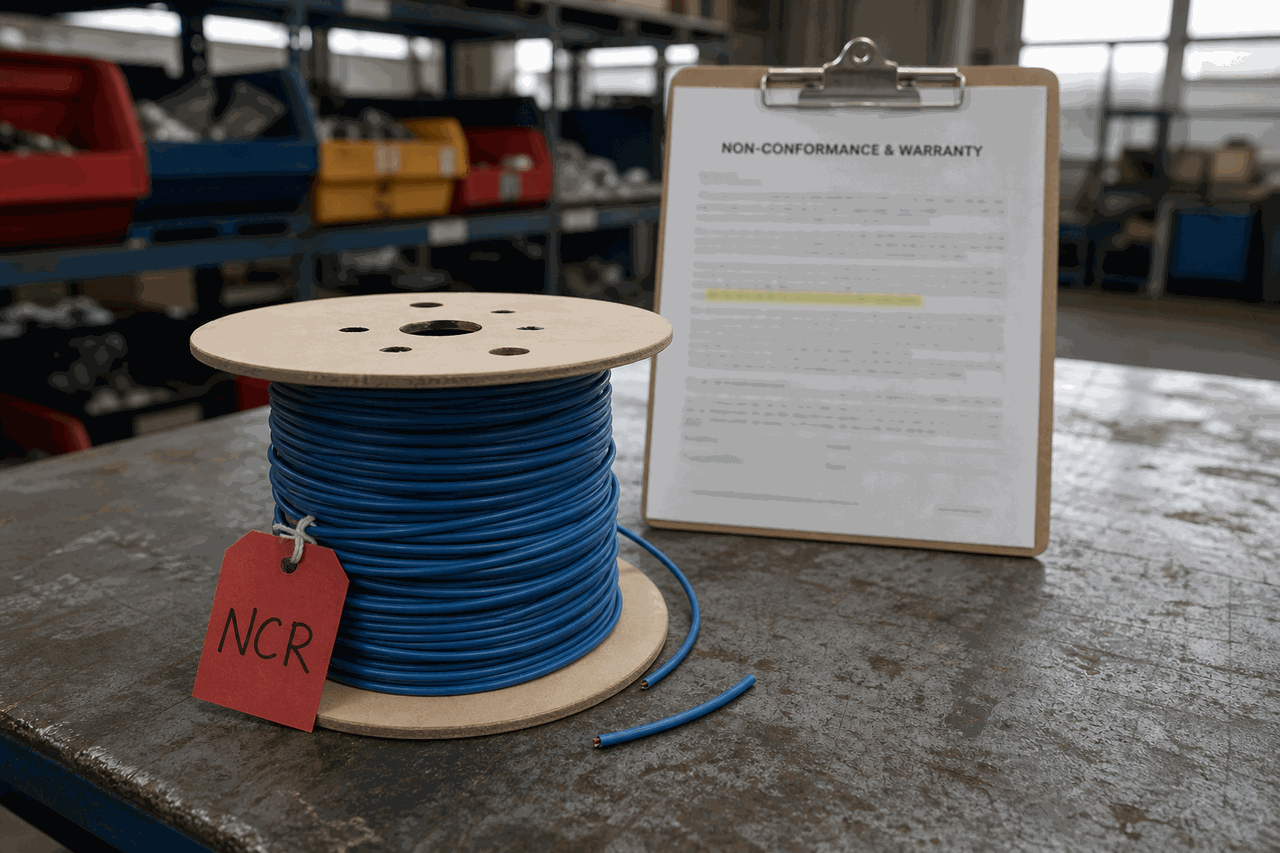
A reel fails incoming inspection. An inspector ties a red tag to it, photographs the carton, and the reel goes to a quarantine shelf. For many buyers that feels like the end of the problem — the bad cable has been caught. It is closer to the beginning. The tag records a fact: this reel, this check, this measured value. What happens next — who ships a replacement, who pays the freight, how quickly, and whether a defect that only shows up three months into service is still the supplier's problem — is decided not by the tag but by the agreement behind it. A red tag is not a remedy. The remedy is written down somewhere, or it is not.
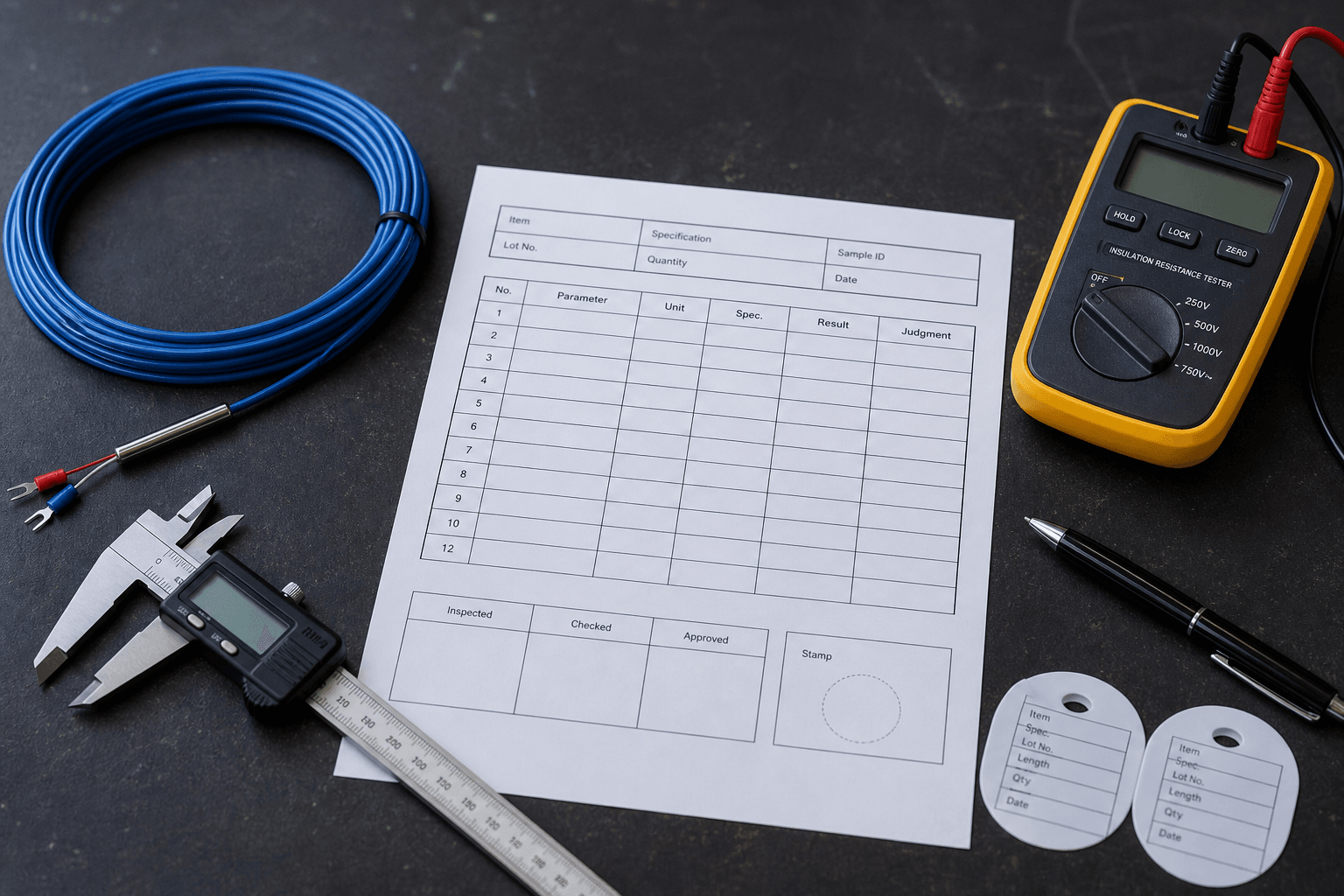
This note is about that written layer: what a non-conformance becomes once it is more than a tag, and what warranty terms are worth negotiating into a thermal sensor cable supplier agreement before the first order ships. It comes after the bench work — the six-check incoming inspection that produces the evidence and the batch inspection report the evidence is read against — and after the RFQ has named a non-conformance position. Those decide whether a reel passes and what the buyer asked for; this decides what the contract owes when a reel does not pass, and what is still owed long after the cartons are emptied.
An NCR Is a Process, Not a Tag
A non-conformance report is often treated as a label: a reel is tagged, set aside, and a photo is filed. Handled that way it stops at containment, which is only the first move. A non-conformance is a short lifecycle, and an agreement that names the steps turns a dispute into a procedure both sides have already agreed to follow.
Log the reel, failed check and measured value, and quarantine the affected stock so it cannot enter production.
The supplier confirms receipt within an agreed response time — the first clause worth a number, before the reel costs the schedule.
Find why the reel left the plant out of band, read against the row on the outgoing inspection report.
Agree what happens to the stock — replace, rework, concession or scrap — and what stops a repeat. This is where money is decided.
Close the NCR with a record both sides keep — what a later audit or warranty claim refers back to.
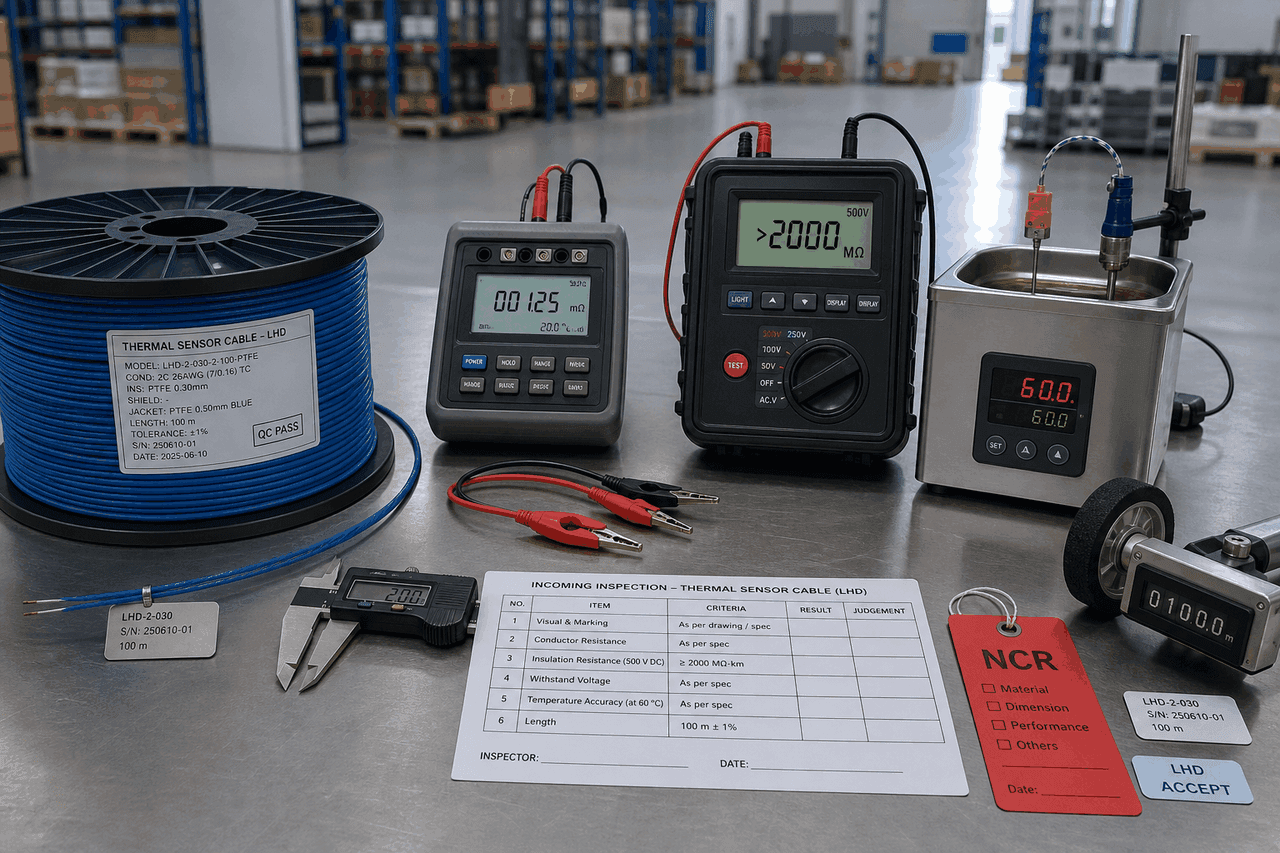
The bench side of this — quarantine, the red tag, the photograph trail — is walked in the incoming inspection SOP. That procedure produces the evidence; everything from acknowledgement onward is the contract doing its work, not the bench. An agreement that names a response time and a disposition path is the difference between a clean close-out and a thread of emails that never quite resolves.
Disposition — Four Ways an NCR Can End
Once a non-conformance is confirmed, the stock has to go somewhere. There are four standard dispositions, and the agreement is clearer when it names who decides each and who carries the cost rather than leaving it to the moment.
| Disposition | What it means | Who typically carries the cost |
|---|---|---|
| Return & replace | Non-conforming reels are returned or scrapped and conforming replacements are shipped. The default for a clear material or measurement defect. | Supplier — replacement reels and freight, per the agreed clause. |
| Rework | The supplier brings the stock back to specification — re-terminating, re-spooling, or re-labelling — where the defect is recoverable without remanufacture. | Supplier, usually, including return freight both ways. |
| Use-as-is (concession) | The buyer accepts out-of-band stock against a documented concession, often for a price adjustment, when the deviation does not matter for the application. | Negotiated — commonly a credit against the affected reels. |
| Scrap | The stock is destroyed, sometimes under witness, with no replacement value recovered. Reserved for stock that cannot be reworked or safely used. | Supplier, where the defect is theirs. |
Use-as-is is the disposition that deserves the most discipline. It should be an engineering decision recorded in writing — a signed concession that names the deviation and why it is acceptable for this application — not a default the schedule pressures the buyer into. A concession granted under deadline and never written down is the one that resurfaces as an argument when the same deviation matters on the next project.
A Warranty Is Not a Replacement Clause
The replacement clause covers reels that fail at the dock — a snapshot at incoming inspection. A warranty covers a defect that surfaces later, in service. They have different triggers, different windows and different evidence, and conflating them leaves a gap that opens at exactly the wrong time: a cable that passes incoming inspection and fails in month four falls outside the replacement clause, and without a warranty it falls outside everything.
The boundary that makes a warranty workable is the line between what the factory controls and what it does not. A warranty that names that line is one a buyer can actually use; one that gestures at total coverage tends to be read down to little when it is tested.
Manufacturing and material defects: a compound whose activation point drifts out of its rated band faster than the specification allows, an insulation system that reads below its declared resistance, a jacket that fails the property it was specified for, or a termination that was not made to the agreed method.
What sits outside the factory's control: misapplication, such as running the cable above its rated working ambient; installation damage, such as a gouge, an over-tight bend or a poor splice; an out-of-specification environment, such as chemical exposure the jacket was never specified to resist; and storage or age beyond the agreed conditions.
The numbers behind those defects — the activation band, the insulation-resistance threshold, the outer-diameter tolerance — are not fixed in the warranty itself. They are inherited from the specification sheet and the values recorded on the batch's outgoing inspection report; the warranty commits to the cable meeting what was specified and measured for that order, not to a separate set of figures written into the contract.
Duration is a negotiation, but the start date matters as much as the length. A warranty that begins at shipment can expire before a cable that sat in a warehouse for several months is even energised — common on project work where delivery and installation are far apart. A start tied to commissioning or installation, capped by a backstop measured from shipment so the window cannot run open-ended, is the fairer structure for that case; for fast-turn OEM builds where the cable reaches the line within weeks, a from-shipment start is simpler and usually enough.
The Clauses Worth Naming in a Supplier Agreement
A handful of clauses carry most of the weight. Each is short, and each closes a question that otherwise gets answered under pressure when a reel is already on the quarantine shelf.
| Clause | What it should state |
|---|---|
| NCR response time | The window within which the supplier acknowledges a documented NCR and proposes a disposition — measured in business days, not left open. |
| Replacement window & freight | How quickly conforming replacements ship after disposition is agreed, and on whose account the replacement and its freight sit. |
| Warranty duration & start | The length of cover, the start point (shipment, or commissioning with a from-shipment backstop), and the named model and batch it applies to. |
| Remedy ladder | What the remedy is — repair, replacement or credit of the affected goods — and in what order, so neither side improvises it during a claim. |
| Systemic-defect clause | Where the same defect is confirmed across a batch, the remedy applies to the batch population rather than reel by reel as units happen to be returned. |
| Traceability obligation | Each reel or cut piece carries a batch reference traceable to its outgoing inspection report, so a claim can be scoped to a defined population. |
| Liability boundary | The remedy is the repair, replacement or credit of the affected goods; this is the clause to keep realistic rather than aspirational on either side. |
Where Each Term Lives — RFQ, PO, or Quality Agreement
The same terms have three possible homes, and which one they belong in depends on how often the cable ships. The RFQ states a position so quotes come back comparable; the purchase order references the terms agreed for one order; a standalone supply or quality agreement binds the full lifecycle and warranty across repeat batches. A one-off purchase may be fully served by PO terms. Programme supply, where the same cable ships batch after batch, is where a quality agreement earns the effort of drafting it.
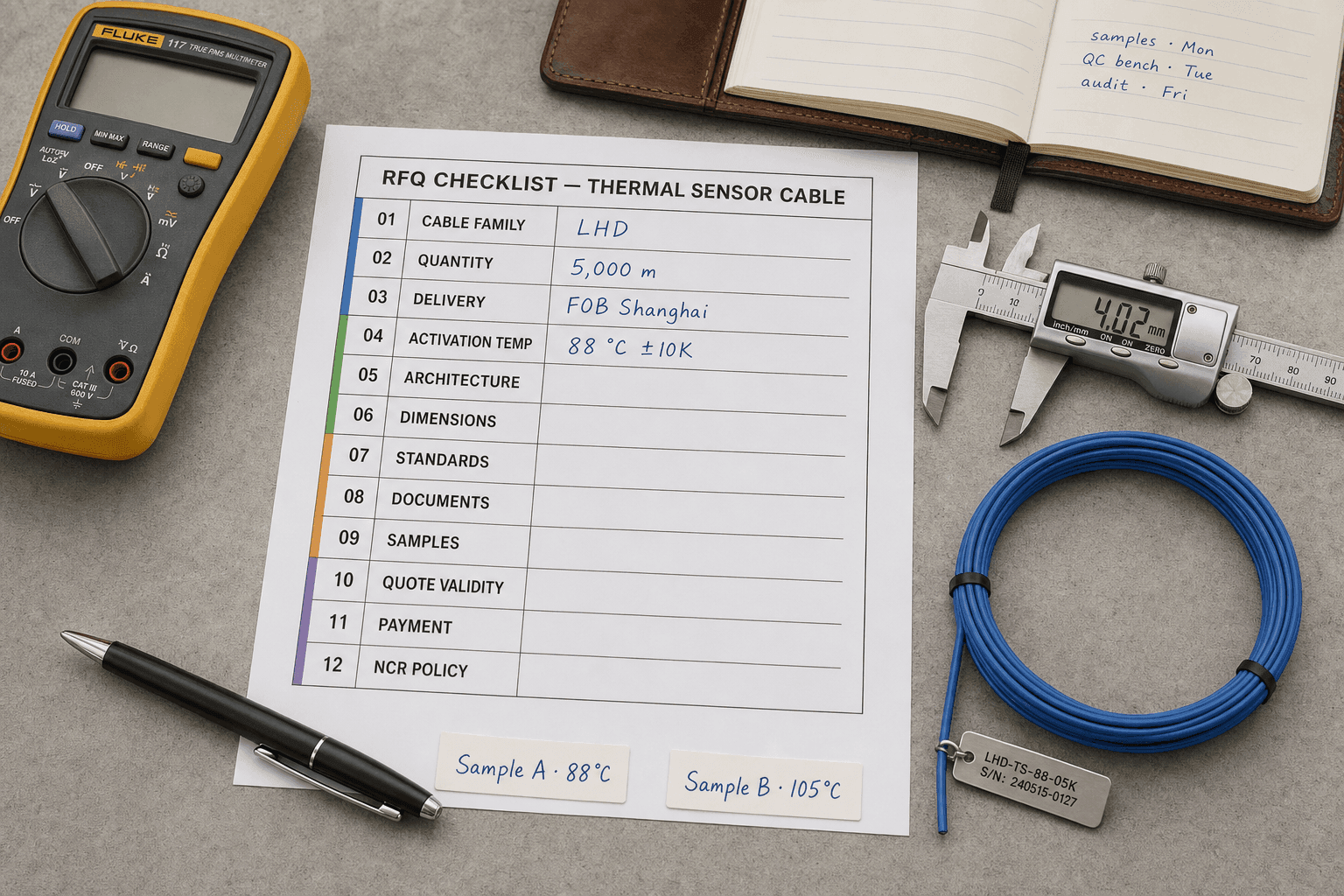
The RFQ side of this is already covered: the non-conformance and replacement line is one of the twelve fields a complete RFQ carries, walked field by field in the RFQ template. What the agreement adds is the part the RFQ never reaches — the lifecycle, the disposition path and the warranty — written as binding terms rather than as an opening position.
Non-conformance: supplier to acknowledge a documented NCR within {N business
days}; disposition (replace / rework / concession / scrap) agreed in writing
before stock is moved; replacement of conforming goods at supplier cost,
freight included, within {N weeks} of agreed disposition.
Warranty: {N months} against manufacturing and material defect, from
{commissioning, with a backstop of N months from shipment}, for the named
model and batch. Remedy: repair, replacement or credit of the affected goods.
Systemic defect: where the same defect is confirmed across a batch, the remedy
applies to the batch, not only to individually returned reels.
Traceability: each reel / piece carries a batch reference traceable to its
outgoing inspection report.
Traceability Is What Makes a Claim Scopeable
A claim is only as strong as the traceability behind it. A warranty clause and a systemic-defect clause are unusable if a failed cable cannot be tied to a batch — without that link, a defect found in one length forces a conversation about the entire order, and neither side can size the remedy. Batch numbering on the batch inspection report lets a claim point at a defined population; for cable delivered as cut-to-length pieces, per-piece or per-bag lot tags carry that same reference down to the part on the line. The traceability obligation is not paperwork for its own sake — it is the thing that turns a clause into something either party can actually invoke.
This is also where a serious supplier and a careful buyer meet. At our own engineering desk we are willing to put non-conformance handling and a defined warranty into a supply or quality agreement, scoped to a named model and batch, with the remedy stated as repair, replacement or credit of the affected goods and a clear line around what a warranty does and does not cover. The terms are negotiated, not promised into existence — but a supplier that expects to stand behind a documented defect tends to make the discussion more concrete, and the buyer who has thought through disposition, window and warranty start before signing rarely has to improvise the conversation when a reel is on the quarantine shelf.
A red tag records a problem; it does not solve one. The agreement behind it decides who replaces the reel, who pays the freight, how fast it ships, and whether a defect that surfaces in month four is still anyone's responsibility. Name the non-conformance lifecycle, separate the warranty from the replacement clause, and tie both to a batch you can trace. A defect you can scope to a batch is a negotiation; a defect you cannot is an argument.
FAQ — NCR and Warranty Terms for Thermal Sensor Cable
What is the difference between a non-conformance (NCR) clause and a warranty for thermal sensor cable?
They cover two different moments. A non-conformance clause deals with cable that fails when it arrives — a reel that misses the outer-diameter tolerance, reads low on insulation resistance, or trips outside its activation band at incoming inspection. It is a snapshot at the dock, and the remedy is usually replacement of the affected reels at the supplier's cost within an agreed window. A warranty deals with a defect that surfaces later, in service — a compound that drifts out of band faster than the specification allows, or an insulation system that degrades early. Its trigger is a field failure rather than a bench measurement, its window runs for months or years rather than at delivery, and it depends on traceability to tie the failed cable back to a batch. Conflating the two leaves a gap: a cable that passes incoming inspection and fails in month four sits outside the replacement clause, and without a warranty it sits outside everything.
What should a thermal sensor cable warranty cover, and what does it exclude?
A warranty should cover manufacturing and material defects — the things the factory is responsible for. That includes a compound whose activation point drifts out of its rated band faster than the specification allows, an insulation system that reads below its declared resistance, a jacket that fails the property it was specified for, or a termination that was not made to the agreed method. It should exclude the things outside the factory's control: misapplication, such as running the cable above its rated working ambient; installation damage, such as a gouge, an over-tight bend or a poor splice; an out-of-specification environment, such as chemical exposure the jacket was never specified to resist; and storage or age beyond the agreed conditions. A warranty that tries to cover everything is usually read down to little in a dispute; one with clear boundaries is the one a buyer can actually rely on.
How long should a thermal sensor cable warranty last, and when does the window start?
Duration is a negotiation, but the start date matters as much as the length. A warranty that begins at shipment can expire before a cable that sat in a warehouse for several months is even energised, which is common on project work where delivery and installation are far apart. A start tied to commissioning or installation, with a backstop measured from shipment so the window cannot run open-ended, is the fairer structure for that case; for fast-turn OEM builds where the cable goes onto the line within weeks, a from-shipment start is simpler and usually enough. Whatever the length, it should be stated against a named model and batch and paired with a remedy — repair, replacement or credit of the affected goods — rather than left as an unscoped promise of performance.
Where should NCR handling and warranty terms be written — the RFQ, the PO, or a separate agreement?
Each has a home. The RFQ states a position so quotes come back comparable — the non-conformance and replacement line is one of the twelve fields a complete RFQ carries, and it signals that the buyer expects the failure case to be handled against a framework rather than improvised. The purchase order then references the terms agreed for that specific order. For an ongoing relationship, a standalone supply or quality agreement is where the full non-conformance lifecycle and the warranty belong, because it binds them across repeat batches rather than re-negotiating each PO. A one-off purchase may be fully served by PO terms; programme supply, where the same cable ships batch after batch, is where a quality agreement earns the effort of drafting it.