The line on the RFQ that quietly drives the next ten years of warranty cost is rarely the activation temperature. It is whether the cable is allowed to come back to life after a trip. Get this single decision wrong on a one-shot fusible thermal cutoff cable versus a resettable PTC thermal sensor cable, and the appliance either ships a recall whenever a customer overshoots a kettle, or it silently reignites a fault that should have ended its service life. We see this question every week, often wrapped in the wrong vocabulary.
This note is the decision tree we use internally before we even open the activation-point catalog. It is written for OEM appliance design engineers, BMS architects and fire-panel integrators who have to defend the spec at an audit — not for a buyer scanning a price list. The decision one level above this one — whether the deployment needs a trigger element like this cable at all, rather than a measurement sensor such as an NTC thermistor or a thermocouple — is in thermal sensor cable vs NTC thermistor vs thermocouple. And whether a routed cable is even the right form factor, against a discrete thermal fuse or a snap-disc thermostat, is compared in thermal cutoff cable vs thermal fuse vs bimetallic thermostat.
First Decision: Define the Trip Before the Temperature
A thermal cutoff cable does two completely different jobs depending on what the trip event means. The temperature value is downstream of that meaning. Treat them out of order and the rest of the spec falls apart.
- If the trip is an end-of-service event — thermal runaway, primary-insulation breakdown, locked rotor with smoke — the cable should make the asset inarguably unusable until a technician inspects it. That is what a fusible one-shot cable was designed for.
- If the trip is a recoverable user condition — empty kettle, lint-blocked dryer, battery warming during a fast-charge — the cable should release the protection once the asset has cooled and let the appliance keep working. That is what a resettable cable was designed for.
Write the trip semantic on the spec sheet before any number. Everything below is just the engineering needed to honour it.
Step 1 — How Each Cable Actually Triggers
Both products live under the same shelf label — "thermosensitive wire", "thermal sensor cable", "thermal cutoff cable" — and they are built around fundamentally different physics. Catalog photos blur this; bench testing exposes it within minutes.
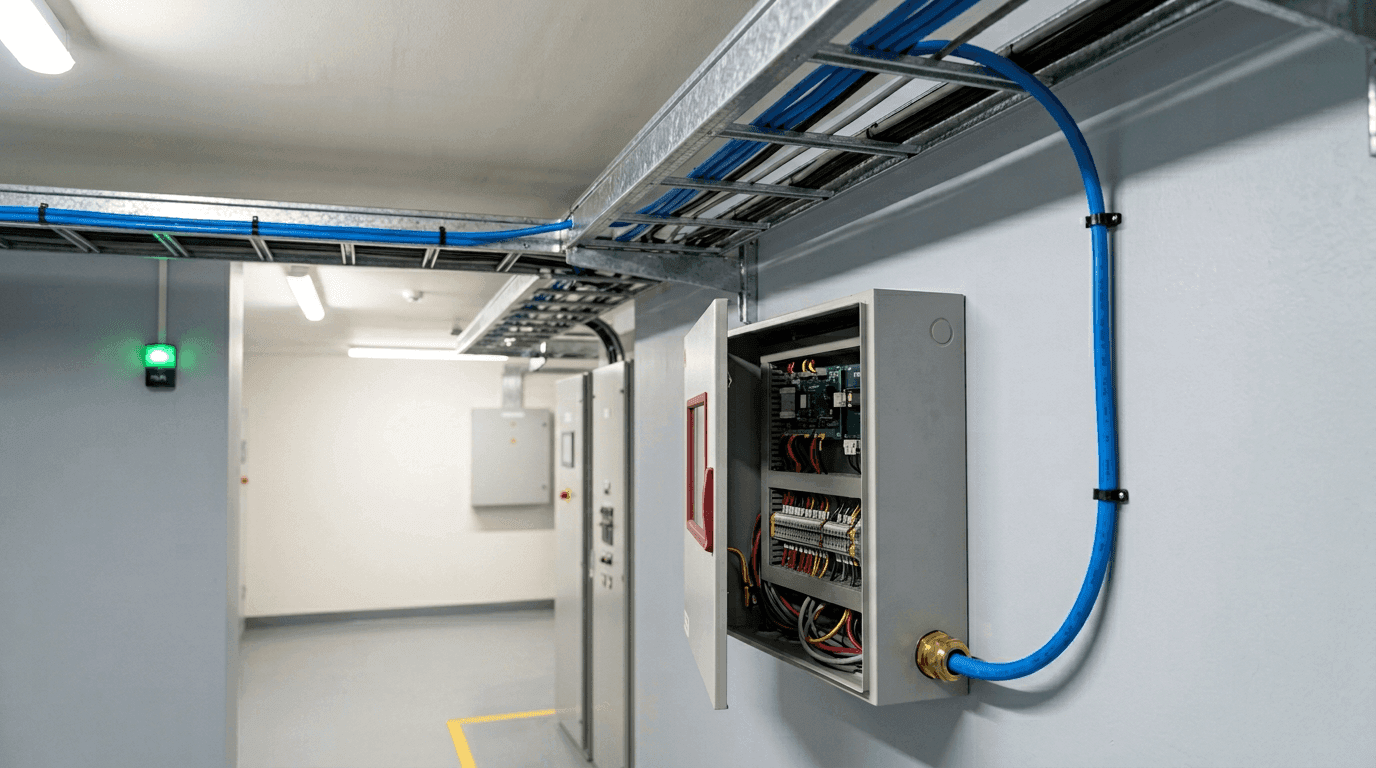
One-shot fusible. Two parallel conductors are separated along the entire length by a thermosensitive polymer with a sharply tuned melt or decomposition window. At the rated set-point the polymer collapses, the cores short hard, and the panel sees a near-zero loop resistance that is unambiguous on any 24 VDC fire-alarm input or appliance comparator. There is nothing to "recover" — the chemistry is gone. The same architecture is what most certified linear heat detectors use, and we cover the panel side of it in our note on how thermal sensor cable wires into a fire-protection system.
Resettable PTC, bimetal or shape-memory. A reversible element does the work. PTC compound resistance climbs roughly two to three orders of magnitude across a narrow knee temperature; a bimetal snaps a contact open at its set-point; an SMA wire shifts phase and re-closes after cool-down. The controller reads the change as an over-temperature event, takes safe action, and the cable re-arms itself once the temperature drops below the lower edge of its hysteresis band. Cycle life ranges from a few thousand operations for shape-memory designs to several hundred thousand for well-formulated PTC sensing cables. The internal stack-up is dissected in our thermosensitive cable anatomy and trigger physics piece.
Step 2 — Why the Same Phrase Means Different Things
The vocabulary is muddy because three engineering communities arrived at the same product family from different doors. Fire-protection engineers grew up with fusible LHD on cable trays and read "thermal sensor wire" as the blue one-shot loop. Appliance teams grew up with bimetal cutoffs and PTC thermistors and read "thermal sensor cable" as a resettable component. Battery-pack engineers split the difference and use either one depending on which fault layer they are protecting. A request for "thermal sensor cable, 105 °C class" can therefore mean either form factor — and the supplier shipping the wrong one is not necessarily at fault.
The cleanest way to break the deadlock is to fix the trip semantic on the RFQ first. Once the semantic is fixed, the form factor is obvious and the temperature is just a number you pick from the catalog.
Step 3 — A Side-by-Side That Reflects the Real Decisions
Most catalog comparison tables list specs that look impressive but never decide a build. The five rows below are the ones that actually move the design — drawn from years of sample requests across appliance, BMS and fire-protection programmes.
One-Shot Fusible
Single trip · service-call audit · zero drift over life
- Service trip
- Yes — replacement section is the audit record
- Trip count
- Exactly one (no reset)
- Panel input
- Two-state (open/short), any standard fire panel
- Tolerance
- ±2 to ±5 K, fixed at manufacture, no drift
- Certification
- UL 521 · EN 54-28 · FM 3210 · GB 16280 · IEC 60691
Resettable Cutoff
PTC · bimetal · SMA · 3k–250k cycles · drift over life
- Service trip
- No — appliance recovers below reset point
- Trip count
- 3,000 – 250,000 cycles by technology
- Panel input
- Analog or hysteresis comparator with reset logic
- Tolerance
- ±3 to ±10 K, 0.5–3 K drift to end-of-life
- Certification
- UL/IEC/EN 60730 + component approvals (PTC / bimetal / sensor)
Per-meter cost is sometimes listed as the decisive cell of a comparison table, but it is the wrong axis. A one-shot cable is roughly the reference cost, a PTC resettable runs 1.6× to 4× higher per metre. Across a 10-year fleet the two costs are dominated by something else entirely: how often the trip happens, and whether the appliance stays in the field or rolls into a service depot.
Step 4 — Pattern Cases We Ship Every Quarter
Cases that pull a one-shot fusible cable.
- Fire-panel LHD loops in cable trays, transformer rooms, parking decks, tunnels, atria. The fire department needs a physical witness. Low-maintenance LHD in inaccessible infrastructure shows the deployment cases in detail.
- Battery-pack last-line runaway protection. A lithium pack that has reached its thermal-runaway precursor must not be allowed to silently reset and restart a charging cycle. The pack should be drained, inspected and re-qualified.
- Appliance "the unit is broken" precursor circuits. Failed motor surface guard, transformer primary insulation aged through, compressor seized. A one-shot cable forces a service event rather than a quiet restart with a degraded asset.
Cases that pull a resettable PTC cable.
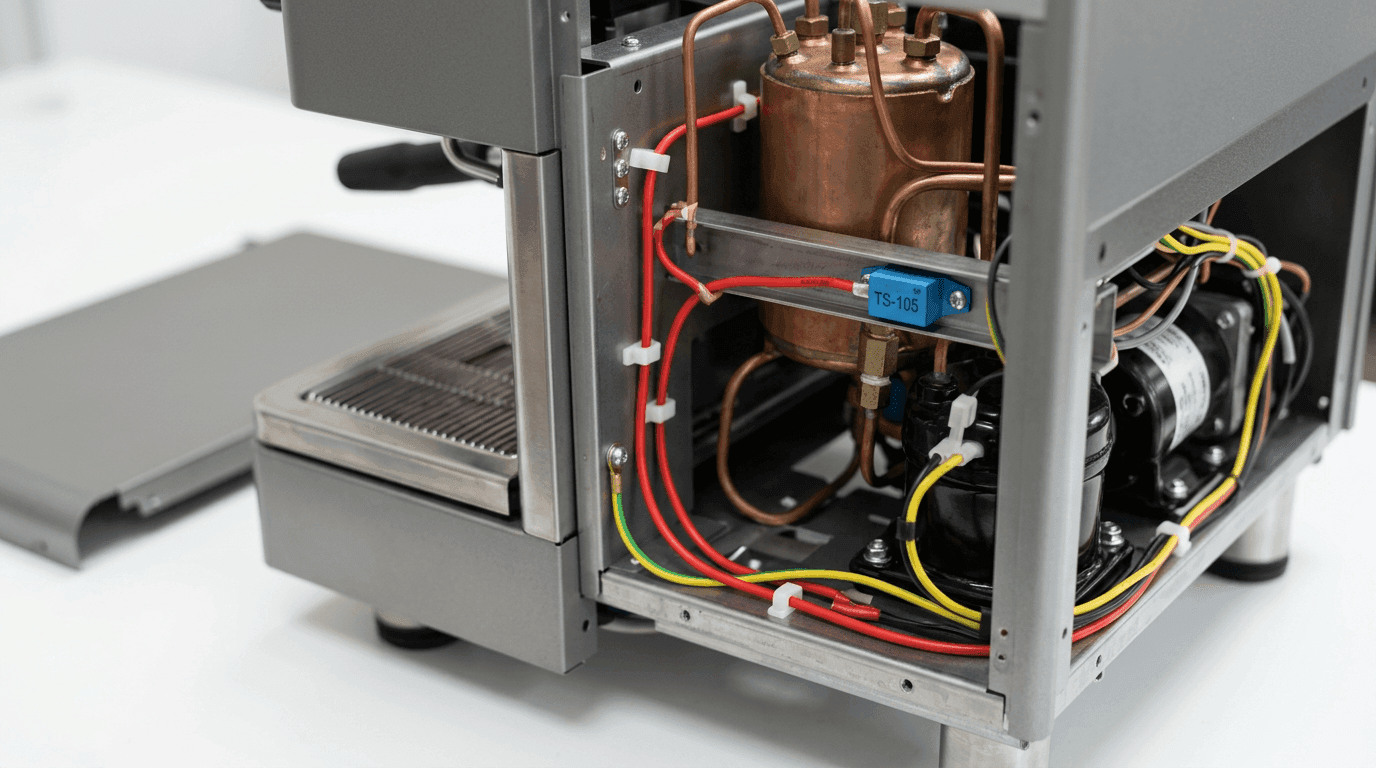
- Dry-boil supervision on kettles, coffee makers and instant water heaters — the user empties the carafe, the heater plate hits 130 °C, the cable opens, the user refills, the plate cools, the cable rearms. The integration template lives in thermosensitive cable as the last line of appliance safety.
- Stalled-rotor recovery on washing-machine, dryer and range-hood motors. Class H winding hits its 165 °C limit, the resettable cable opens, the motor cools, the appliance attempts a soft restart.
- Battery-pack first-line cell-balance limiting during fast-charge. The BMS uses the resistance climb of a PTC sensing cable to derate the charge current rather than tripping the contactor — a graceful degrade, not an end-of-service event.
- Idle-mode supervision on ovens, air fryers and induction cookers. The user routinely walks away with the cavity hot; the cable cycles thousands of times across the product's life with zero service intervention.
Mature appliances often use both — a resettable cable on the recoverable path and a fusible cable in series as the unrecoverable fail-safe. A coffee maker with a resettable cable on the heater plate plus a fusible thermal link in the boiler is the classic pattern.
Step 5 — Two Engineering Limits Catalogs Tend to Hide
Resettable cables drift; that is not a defect, it is the physics. PTC knee temperature, bimetal snap-point and SMA transition all shift monotonically with cycling — typically 0.5 to 3 K across rated life. The drift is predictable, but it means the activation tolerance you accept is the end-of-life number, not the first-cycle number. Specifying "105 °C ± 3 K" without saying when reads as a marketing statement, not an engineering one. Insulation aging adds a second drift component which the team unpacks in how insulation materials shape response time.
Fusible cables have batch tolerance, not unit tolerance. Every length cut from a manufactured drum — whether you cut it in-house or order it cut to length — shares the same polymer recipe, so trigger temperature is a batch property within ±2 to ±5 K of nominal. A unit-level trim — the way a thermistor is calibrated — does not exist for fusible chemistry. If your design genuinely needs ±2 K unit-level accuracy, pair the fusible cable with an analog thermistor sensor and use the fusible cable strictly as the fail-safe, not as the primary control element.
Step 6 — RFQ Template That Survives an Audit
Six lines on the request that, in our experience, separate a real procurement spec from a hopeful one. Send these and the supplier knows exactly what to build.
- Trip semantic. "End-of-service event" → fusible. "Recoverable user condition" → resettable. One sentence, plain English.
- Activation point with full tolerance window. Fusible: "105 °C, ±5 K, single-shot, batch-mean." Resettable: "105 °C ±3 K at first cycle, drift < 3 K to 50,000 cycles, hysteresis 15 K nominal."
- Cycle-life evidence. For resettable, demand an accelerated cycling report to the rated cycle count, with trigger drift logged at every 10 % of life. The test method should be the one referenced by the applicable control or component standard.
- Certification path. Pick one and stick to it: UL 521 / EN 54-28 / FM 3210 / GB 16280 for fusible (non-resettable) LHD — EN 54-22 covers the resettable line-type variants instead; UL/IEC 60691 for non-resettable thermal links; UL/IEC/EN 60730 for resettable appliance controls. Mixing routes is the most common reason production is paused at the certification gate.
- Panel-side interface. Two-state contact for fusible, analog or hysteresis comparator for resettable. State the MCU pin count and the pull-up/pull-down topology you expect — it constrains the supplier's recommended jacket and termination.
- Per-batch test report bound into the PO. Activation point pull, insulation resistance, dielectric strength, and a cycle-life sample for resettable. The marginal cost is small; the warranty cost of skipping it is not.
If the appliance also lives in a chemically aggressive room — solvent vapour, salt-laden air, fertiliser dust — bolt the chemical and mining plant durability spec onto the same RFQ.
Step 7 — The Quick Decision the Engineering Desk Actually Uses
If the trip is itself an end-of-service event, specify a one-shot fusible thermal cutoff cable. If the trip is a recoverable user condition the appliance is expected to ride through, specify a resettable PTC thermal sensor cable. If both fault classes can occur in the same product — and on a serious appliance they usually do — fit both, with the resettable on the recoverable path and the fusible in series as the unrecoverable fail-safe. Anything in between is marketing.
If you have a thermal-cutoff cable spec on your bench right now and the trip semantic is still ambiguous, send us the protected-asset description, the worst-case ambient and the single sentence you would use to describe what should happen after the cable opens. The engineering desk returns a recommended form factor, an activation class, the certification path and an evaluation sample — turnaround scheduled subject to project scope, sample availability and engineering review.
FAQ
What is the practical difference between a one-shot fusible cable and a resettable thermal sensor cable?
A one-shot fusible thermal cutoff cable triggers by destroying its own dielectric at the rated set-point — the polymer melts or decomposes, the two parallel cores short, and the cable section must be cut out and replaced after the event. A resettable thermal sensor cable uses a reversible mechanism — typically a PTC compound, a bimetal contact embedded along the cable, or a shape-memory wire — that recovers once the temperature drops back into its hysteresis band. Choose one-shot when the trip is itself an end-of-service event; choose resettable when the trip is a recoverable user condition.
Why are fire-panel LHD loops typically wired with one-shot fusible cable?
Linear heat detection wired into a fire-alarm panel must leave a permanent, tamper-evident record of the activation. A fusible LHD cable for fire panel loops produces a hard short at the trigger location that the panel reads as an unambiguous alarm and that an inspector can physically locate during post-event audit. The certification routes the integrator typically follows — UL 521, EN 54-28 (the European standard for non-resettable line-type heat detectors; EN 54-22 covers the resettable variants), FM 3210, GB 16280 — were written around exactly that one-shot behaviour, and a silently self-resetting cable would defeat the audit trail.
When should an OEM appliance designer specify a resettable thermal cutoff cable?
Specify a resettable PTC thermal sensor cable whenever a normal end-user behaviour can legitimately push the appliance into its protection limit and the user expects the product to recover by itself: kettle dry-boil, washing-machine stalled-rotor, dryer lint blockage, fast-charging battery pack temperature limiting, induction-cooker idle-mode supervision. Reach for a fusible cable only when the trigger means the appliance must not restart without service — thermal runaway, insulation breakdown, transformer primary failure, motor lock with seized bearings.
How is hysteresis specified for a resettable thermal cutoff cable?
Hysteresis is the temperature gap between the activation point (where the cable trips) and the reset point (where the cable returns to its low-resistance state). For a PTC sensing cable a hysteresis of 5 to 25 K is typical and is specified along with the activation tolerance. The number is not optional: too narrow and the cable chatters in and out of trip on every duty cycle, too wide and the appliance stays locked out long after the protected component has cooled. Both the activation tolerance and the hysteresis should be stated on the RFQ at first cycle and at end-of-life.
How do certification paths differ between one-shot and resettable thermal cutoff cables?
Resettable thermal cable used as an automatic appliance control is normally evaluated through UL/IEC/EN 60730, with the component-level approval depending on whether the design uses a PTC, a bimetal or a sensor-circuit topology. One-shot thermal links and fusible cutoffs may follow UL/IEC 60691, while fusible LHD cable for fire panel loops is qualified under UL 521, EN 54-28 (resettable line-type LHD falls under EN 54-22), FM 3210 or GB 16280. Mismatched certification — a resettable component approved as a control trying to act as a fire detector, for example — is a frequent reason production runs are stopped at the certification gate.