A quote usually arrives with a confident cover note. ISO certified. Fully compliant. Meets EN 54. The promise is free, and every supplier sends one. The paper behind it is what survives an audit, a site inspection or a warranty dispute two years later — and the paper is exactly what gets waved through in the rush to compare prices. The thermal sensor cable document package is the set of documents a buyer should demand alongside the number, so that the confident sentence in the email has something underneath it.
This note is the request list itself: which documents to ask for, what each one actually proves, and when in the buying process to ask. It sits beside three companions rather than repeating them. Field 10 of the specification guide names the package as a spec-sheet row; the compliance map for EN 54-22, UL 521 and FM 3210 covers how to read the fire-detection standards themselves; and the supplier evaluation guide runs the whole four-stage process the request lives inside. Here the focus is narrow and practical: the documents, and what each is worth.
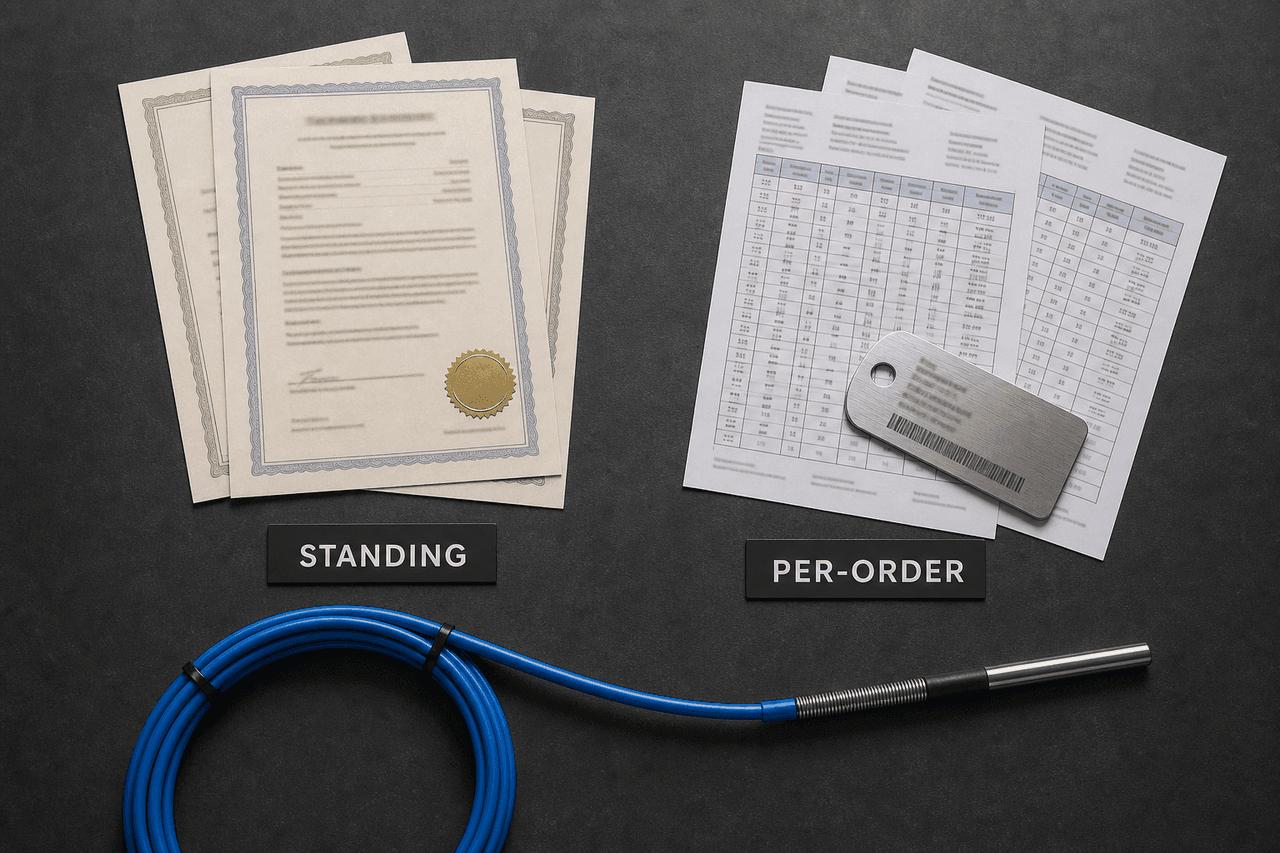
Two Kinds of Paper: Standing and Per-Order
Before the list, one distinction does most of the work. The documents split into two kinds, and confusing them is how a buyer ends up reassured by the wrong evidence.
Issued once and valid for a period: the ISO 9001 certificate, substance declarations, regional market evidence and any type-test report. They describe the manufacturer's capability and legal standing. They say nothing about the specific reels on your order.
Produced for your shipment: the per-batch test report keyed to the lot number on the jacket. It is the only document in the package that measures the cable you are actually buying, and it is the one most often left out.
A package that is heavy on standing certificates and silent on the per-batch report has told you a great deal about the factory and nothing about your order. Both kinds matter, but they answer different questions, and a strong request asks for both on purpose.
The Request List — and What Each One Proves
Four documents form the baseline request for any thermal sensor cable order. The value of each is not that it exists but that it proves a specific thing — and reveals a specific weakness when the version you receive is thin.
Proves: a managed, audited process exists at the factory — repeatability, not product quality.
Weak version: expired date, or a scope line that covers a trading or assembly activity rather than cable manufacturing.
Proves: the materials are legal to place on the destination market — a substance question, not a performance one.
Weak version: a generic template with no product or model named, so it could apply to anything the company makes.
Proves: a basis for market access in the destination — a Declaration of Performance (or Declaration of Conformity) behind a CE mark, or the UL record behind a listing claim.
Weak version: a CE logo on a brochure with no Declaration of Performance to stand on. The logo is not the document.
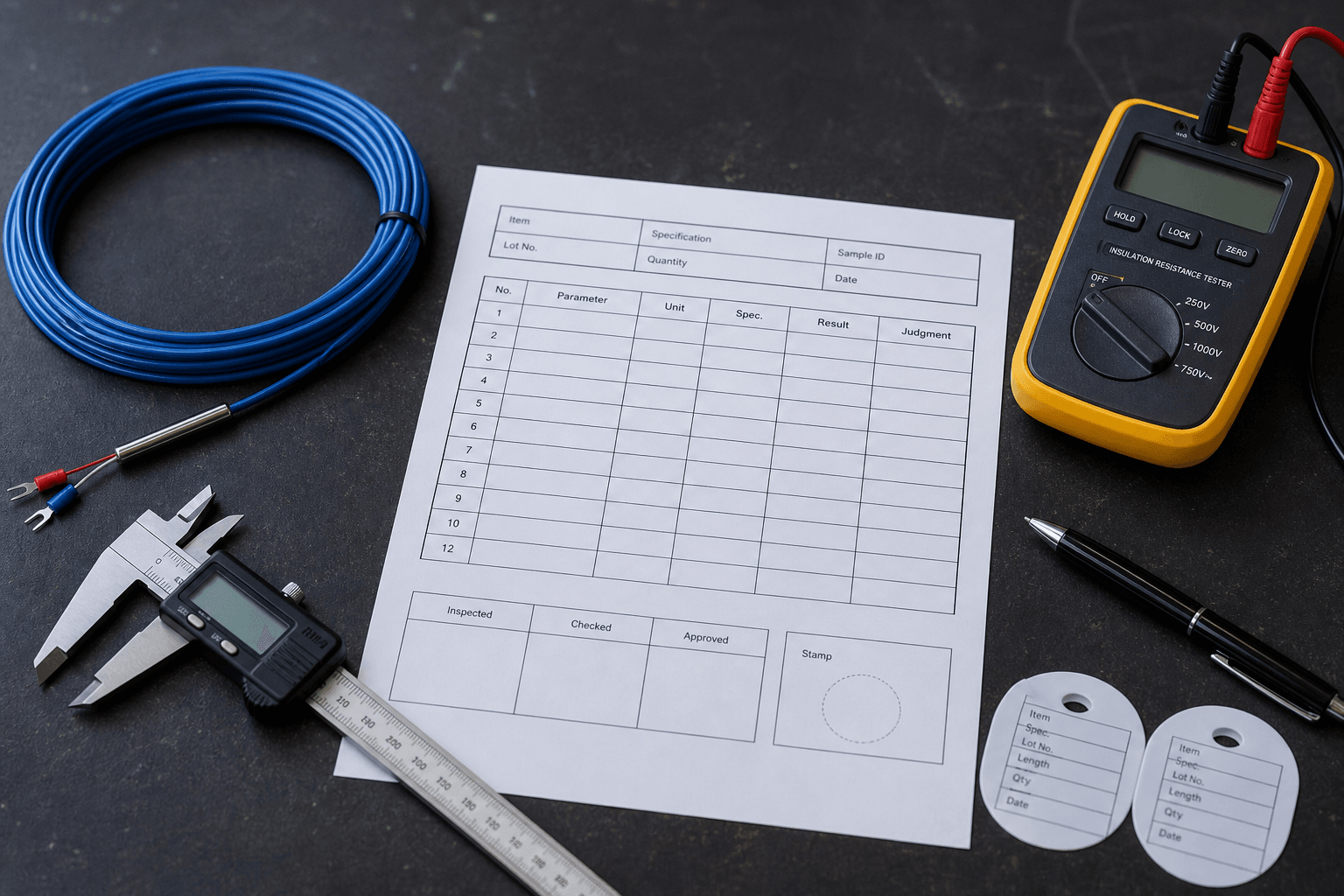
Proves: this shipment was actually measured against the spec — the only measurement document tied to the reels you receive.
Weak version: undated, no lot number matching the jacket print, or identical figures copied across every batch.
On top of the baseline, the deployment adds a short conditional list: LSZH halogen-free certification and IEC 60332 flame-propagation data for tunnels, metros and public buildings; UL VW-1 vertical-wire flame documentation for consumer and EV cut-off applications; and the local fire-authority approval or EN 54-22 / EN 54-28 type-test report for fire-protection projects. Add only what the route requires — and read each one the way the compliance map sets out, where a claim of designed against a standard is shown to be a different thing from a certificate issued by a recognised body.
When to Ask for Each
The same document is cheap to obtain at one stage and expensive to chase at another. Asking in the right order is what turns the package from a post-problem scramble into a quiet filter.
| Stage | What to request | Why then |
|---|---|---|
| RFQ stage | The standing documents: ISO 9001, RoHS or REACH, regional market evidence, any applicable type-test report. | A supplier that cannot produce these is filtered before a price is even compared — the cheapest possible point to walk away. |
| Pre-purchase sample | The per-batch report format, plus measured data from a sample reel. | Agreeing the report you will receive later, while a sample is on the bench, means no surprise about its contents after the order ships. |
| Every shipment | The actual per-batch test report, keyed to the lot number on the jacket. | This is the only measurement document tied to the reels in the crate. Required per delivery, not requested after a fault appears. |
The pre-purchase step is where this list overlaps the bench work: the sample evaluation procedure checks that a sample reel matches the written spec, and the incoming inspection SOP checks each later shipment against the report it ships with. The document request is what makes both of those checks possible — there is nothing to verify against if the report was never agreed.
Reading the Pack, Not Just the Cover
A document can be entirely genuine and still prove nothing about your order. Before reading the technical content of any certificate, read five things about the document itself — the checks that separate real evidence from a template with a logo.
| Check | What to look for |
|---|---|
| Scope | Does the certificate cover cable manufacturing, or a different activity registered to the same company name? |
| Date | Is it current, or expired and quietly re-sent? A surveillance-audit date that has lapsed is a flag, not a formality. |
| Specificity | Does it name the product or model, or is it a generic template that could belong to any line in the catalogue? |
| Traceability | Does the per-batch report carry a lot number that matches the print on the cable jacket? No link means no proof for this shipment. |
| Source | Is it a third-party assessment, or a self-declaration on company letterhead? Both have a place, but they are not the same weight of evidence. |
These are document-package checks, not standard-clause reading. The deeper question — what EN 54-22, UL 521 and FM 3210 each govern, and what one certificate can and cannot tell you about a product line — is the subject of the compliance map. The five checks here come first: they decide whether a document is worth reading closely at all. When the document is a third-party report or certificate rather than a self-declaration, the further step of confirming it at source — looking the reference number up with the issuing body and checking the scope covers your model — is covered in how to verify a third-party certificate.
Writing the Document Package into the RFQ
A request that lives only in an email gets answered loosely. The package that arrives complete is the one written as its own line on the request, with the baseline named, the conditional documents keyed to the deployment, and the per-batch report called out separately so it cannot be absorbed into the standing certificates.
Document package required with quotation: ISO 9001 certificate (scope to include cable manufacturing, current), RoHS/REACH declaration naming the model, regional market evidence (CE DoP or UL record) for the destination. Per-batch test report keyed to jacket lot number required with every shipment. Conditional per deployment: LSZH + IEC 60332 data / UL VW-1 / EN 54-22 or EN 54-28 type-test, as applicable.
That row does three things a vague request cannot: it separates the standing documents from the per-batch evidence so neither is allowed to stand in for the other, it ties the report to the lot number so the shipment is traceable, and it makes the conditional documents a function of the route rather than an afterthought. From there it pairs with RFQ Field 08 — Documentation Set Required with Each Shipment, where the documentation set is named — with the standards line written alongside RFQ Field 07 — and with the twelve-field specification guide that ties the whole sheet together. The cable family the package attaches to is set out on the cable series page.
Every supplier sends the promise; the document package is what makes it checkable. Ask for the standing certificates and the per-batch report on purpose, request each at the stage where it is cheap to get, and read the document before you read its contents — scope, date, specificity, traceability, source. The cable you receive is only as good as the paper you can hold it to.
FAQ — The Thermal Sensor Cable Document Package
Which documents should I request from a thermal sensor cable supplier?
Four documents form the baseline request for any order: an ISO 9001 quality-management certificate, a RoHS or REACH substance declaration, the regional market evidence appropriate to the destination — a CE Declaration of Performance or Declaration of Conformity, or a UL record — and a per-batch test report keyed to the lot number printed on the cable jacket. The deployment then adds conditional documents: LSZH halogen-free certification and IEC 60332 flame-propagation data for tunnels and public buildings, UL VW-1 compound documentation for consumer and EV applications, and the local fire-authority approval or EN 54-22 / EN 54-28 type-test report for fire-protection projects. Require all four in the RFQ — the three standing documents up front, and the per-batch report committed as a deliverable with every shipment — so a supplier that cannot produce them is filtered before a price is even compared.
What does each compliance document actually prove?
Each document proves a different thing, and the most common mistake is treating them as interchangeable. An ISO 9001 certificate proves a managed process exists at the factory — not that any one cable is good. A RoHS or REACH declaration proves the materials are legal to sell in the market, not that the cable performs. A CE Declaration of Performance or Declaration of Conformity, or a UL record, proves a basis for market access. Only the per-batch test report, keyed to the lot on the jacket, proves that this shipment was actually measured. The standing documents prove the factory can; the per-batch report proves this reel did. A package that is strong on standing documents but silent on the per-batch report has told you about the factory and nothing about your order.
When in the buying process should I ask for each document?
Request the standing company-level documents — ISO 9001, RoHS or REACH, the regional market evidence and any applicable type-test report — at the RFQ stage, so a supplier that cannot produce them is filtered before the price is compared. Ask to see the per-batch test report format, and the data from a sample reel, at the pre-purchase sample stage, so the report you will receive later is agreed before the order is placed. Then require the actual per-batch report, keyed to the lot number, with every shipment. Asking for the per-batch report only after a problem appears is the expensive version of the same request.
How do I tell a strong compliance document from a weak one?
Read five things before you read the technical content. Scope: does the certificate actually cover cable manufacturing, or a different activity at the same company? Date: is it current, or expired and quietly re-sent? Specificity: does it name the product or model, or is it a generic template with a logo dropped on? Traceability: does the per-batch report carry a lot number that matches the print on the cable jacket? Source: is it a third-party assessment or a self-declaration? A document can be perfectly real and still prove nothing about your order if its scope, date or traceability does not line up. How to read the fire-detection standards themselves — EN 54-22, UL 521 and FM 3210 — is a separate question covered in the compliance map.