Most "thermal cable buyer's guides" on the internet list temperature, diameter and color and move on. That is not a framework — it is a data sheet. This note is the framework our engineering desk actually uses when a customer calls in with a new project. Five steps, each with an input question and an output deliverable.
Step 1 · Map the Application Before Touching the Catalog
Input question: what physical event is this cable protecting against, and what happens if the cable does not activate?
Before anyone looks at a catalog, the conversation should produce a one-paragraph application brief. "LHD loop on a panel covering a 2 km road tunnel, mounted within 15 cm of the ceiling, expected to survive 24/7 diesel-exhaust exposure" is a brief. "We need some fire cable" is not. And one level upstream of this framework — if the project has not yet settled on a thermal sensor cable at all, as opposed to a point thermistor or thermocouple — that sensor-type decision is in thermal sensor cable vs NTC thermistor vs thermocouple; this framework picks up once a thermal sensor cable is the chosen sensor type.
Two Broad Application Families
Almost every thermal sensor cable project falls into one of these families, and the family drives every subsequent choice:
- Linear Heat Detection (LHD). The cable is a fire sensor wired to a fire-alarm panel. Tunnels, cable trays, warehouses, data centers, petrochemical plants. The wiring side of that decision is covered in our note on where the cable sits on the panel drawing; the upstream architecture choice is in our linear heat detection architectures comparison.
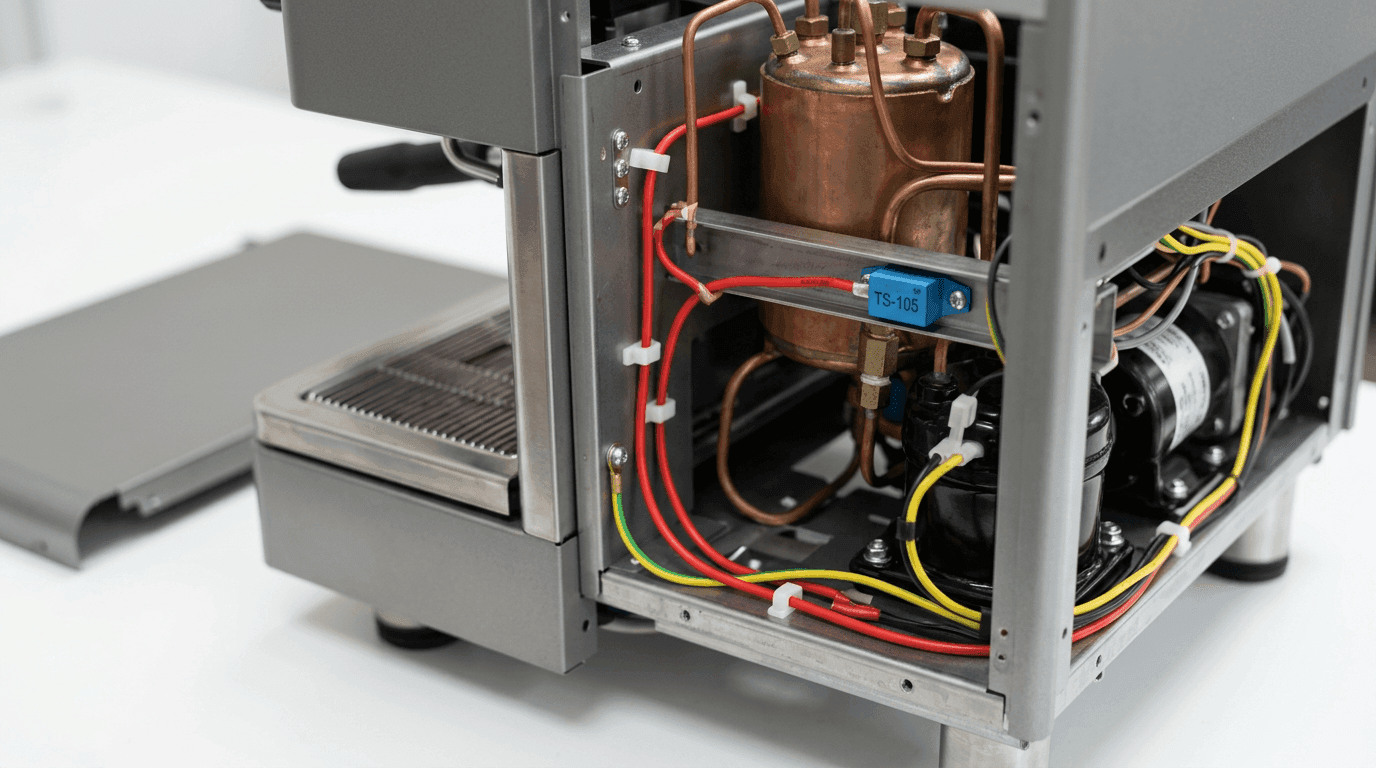
- In-Device Over-Temperature Cut-Off (TS). The cable sits inside a product as a passive safety element. EV battery packs, motor windings, transformer cores, adapter enclosures, appliance control boards. See our design note on thermosensitive cable in the OEM cut-off path for the architecture this family slots into.
Step 2 · Fix the Activation Target (and the Tolerance)
Input question: what temperature must trigger the alarm, and how tight can the spread be?
This is where most orders go wrong. Engineers quote the "nominal" activation temperature and forget the tolerance. An LHD cable rated 105°C ± 15°C alarms anywhere between 90°C and 120°C — comfortable above a 70°C indoor process, but wrong over a warehouse aisle whose summer ambient peaks near 88°C, because the bottom of that tolerance band now sits on top of the working ambient and nuisance-alarms. Pinning down that ambient figure honestly — surveying the route rather than quoting a set-point — is the subject of where it lives is not where it trips.
Quick Activation Point Heuristics
- Cold-storage / refrigerated warehouses → 68°C
- Indoor commercial ceilings / office buildings → 88–105°C
- Server rooms and data-center cold aisles → 88°C
- Standard building & tunnel LHD → 170°C ± 15°C
- High-bay warehouses with hot summer ambients → 138–170°C
- Turbine halls, boiler rooms, petrochemical plants → 185°C
- Motor winding / transformer cut-off → 120–150°C (custom)
- EV battery safety cut-off → 85–110°C (custom)
Step 3 · Specify Jacket, Geometry & Mechanical Envelope
Input question: what does the cable have to survive, physically, for the next 10–25 years?
Jacket Polymer Selection
- PVC — indoor, clean environments, low cost. Not acceptable in many tunnel and metro codes.
- LSZH (low-smoke zero-halogen) — default for tunnels, metros, public buildings. Required by most European smoke-toxicity codes.
- Silicone — high ambient, motor windings, transformer cores. Excellent dielectric.
- Fluoropolymer (FEP / PTFE) — chemical plants, oil refineries, semiconductor fabs. Expensive, irreplaceable where specified.
Cable-Internal Architecture
Whether the spec sheet should call for metal-core or non-metal-core decides three things downstream: the panel-side EOL hardware (dry-contact LHD device vs single-resistor termination), the cross-section the install crew terminates, and the per-metre cost band. The five-axis buyer-side decision matrix — response window shape, mechanical robustness, termination, cost band and dry-contact panel fit — together with five deployment scenarios and three substitution detection signals is in our companion note on the cross-section comparison of metal-core and non-metal-core architectures.
Geometry
- Diameter 2.5–3.0 mm is typical for LHD. Cable-tray installers expect it.
- Smaller diameters belong in TS applications — 1.5–2.0 mm where a motor slot or battery pack aisle is the constraint.
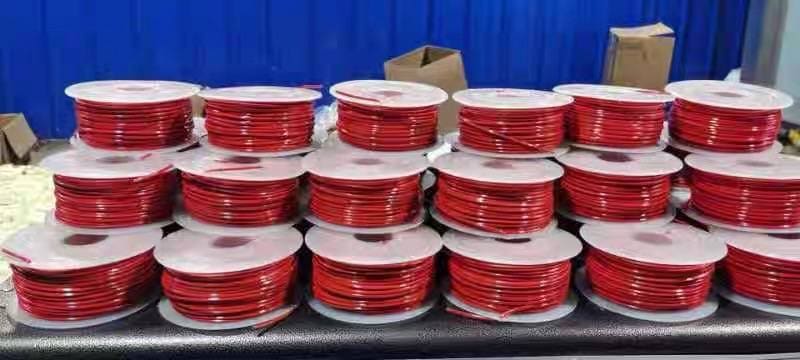
- Spool length — 50 m for buildings, 500 m or 1000 m drums for tunnels and cable galleries.
Step 4 · Line Up the Compliance Paperwork Early
Input question: what documentation will procurement and QA ask for before releasing the PO?
Compliance is not a post-PO task. It is a gating task. The three documents almost every project needs:
- ISO 9001 QMS certificate — evidence of batch-level process discipline.
- RoHS / REACH declaration — mandatory for EU shipments and increasingly common elsewhere.
- CE marking or regional fire-code approval — matched to the target market's regulatory framework.
For fire-protection projects, add any local type-test or third-party approval the integrator's authority having jurisdiction (AHJ) requires. Asking about it on day one saves weeks at acceptance.
Step 5 · Qualify the Supplier as Carefully as the Product
Input question: is this a factory, or a trading desk with a brochure?
The supplier audit and the per-batch QC audit are two layers of the same question. We unpack each in detail in our six factory-floor signals for thermal sensor cable supplier qualification and the nine-parameter QC pass for batch acceptance; the short version below is the field summary.
Six supplier signals that separate an engineering partner from a reseller:
- Own extrusion line — not just rebranded cable from a third party.
- Per-batch inspection report — attached to the shipment, with the lot number printed on the jacket for traceability.
- Evaluation samples — subject to sample availability and project review; the buyer typically covers freight, the factory covers the cable.
- Spec-sheet review before quoting — a real engineer reading your application brief, not a salesperson round-tripping a PDF.
- Panel or system compatibility confirmation — for LHD, they should confirm end-of-line resistance and supervision current for your specific panel model.
- After-sales reachability — your commissioning engineer can still reach the supplier six months after shipment, without opening a ticket queue.
LHD vs TS — Decide by Application
The decision is rarely ambiguous once the application envelope is on paper. LHD is route-driven and feeds a panel; TS is product-driven and cuts a local power loop. The two cards below summarise when each family applies, the typical projects it ships into, and the parameters that follow from the choice.
Linear Heat Detection
The cable is the sensor along a physical route.
Choose LHD when
- The cable follows a continuous physical route — tray, tunnel, ceiling, conveyor.
- It feeds a fire-alarm panel expecting a dry-contact short on alarm.
- Coverage is measured in metres of run, not per device.
Typical applications
Road & rail tunnels · Cable trays · High-bay warehouses · Petrochemical plants · Data centres
Spec at a glance
- Activation
- 68 · 88 · 105 · 138 · 170 · 185°C
- Diameter
- 2.5 – 3.0 mm
- Length
- 50 / 500 / 1000 m reels
- Colour
- Blue (industry default)
- Priority cert
- ISO 9001 + fire-code type test
- Critical property
- Waterproof, tensile, panel compatibility
Thermosensitive Cable
The cable lives inside the product it protects.
Choose TS when
- The cable is integrated inside a product — pack, winding, enclosure, board.
- It cuts a local power loop on over-temperature instead of feeding a panel.
- Activation is tied to one component, not a path length.
Typical applications
EV battery packs · Motor & transformer windings · Adapter enclosures · Appliance control boards · Display backlights
Spec at a glance
- Activation
- Custom, typically 75 – 180°C
- Diameter
- 1.5 – 2.0 mm typical
- Length
- Cut to length, short
- Colour
- Red / OEM-matched
- Priority cert
- RoHS + UL-grade compound
- Critical property
- Drift stability, tight activation spread
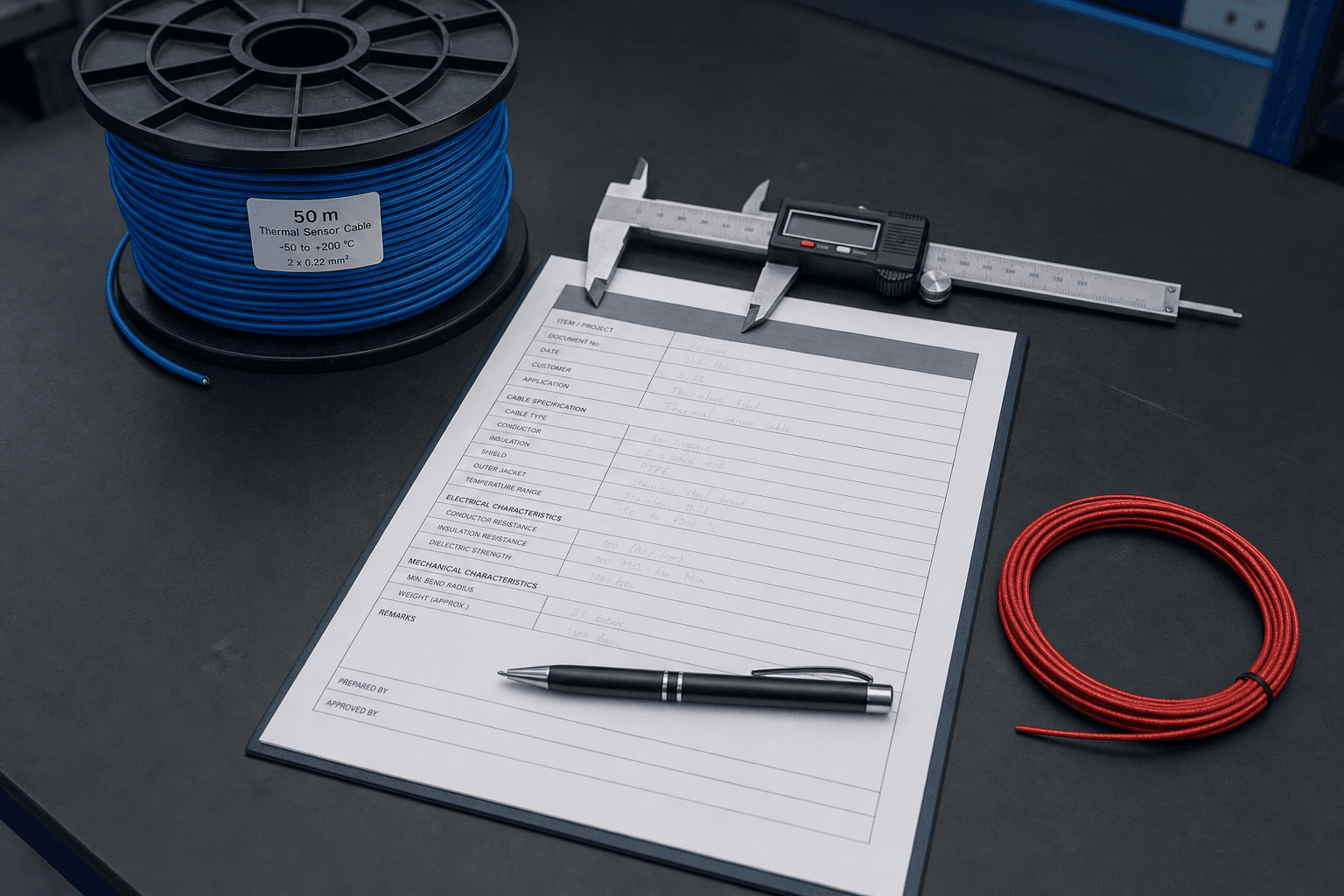
A good thermal sensor cable spec sheet is two pages of numbers your auditor can read. A bad one is three pages of marketing. The difference is the difference between a working project and a remediation meeting.
What to Send to an Engineering Desk
If you want our desk to draft a spec sheet for your project, the first email should contain: activation target & tolerance, application family (LHD or TS), environment (ambient, chemistry, UV, mechanical), quantity & destination country, and the panel or host-device model if it is an existing system.
That one email is acknowledged by our engineering desk and returned with a draft spec sheet, a compliance checklist and an evaluation-sample arrangement — turnaround and sample dispatch are scheduled subject to project scope, sample availability and engineering review. Start the conversation here.
FAQ — Thermal Sensor Cable Selection
How do I decide between LHD and TS thermal sensor cable for my project?
Start from the application. If you are protecting a continuous physical run — a cable tray, tunnel, warehouse, conveyor or under-floor void — and the cable feeds a fire-detection panel expecting a dry-contact short, specify LHD (linear heat detection cable). If you are integrating a cable inside a product — a motor, transformer, battery pack, appliance — and the cable cuts the local power loop on over-temperature, specify TS (thermosensitive cable). LHD is route-driven, TS is product-driven; the decision is rarely ambiguous once the application envelope is on paper.
What activation temperature should a thermal sensor cable target?
Set the activation point at least 20–30 °C above the highest sustained ambient the cable will see in normal operation, but below the threshold at which the protected asset suffers irreversible damage. For warehouse and tunnel LHD that runs at 25 °C ambient, 68 or 88 °C is typical. For cable trays adjacent to motors, 105 or 138 °C is common. For TS cables embedded in motor windings, the activation point matches the insulation class — 130 °C for Class B, 155 °C for Class F, 180 °C for Class H. Tolerance band matters too: ±15 K is loose, ±5 K is tight, and the application decides which is acceptable.
Which jacket material should I specify for a thermal sensor cable?
Pick the jacket against ambient temperature, chemical exposure and code requirements — not against the activation temperature. PVC handles indoor low-cost runs to 70 °C ambient. LSZH is the default for tunnels, metros, public buildings and any application where local fire codes require low-smoke and halogen-free jackets — IEC 60754 covers halogen content, IEC 61034 covers smoke density, IEC 60332 covers flame propagation. Silicone tolerates 180 °C ambient and is the right choice next to high-wattage motors and transformers. PTFE, PFA and FEP fluoropolymers handle chemical environments, oil mist and very high ambient — PTFE / PFA continuous to about 260 °C, FEP continuous to about 200 °C. The jacket choice typically dominates the unit price more than the compound choice. The companion jacket material decision matrix expands this one-paragraph summary into a five-material × five-axis selection tool with the standards mapping the document package has to satisfy.
What compliance documents should I expect from a thermal sensor cable supplier?
At minimum: a per-batch test report keyed to the lot number printed on the jacket (covering activation point, insulation resistance, waterproof, tensile and burn-speed checks), an ISO 9001 QMS certificate, RoHS and CE declarations, and where the application requires it, UL-grade compound documentation. For tunnel, metro and EV projects, ask additionally for LSZH halogen-free certification, IEC 60332 flame-propagation data and a panel-compatibility statement. A supplier that cannot produce these on request is a trading desk; buy from a factory.