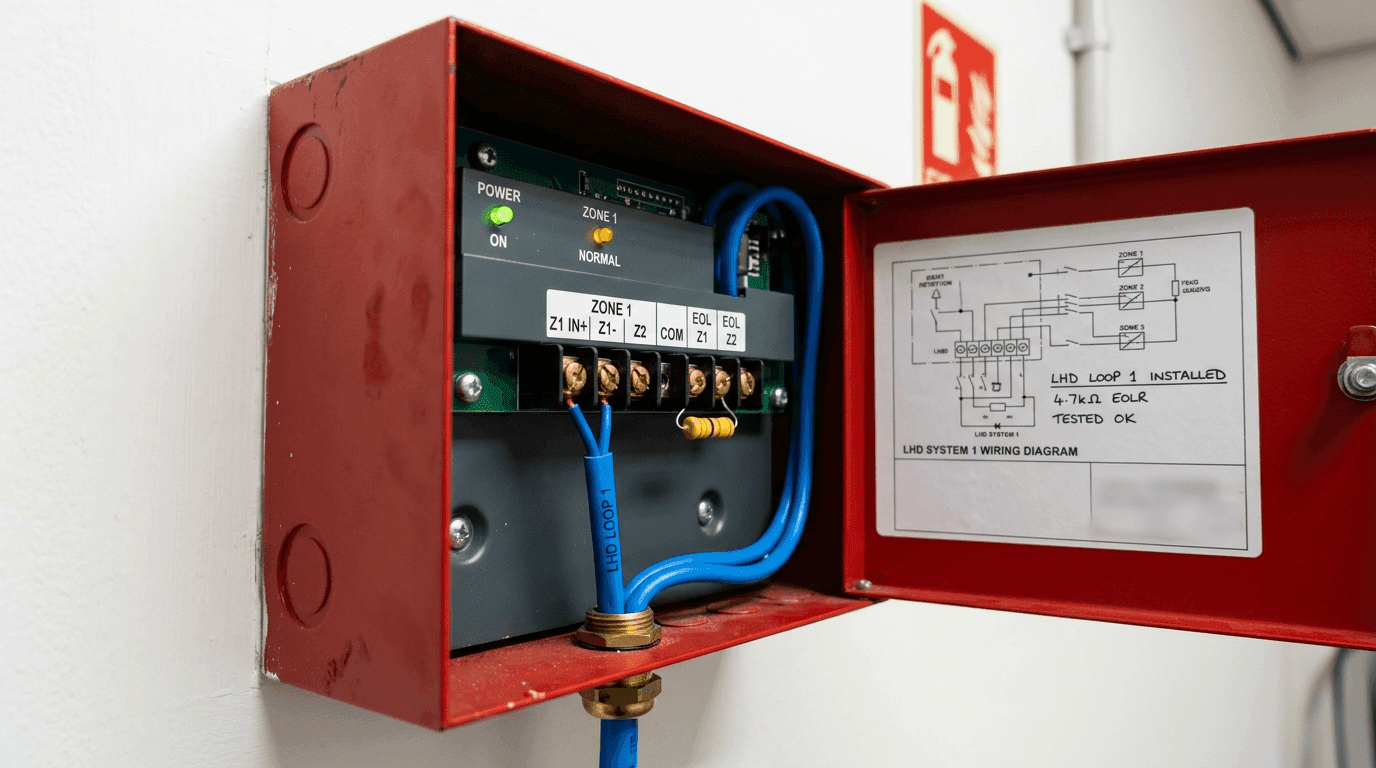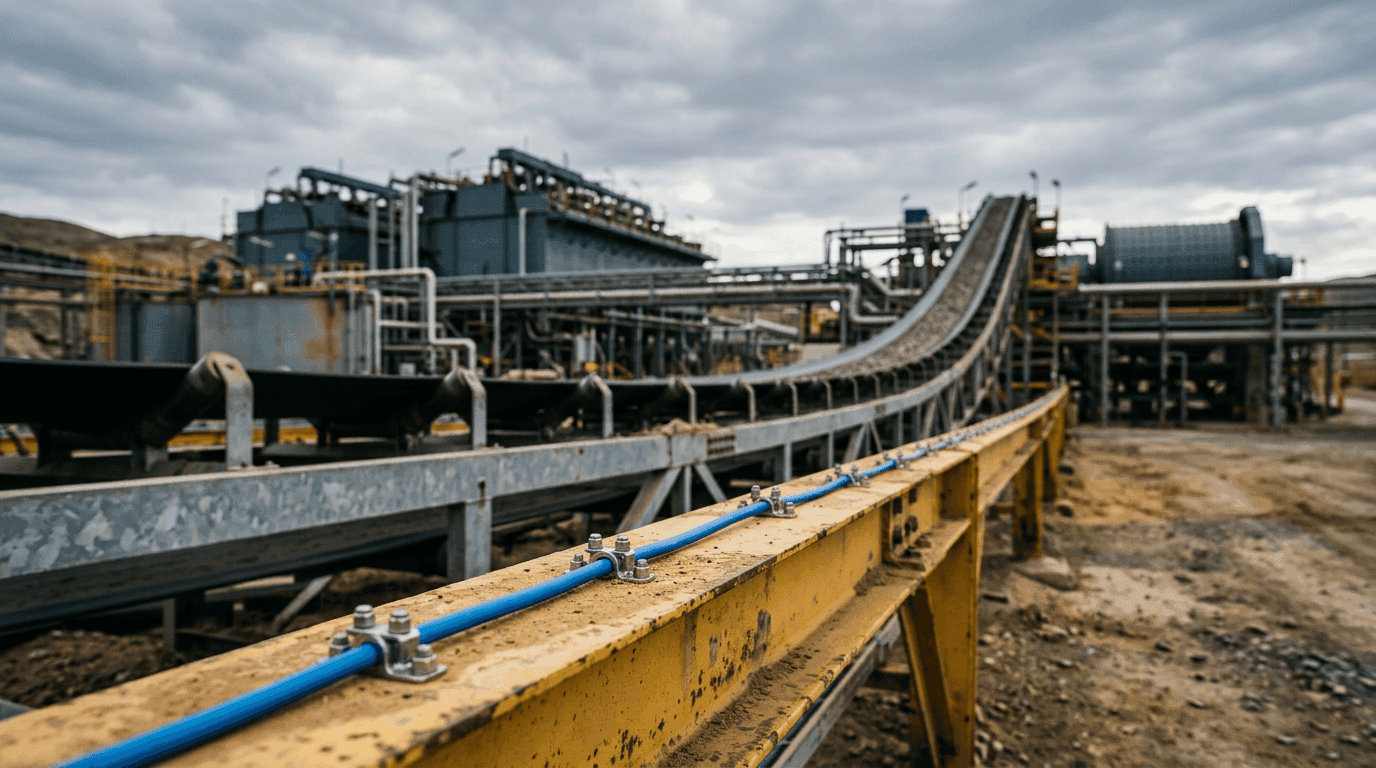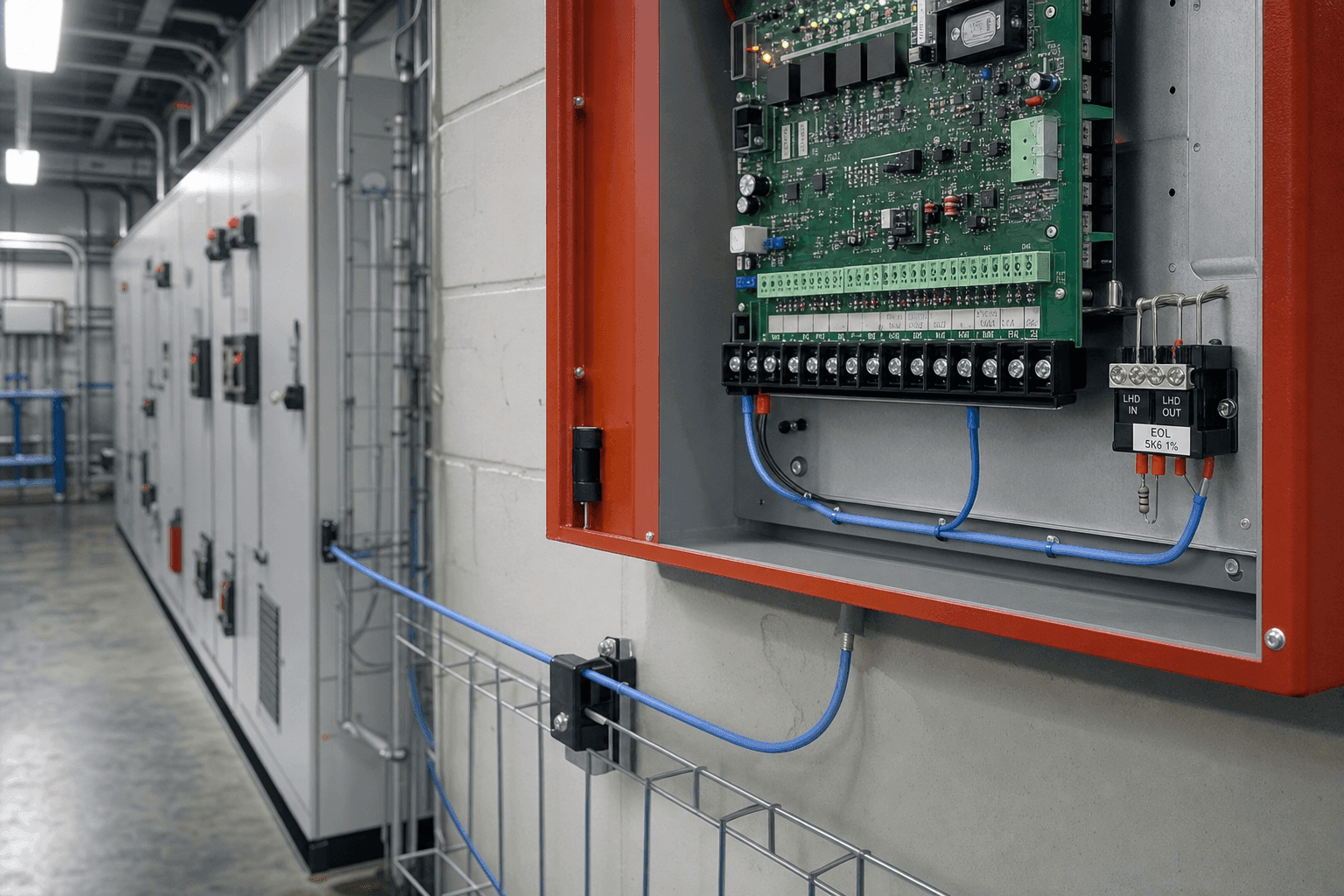
Most datasheets explain what a thermal sensor cable is. This note is about where it lives — inside a real fire-protection system, on a panel drawing, wired into a control loop that has to pass a commissioning walkthrough before anyone signs off on the building.
If you are specifying linear heat detection for the first time, the question to ask is not "how does the cable work?" but "how does the cable talk to the panel, and what does the commissioning engineer look at on acceptance day?" The choice between fusible cable and the other two linear heat detection architectures happens before this — once it is made, the wiring side of the decision is what this note covers.
Where the Cable Sits on the Panel Drawing
On a conventional fire-alarm panel, a linear heat detection cable is, by industry convention, drawn as a two-wire zone, terminated with an end-of-line resistor (EOL). The panel sees it as one long, continuous contact — closed under normal conditions, shorted when any point along the cable reaches the activation temperature.
On an addressable panel, the same cable is usually interfaced through a dry-contact input module (sometimes called a monitor module). The module reports the zone state onto the loop address where the panel's programming expects a "heat" event.
Three practical consequences fall out of this:
- The cable itself does not have an electronics package to fail — it is a passive length of thermosensitive insulation between two conductors.
- End-of-line resistor value must match the panel's wiring supervision circuit. Wrong EOL value = "open" or "short" fault at power-on — and on a long run the cable's own resistance stacks on top, which is why the EOL value and loop-resistance calculation is worth doing before the resistor is fitted.
- Splices and terminations become the actual reliability story — not the cable.
Two Trigger Paths You Need to Know
A well-engineered LHD cable gives the panel two different ways to raise an alarm, and the commissioning engineer usually tests both:
- Thermal-threshold collapse. When the ambient temperature around the cable stays above the rated activation point (commonly 68, 88, 105, 138, 170 or 185°C) long enough for the thermosensitive insulation to soften, the two conductors touch and the loop shorts.
- Direct flame contact. A flame reaching the cable is a concentrated heat source that drives the thermosensitive compound past its activation point at the contact point within seconds, giving an almost-instant local short. This is the response you want when a hidden fire flashes against a cable tray.
Commissioning-Day Checklist
When a fire-protection integrator accepts an LHD installation, the walkthrough is usually structured around these checks. Treat them as the minimum bar, not a full list — the full witnessed acceptance procedure sets out what is checked cold, what is tested live and what gets recorded and signed:
- Loop continuity. Disconnect the EOL resistor; panel should show "open fault". Reconnect; panel should clear.
- Resistance measurement. Measure the loop cold. Confirm it sits within the panel's supervision window.
- Alarm verification. Prove the alarm path without sacrificing a fusible run: a documented short at the EOL terminals confirms the panel reads a short as an alarm on the right zone, and a calibrated point-heat test on a sacrificial offcut or a designated test section confirms the cable triggers within its response window. Only a resettable cable that recovers is point-heat tested on the installed run itself.
- Zone mapping. On addressable panels, confirm the module reports the right zone label to the operator graphic.
- Documentation. Per-batch inspection report filed, installation as-built drawing updated, activation point recorded in the commissioning log.
Routing and Splicing — Where Installations Actually Fail
Cable failures in fire-protection systems are rarely cable failures. They are installation failures. When a fault does materialise on a live loop, our field workflow for diagnosing an LHD short circuit without cutting cable is the next reference point. Three routing rules avoid most of those events to start with:
- Mount within 15 cm of the ceiling or the thermal risk surface. If the cable is too low, the fire plume reaches it too slowly.
- Respect the minimum bend radius. Tight bends damage the thermosensitive insulation and shift the activation curve unpredictably.
- When splicing, overlap at least 20 cm and secure mechanically. Solder joints inside a fire-detection loop are a bad idea — heat shrink and crimp to a manufacturer-approved splice kit instead.
Linear heat detection is "continuous sensing" only if the commissioning engineer can verify that every installed meter is actually part of the supervised loop. That is what separates a certified install from a ceiling full of unmonitored cable.
Specification Checklist Before You Order
Before an LHD cable leaves our factory, we ask the project team for these five inputs — it is a useful checklist even if you order from somewhere else:
- Activation temperature and tolerance — 170±15°C is the default, but 68°C cold-storage runs and 185°C turbine enclosures need their own points.
- Jacket system — PVC is cheap, LSZH is code-required in many tunnels, fluoropolymer is the right call in chemical plants. For chemical and mining service the jacket and routing constraints we publish for those industries are the right starting point.
- Panel model and loop type — we confirm EOL resistance, supervision current and whether a monitor module is in the bill of materials. Settling these against the named panel before the order is the panel-compatibility check worth running first.
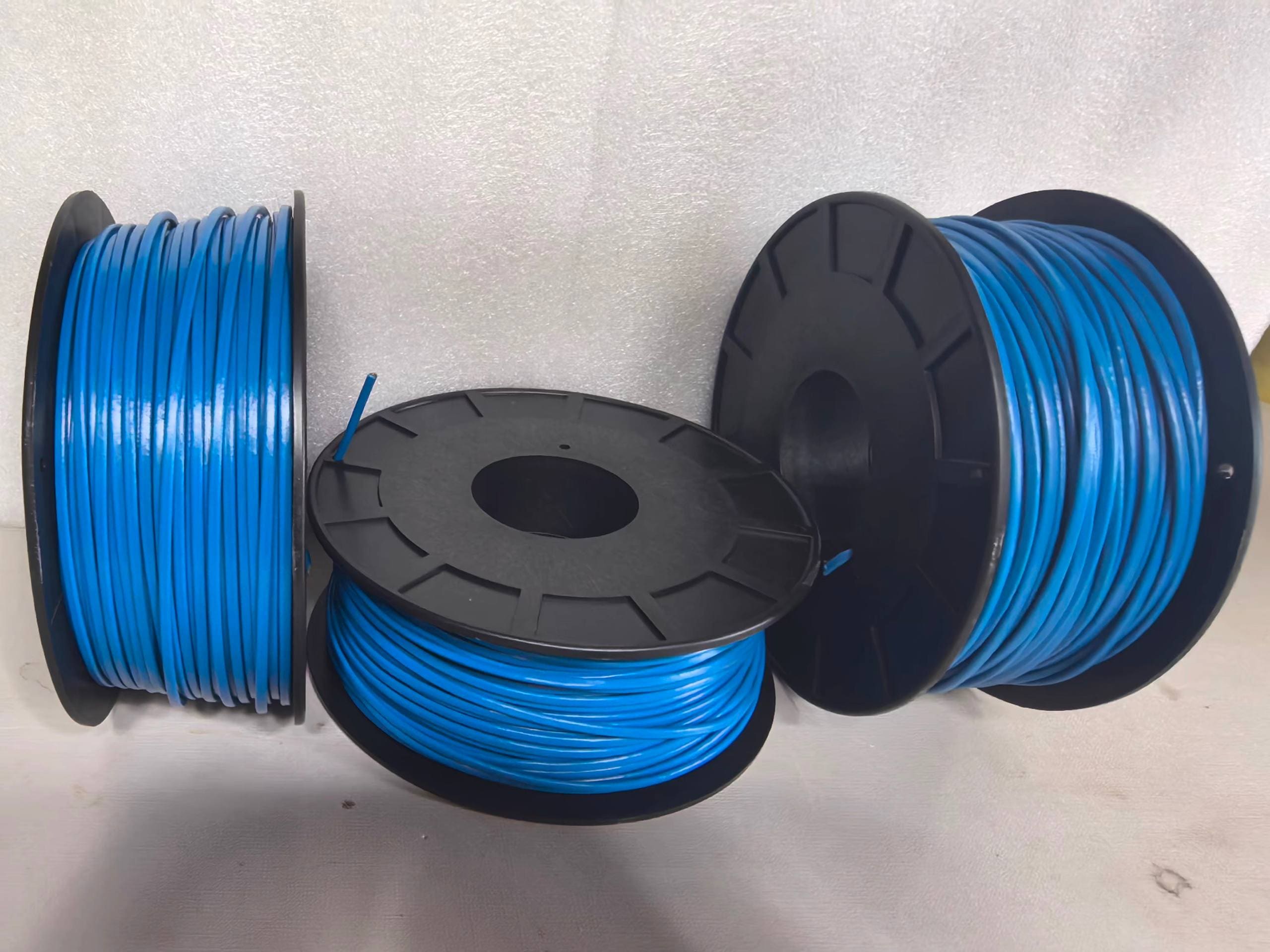
- Spool length and run layout — 50 m spools fit most buildings; cable galleries usually want 500 m or 1000 m drums.
- Installation environment — ambient range, vibration, UV, washdown, chemistry. These drive jacket chemistry and mechanical envelope.
Supplier Due Diligence, in One Paragraph
A supplier worth trusting on a fire-protection job will ship a per-batch inspection report keyed to the nine acceptance parameters we publish for thermal sensor cable QC (activation point, burn speed, tensile, waterproof, dielectric and four more), hold RoHS/CE plus ISO 9001, offer evaluation samples (subject to availability and project review), confirm panel compatibility before quoting, and stay reachable after shipment. Anything less and you are buying a spool of cable, not a fire-protection component.
Our LHD Series is built to exactly that brief. If you need a spec sheet drafted for a specific panel and environment, message our engineering desk — turnaround on the draft spec and any sample dispatch is scheduled subject to project scope and engineering review.
FAQ — LHD on a Fire-Protection Panel
How does a thermal sensor cable connect to a fire-protection panel?
On a fire-panel drawing, the thermal sensor cable sits on a dedicated zone card or addressable input, terminated by an end-of-line resistor (typically 4.7 kΩ or panel-specified). The two inner conductors run as a closed loop; the panel monitors the loop resistance continuously. When the cable activates, the conductors short and the loop resistance drops to near zero — the panel registers an alarm on that zone. Open circuits, short circuits and ground faults are reported as supervisory faults rather than alarms.
What is the function of the end-of-line resistor on an LHD loop?
The end-of-line resistor (EOLR) closes the supervisory loop so the panel can distinguish four states: normal (resistor in circuit, supervisory current flowing), alarm (cable shorted, current exceeds alarm threshold), open fault (no current, broken conductor or termination), and ground fault (current path to earth). Without an EOLR, the panel cannot tell a healthy loop from a broken one — which is why every commissioning checklist verifies the EOLR value and termination integrity before the loop goes live.
What does a commissioning engineer check during LHD acceptance testing?
Acceptance testing typically covers: loop resistance against the calculated value (verifies cable length and EOLR); insulation resistance to ground (>20 MΩ minimum); end-of-line termination integrity; alarm-on-short verification using a controlled hot-air gun on a sacrificial section or a documented short at the EOLR; supervisory fault simulation (open and ground); panel zone-mapping confirmation; lot-number traceability to the per-batch QC report. The result is signed off against the project specification and handed to the AHJ.
Is an LHD cable compatible with any addressable fire panel?
A fusible LHD cable produces a clean dry-contact short on activation, which is compatible with most conventional zone panels and many addressable panel input modules — provided the zone card supplies enough supervisory voltage (typically 24 VDC) and accepts the EOLR value the cable expects. Some addressable panels require a specific input module for resistance-based location sensing; in that case, panel and cable have to be specified together. Aetherm's LHD cable has been deployed against the major Western and Chinese panel families covered by our engineering desk; we share a panel-compatibility statement with the spec sheet on request.