Linear heat detection (LHD) is not a single product — it is a family of three distinct sensing architectures that happen to share a shape. A specifying engineer who treats them as interchangeable will either overspend or underprotect. This note compares the three architectures on the variables that actually matter on a real project: event resolution, location resolution, response time, cost per metre and code acceptance. Architecture is only half the specification, though — the other half is the detection mode (fixed-temperature, rate-of-rise or analogue), a separate axis compared in how hot versus how fast — fixed-temperature vs rate-of-rise vs analogue heat detection.
Architecture 1 · Fusible Thermosensitive Cable
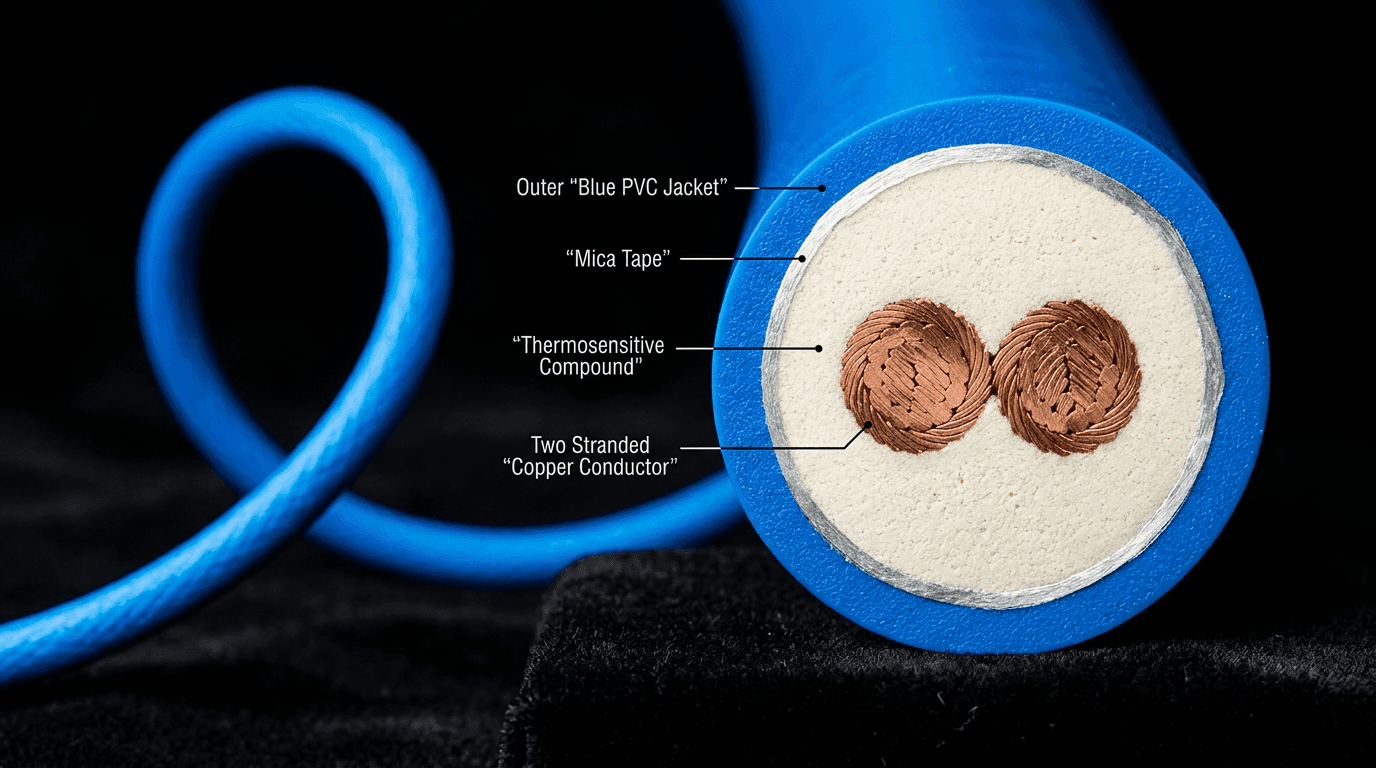
This is the workhorse architecture, and the one we manufacture. Two tinned copper conductors are separated by an engineered thermosensitive compound. Below the rated activation point the compound is a stable dielectric; above it, the compound collapses and the two conductors short. The downstream panel reads a zone-level alarm.
- Event resolution: on/off. The panel knows the loop alarmed, not the exact metre.
- Location resolution: zone-level. In practice, the installer engineers zone length to match the needed response granularity (50 m zones in warehouses, 500 m zones in tunnels).
- Response time: seconds for direct flame contact; 30–60 s for slow-heating events, depending on ambient and jacket wall thickness.
- Reset behaviour: one-time-use. Activated section is cut out and replaced; the rest of the loop keeps working.
- Typical cost (cable only): low.
Architecture 2 · Digital Addressable Cable
A cable with discrete digital temperature sensors spliced in at fixed intervals (typically 5–10 m). Each sensor has an address; the panel queries them in sequence. The panel sees a temperature map along the cable, not just an alarm bit.
- Event resolution: analog-over-threshold, per sensor.
- Location resolution: address-level (5–10 m typical).
- Response time: depends on sensor dwell time; usually 10–30 s.
- Reset behaviour: reusable. Sensors survive unless the cable itself burns.
- Typical cost: 3–6× fusible cable, plus a more expensive panel.
Architecture 3 · Distributed Fiber-Optic Sensing
A passive optical fibre is pulled through the protected area. A laser interrogator at one end measures the back-scattered light (Raman or Brillouin) and reconstructs the temperature along the fibre at metre or sub-metre resolution. No electronics in the field — just glass.
- Event resolution: full temperature profile along the fibre.
- Location resolution: 1 m or finer, up to tens of kilometres.
- Response time: seconds (limited by interrogator cycle).
- Reset behaviour: reusable. The fibre is passive and survives most events.
- Typical cost: 10–30× fusible cable, dominated by the interrogator.
Side-by-Side at Project Scale
The same six dimensions, read off each architecture's spec sheet:
Fusible Thermosensitive
Zone-level · one-time-use · workhorse
- Resolution
- Zone (50–500 m)
- Max length
- ~1000 m
- Response
- Fast (seconds)
- Reusable
- No
- Capex
- 1× (baseline)
- Opex
- Low
Digital Addressable
5–10 m precision · reusable · queries a map
- Resolution
- 5–10 m
- Max length
- ~2000 m
- Response
- Medium (10–30 s)
- Reusable
- Yes
- Capex
- 3–6×
- Opex
- Low
Distributed Fibre-Optic
Sub-metre · 10 km+ · passive glass
- Resolution
- ≤1 m
- Max length
- 10 km+
- Response
- Medium (interrogator cycle)
- Reusable
- Yes
- Capex
- 10–30×
- Opex
- Low
Fusible Cable vs Point Detectors — Where the Money Actually Goes
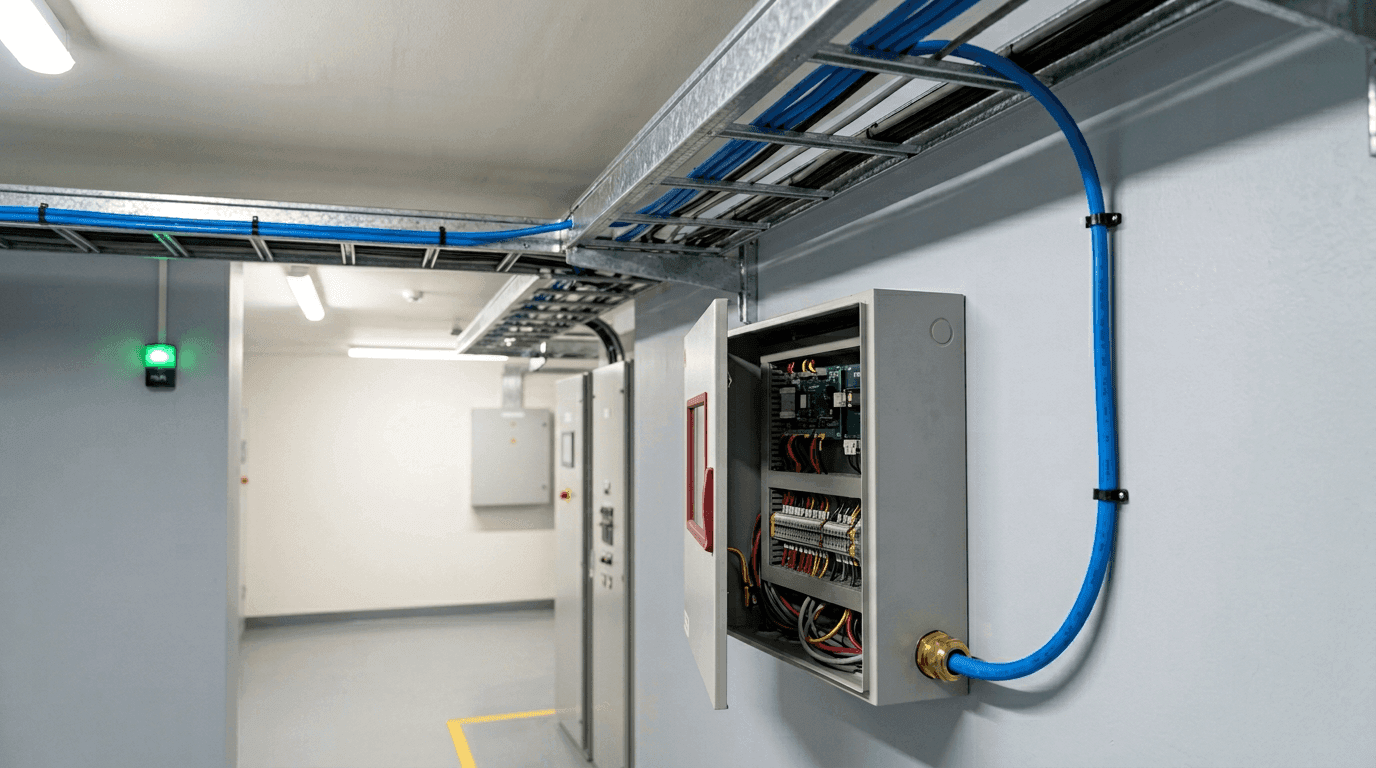
In large open spaces, point detectors multiply quickly — each detector protects a limited circular area, so a warehouse or hangar can easily need 200+ units. A single fusible cable run can replace much of that array, its coverage following the routing. The arithmetic below explains why fusible LHD is usually the economical default in large or continuous environments (for the full device-class decision — coverage geometry, location resolution and where spot / point detectors are actually the better choice — see the dedicated comparison):
| Project | Point Detectors | Fusible LHD |
|---|---|---|
| Hangar, 80 × 40 m | ~60 detectors + wiring | One 500 m loop, one zone card |
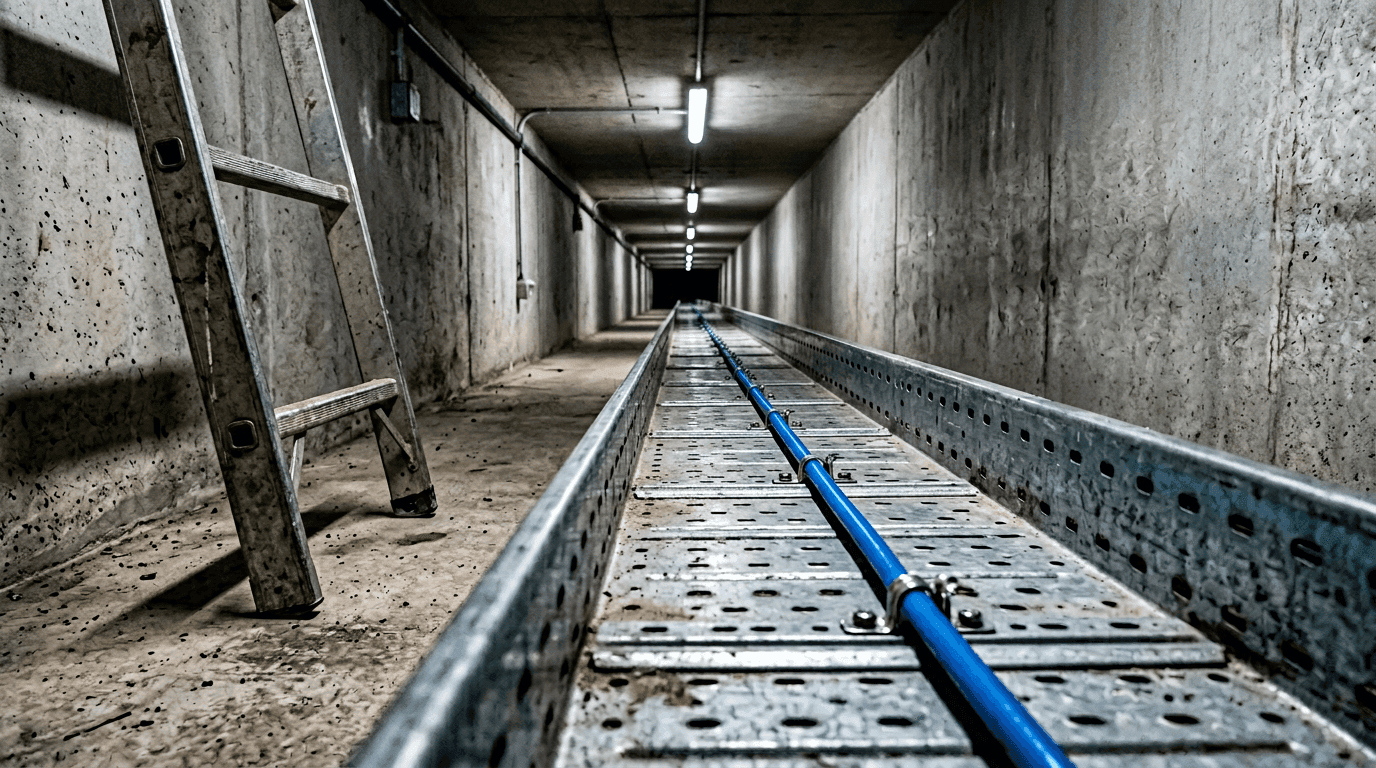
| Cable tray, 300 m linear | ~25 detectors, spacing-critical | One 300 m run, tied to the tray |
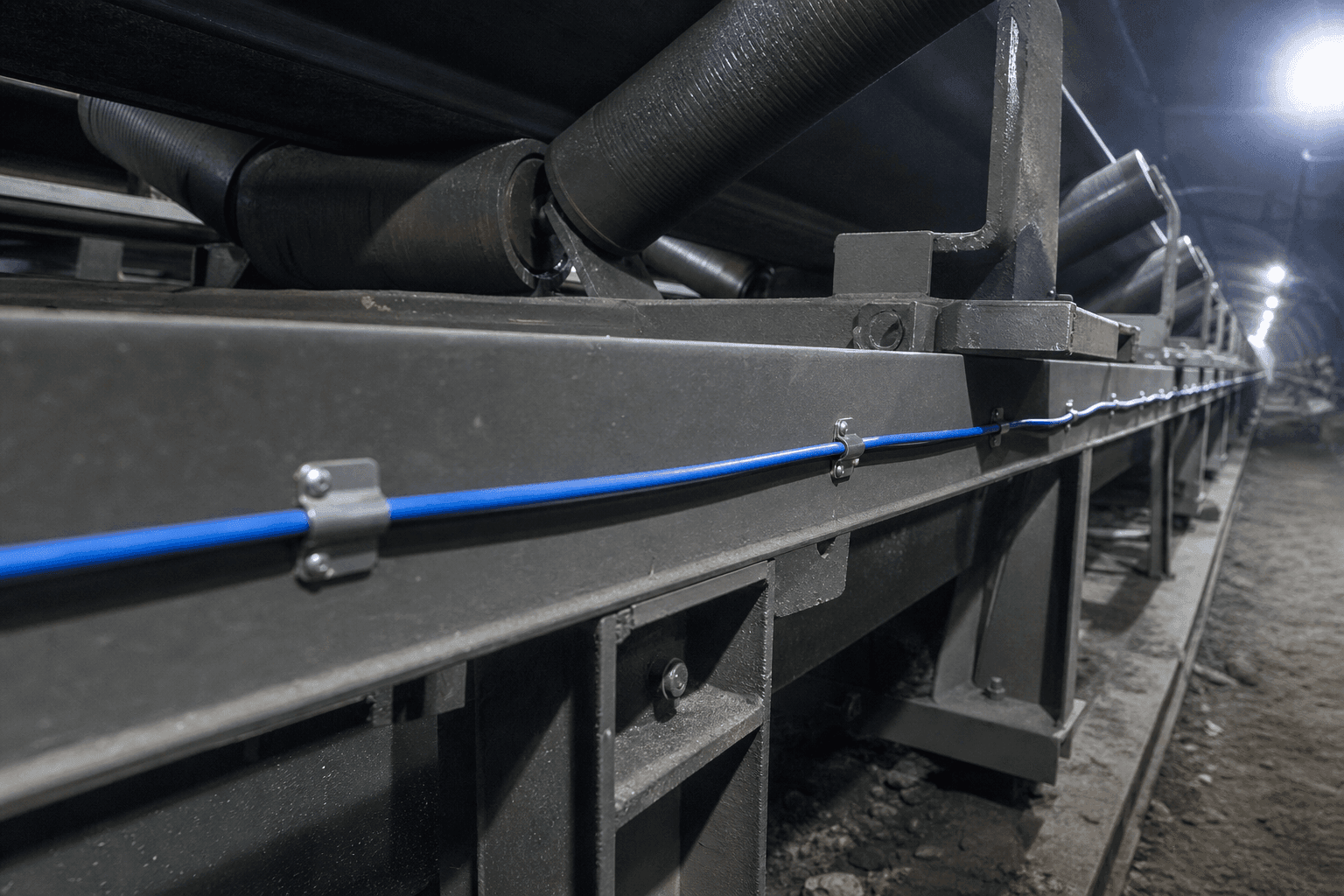
| Conveyor, 1 km | Not practical | One 1000 m run, zoned in 250 m sections |
Where Each Architecture Wins
Specify Fusible Cable When
- Budget is tight and location resolution can be managed by zone engineering.
- The protected space is large, harsh, or electrically noisy (cable trays, hangars, parking decks, tunnels). Chemical and mining service in particular carries jacket and routing constraints documented in our LHD specification note for chemical and mining plants.
- The asset is hard to access for periodic maintenance — the lifecycle case for that scenario is built out in LHD cable for inaccessible assets — the 20-year TCO argument.
- The panel expects a simple dry-contact short on activation. The wiring side of that integration sits in where the cable sits on a fire-protection panel drawing.
- Code acceptance is established (fusible LHD cable has a long, well-established AHJ track record).
Specify Digital Addressable When
- You need to know which 10 m section alarmed — not just the zone.
- The project funds a compatible addressable panel anyway.
- Reusability and ambient temperature trending are valuable.
Specify Distributed Fibre When
- Length exceeds a few kilometres — long tunnels, pipelines, power cables.
- Sub-metre hotspot location is a contract requirement.
- The asset owner has budget for a high-end interrogator and a commissioning team.
Fusible cable is the Toyota Hilux of heat detection — not the fastest or the most precise, but rugged, widely accepted and easy to source. For most large, linear or harsh spaces it is the sensible default; reach for fibre only when the project explicitly demands sub-metre resolution or multi-kilometre runs.
Installation Constraints That Apply to All Three
- Mount near the ceiling or the apex of the protected volume — heat rises, and the cable needs to see it.
- Maintain a minimum bend radius (25 mm for fusible, 50 mm for fibre).
- Respect spacing to heat-producing equipment (motors, lighting, HVAC vents) to avoid nuisance triggers.
- Terminate into compatible panel cards — a fusible cable on a point-detector card will be undervolted and mis-read. The end-of-line resistor has to be the value the card expects, and on a long run the cable's own resistance stacks on top of it; the EOL and loop-resistance calculation keeps the supervised loop inside the panel's window.
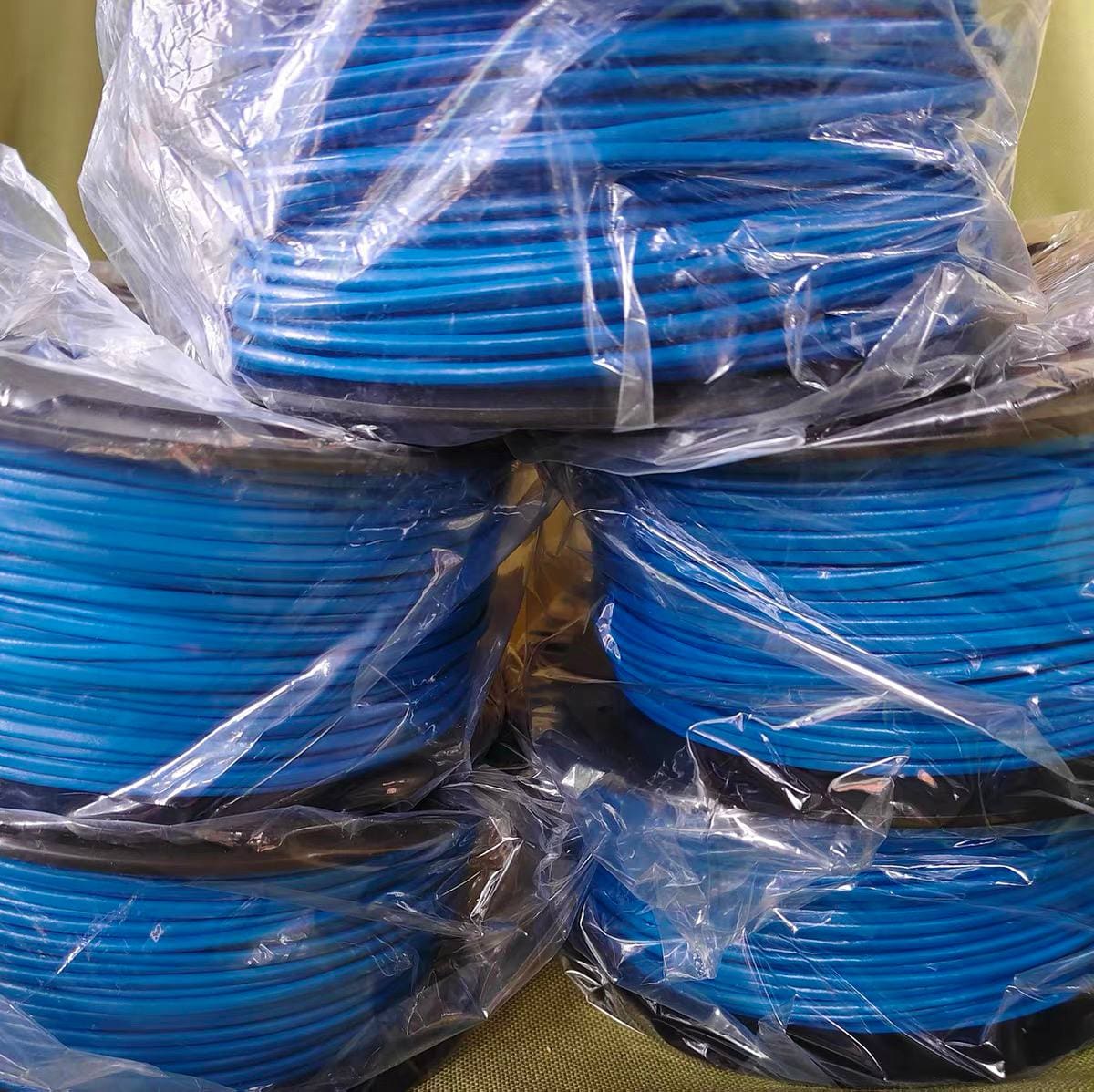
- Log the lot number printed on the jacket — it is the traceability tag to the batch QC report.
Once an LHD loop is in service, the most common false-alarm cause is not a thermal event at all — it is moisture ingress, crush damage at a tray edge, or a deteriorating splice. If your panel reports a short on a fusible loop and you are not sure whether it is real, our field-diagnosis sequence for LHD short circuits walks through how to isolate the loop, run insulation-resistance and TDR distance checks, and classify the fault before replacing cable.
Closing Note
If you are at the specification stage and cannot tell whether fusible, digital or fibre is the right answer, send us the application brief — protected volume, length, location-resolution requirement, budget envelope and AHJ. We will come back with a recommendation and a draft spec sheet — turnaround scheduled subject to project scope and engineering review. Start a conversation.
FAQ — LHD Architectures
What are the three main types of linear heat detection?
Linear heat detection comes in three architectures. (1) Fusible thermosensitive cable — the workhorse: two conductors separated by a thermosensitive compound that collapses at the activation point and shorts the loop. (2) Digital addressable cable — discrete digital sensors spliced in at 5–10 m intervals, each individually addressable from the panel. (3) Distributed fibre-optic sensing — a passive optical fibre interrogated by a laser at one end, measuring temperature at metre or sub-metre resolution along the fibre. Cost rises and resolution improves left-to-right; fusible dominates by volume.
When should I specify fusible LHD cable instead of fibre-optic DTS?
Specify fusible cable when budget is tight, the protected space can be zoned at 50–500 m granularity, the panel expects a dry-contact short on activation, and AHJ acceptance is the deciding factor. Fibre-optic DTS is justified when the project explicitly requires sub-metre hotspot location, the run exceeds a few kilometres (long tunnels, pipelines, power cables), and the asset owner has the budget for a high-end interrogator and a commissioning team. For most warehouse, hangar, cable-tray and tunnel projects, fusible cable is often the most practical answer.
How does fusible LHD cable compare to point smoke or heat detectors?
Point detectors protect a limited circular area each, so a large warehouse or hangar can need a large number of spacing-critical units laid out on a grid. A single fusible cable run can replace much of that array — every centimetre of the cable senses, so coverage follows the route rather than a grid of discrete heads to lay out and maintain. The arithmetic typically lands at 1× LHD cable run versus dozens of point detectors plus their zone wiring; for cable trays and conveyors longer than ~50 m, a point grid becomes hard to justify. LHD exposure is largely set by its jacket, so it can tolerate dust, vibration and temperature extremes that would derate many point sensors.
Is fusible thermosensitive LHD cable reusable after activation?
No — fusible cable is one-time-use by design. Once the compound has collapsed at the activation point, that section is permanently shorted; the activated length is cut out and replaced with a new spool, while the rest of the loop continues to work. Digital addressable cable and distributed fibre-optic sensing are both reusable. The trade-off cuts both ways: being non-resettable means a genuine thermal activation cannot quietly reset itself before a crew investigates, but it also means any real activation ends in reaching and replacing that length. That profile suits inaccessible infrastructure precisely because true activations there should be rare — though a fusible loop can still report a fault from moisture, crush or a bad splice rather than heat, which is a different failure to diagnose.