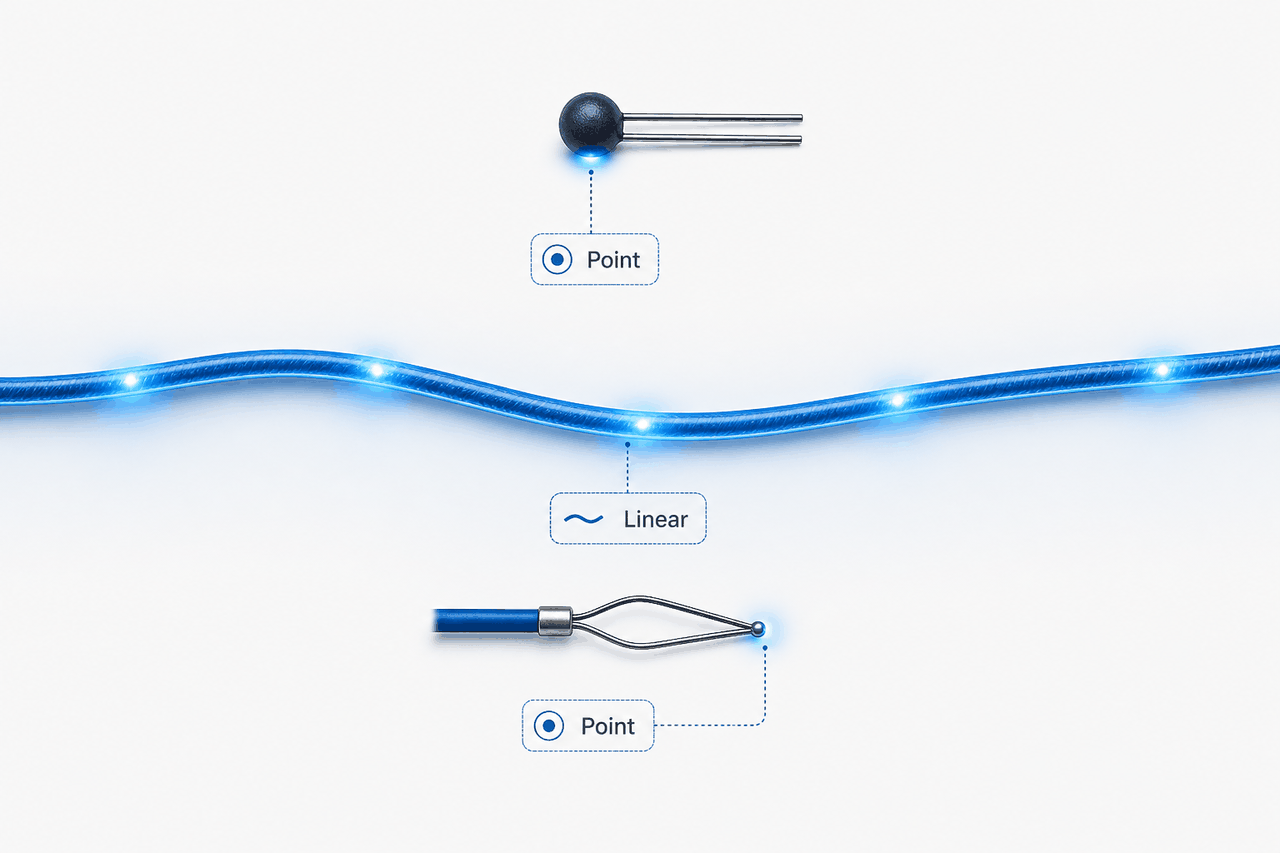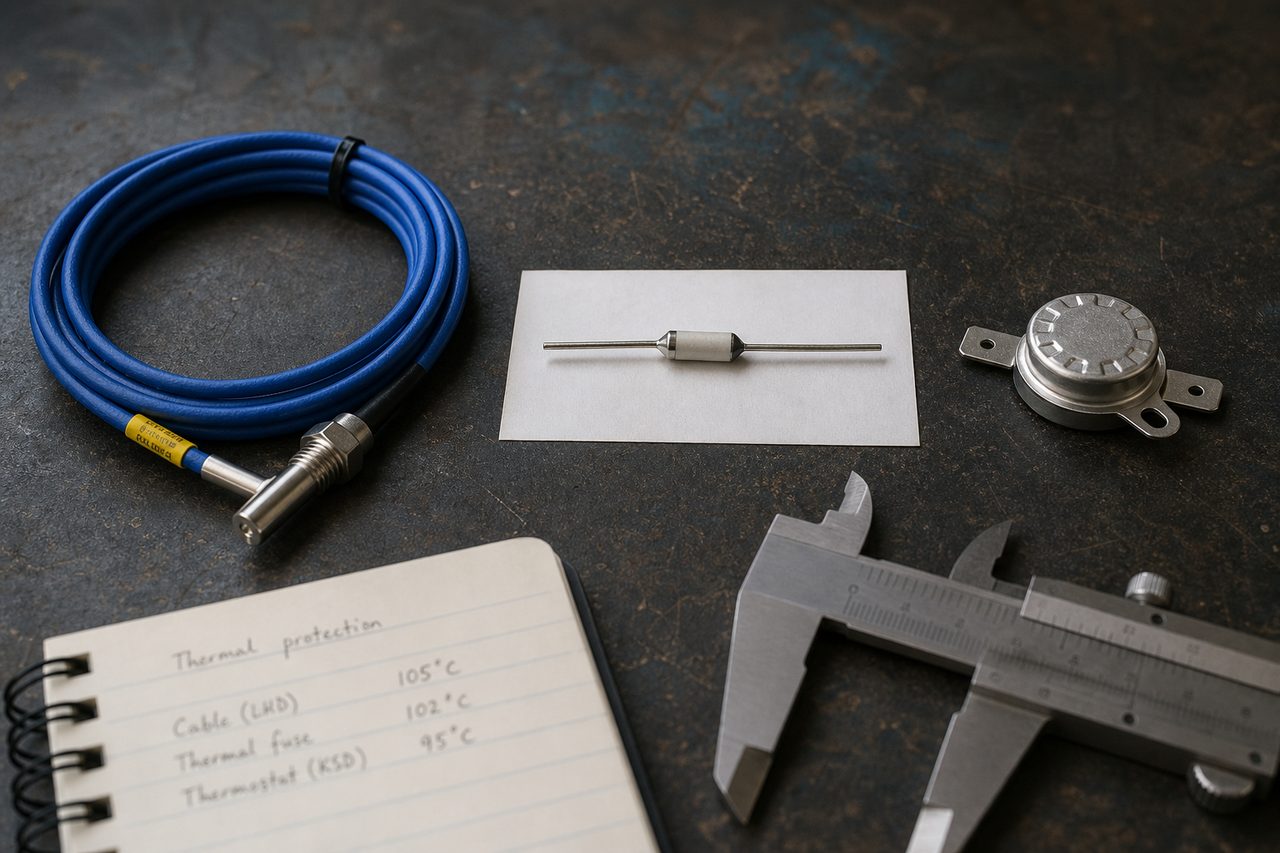
Three components on a bench, and every one of them does the same job in the crudest possible summary: when something gets too hot, it cuts the power. A thermal fuse blows and stays blown. A bimetallic thermostat snaps open, cools, and snaps back. A thermal cutoff cable watches an entire length and trips at the hottest point along it. Ask an OEM engineer which one their product needs and the honest first answer is usually another question — because these are not three brands of the same part, they are three different answers to where the heat is, what happens after the trip, and whether the device itself breaks the circuit.
This note compares the three over-temperature protection devices a designer actually chooses between, on the axes that decide a bill of materials: point versus linear coverage, one-shot versus auto-reset behaviour, and whether the device carries the load current itself or signals something else to open. It is a companion to two related notes — thermal sensor cable versus NTC thermistor versus thermocouple, which compares the sensing elements that only measure temperature, and one-shot versus resettable thermal cutoff cable, which is the decision inside the cable family once you have chosen a cable. This note is one level up: whether a routed cable is even the right form factor against a discrete fuse or a snap-disc thermostat.
Device 1 · Thermal Fuse — the One-Shot in the Power Path
A thermal fuse (often written TCO, thermal cutoff) is the simplest of the three. It is a discrete component wired in series with the load, and it carries the actual current the circuit draws. Inside is a small pellet or spring held by a fusible element rated to a functioning temperature, Tf — 72, 92, 121, 216 °C and so on. Below Tf it is a low-resistance conductor. At Tf the element melts, a spring pulls the contact apart, and the circuit opens permanently. There is no coming back: once a thermal fuse operates, it is replaced.
- Coverage: a single point — wherever the component is physically mounted.
- After it trips: one-shot. Open forever; the part is scrapped and swapped.
- In the circuit: in-line, carrying load current up to its rated amps and volts.
- Fails: open — the safe state for an over-temperature event.
- Cost / size: lowest of the three, and physically tiny.
The one-shot behaviour is the whole point. A thermal fuse is the last-ditch device you want to operate only in a genuine fault — a hair-dryer heater that jams, a transformer that overheats, a coffee-maker boiler that boils dry. Because operation means the product stops working until it is serviced, an unwanted trip is expensive and obvious, which forces the design to set Tf well clear of the highest legitimate operating temperature. Its limitation is that it protects exactly one spot: if the hot region can move — down a motor winding, along a battery module, across a cable tray — a single point fuse can be in the wrong place when the fault is somewhere else.
Device 2 · Bimetallic Thermostat — the Snap Switch That Comes Back
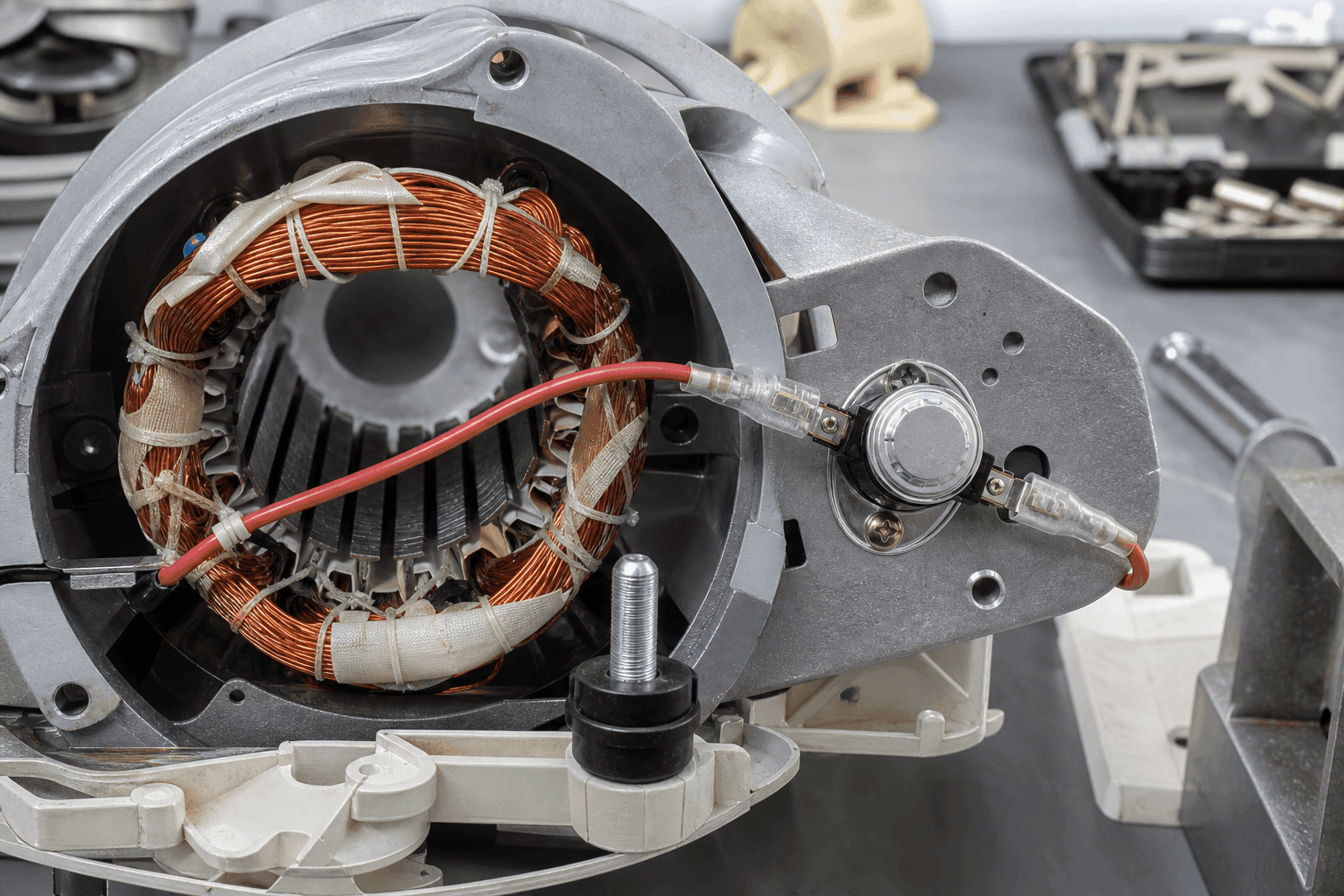
A bimetallic thermostat (a snap-disc or KSD-type thermal protector) is a mechanical switch. Two bonded metals with different expansion rates form a disc that snaps from one shape to the other at a set temperature, opening (or in some parts closing) a contact. When the temperature falls back below a lower reset point, the disc snaps back and the contact re-closes on its own. That gap between the trip temperature and the reset temperature is the differential — the hysteresis that stops the contact chattering around the set point.
- Coverage: a single point — like the fuse, it senses where it is mounted.
- After it trips: auto-reset (or manual-reset variants) — it cycles power back on when it cools.
- In the circuit: switches contacts directly; can carry a load current within its rating, or switch a control signal to a contactor.
- Fails: designed to open, though contacts can wear or weld over heavy cycling.
- Cost / size: low, a small disc; reusable across many operations.
The auto-reset is both the strength and the trap. For thermal regulation — a heater that should cycle around a temperature, a motor that should restart once it cools — a self-resetting thermostat is exactly right, and when correctly rated it can cycle repeatedly without a service call for a normal event. But as a fault protector it can hide a problem: if the underlying fault has not cleared, an auto-reset device will keep cutting and restoring power, cycling the product through the fault repeatedly. That is why safety-critical cut-off paths often use a manual-reset thermostat or a one-shot fuse instead, so a genuine fault forces a human to look. Like the fuse, it is a point device — it knows nothing about temperature a few centimetres away.
Device 3 · Thermal Cutoff Cable — Protection Along a Length
A thermosensitive thermal cutoff cable is the odd one out, because it is not a point at all — it is linear. Two conductors run the length of the cable separated by a heat-sensitive compound engineered to stay a stable insulator below the rated activation point and to collapse at it, shorting the pair. The cable responds to the hottest point anywhere along its run, whether that is at the connector or forty metres down a tunnel. The layer-by-layer construction that makes this possible is covered in how a thermosensitive cable is built and triggers.
- Coverage: linear — the entire routed length is the sensor.
- After it trips: depends on the type — one-shot fusible (replace the run) or resettable PTC (recovers on cooling), the decision in the one-shot versus resettable cutoff note.
- In the circuit: most often it signals — the short is read by a control panel or a relay that opens the real power path, rather than the cable breaking a heavy load itself. In some appliance cut-off topologies it sits in series with a low-current control loop.
- Fails: supervised — with an end-of-line resistor a panel can tell an open (break) from a short (alarm), so a cut or disconnected cable is detectable.
- Cost / size: higher per protected zone, but one run replaces many point devices where the hot spot can be anywhere.
The reason to reach for a cable is coverage, not cleverness. When the thing you are protecting is long or the hot spot is unpredictable — cable trays, conveyors, tunnels, warehouse racking, a battery pack where any one cell can run away, transformer windings — point fuses or thermostats rarely cover it as efficiently as a single continuous run. That is the entire premise of linear heat detection. The trade is that a cable usually needs a panel or relay to actually cut power, and it is fixed-temperature by physics — it triggers at an absolute point, not on a rate of rise, a distinction unpacked in fixed-temperature versus rate-of-rise detection.
The Three Axes That Actually Decide
Strip away the form factors and the choice comes down to three questions. Answer them and the device usually selects itself.
1 · Point or line — where is the heat? If the hazard is a known component that gets hot in one place — a specific heater, a boiler, a transformer core — a point device sitting on it is the direct answer. If the hot spot can appear anywhere along a route, or the asset is physically long, a linear cable earns its cost by covering the whole run with one element. This is the single axis that most often rules a fuse or thermostat out and a cable in, or vice versa.
2 · One-shot or reset — what should happen after it trips? A one-shot device (thermal fuse, or fusible cable) makes a trip a permanent, visible event that demands service — the right behaviour when operation means a real fault. An auto-reset device (bimetallic thermostat, or resettable PTC cable) restores power on cooling — the right behaviour for routine thermal cycling, the wrong behaviour if it quietly masks a recurring fault. A manual-reset thermostat sits between the two.
3 · Load-carrying or signalling — does the device break the circuit itself? A thermal fuse and a thermostat are usually in the power path: they interrupt or switch the current directly, so their current and voltage rating has to match the load. A thermal cutoff cable usually signals — it presents a short or open that a panel or relay acts on, which is why it can protect a heavy circuit without carrying heavy current, but also why it needs that panel to exist.
Thermal Fuse
One-shot, in the power path
- Coverage
- Single point
- After trip
- One-shot — replace
- In circuit
- In-line, carries load
- Failure
- Opens (fail-safe)
- Standard
- IEC / UL 60691
- Cost
- Lowest
Bimetallic Thermostat
Snap switch, auto-reset
- Coverage
- Single point
- After trip
- Auto / manual reset
- In circuit
- Switches contacts
- Failure
- Opens; contacts can wear
- Standard
- IEC / UL 60730
- Cost
- Low
Thermal Cutoff Cable
Linear, usually signals a panel
- Coverage
- Whole length
- After trip
- One-shot or resettable
- In circuit
- Signals a panel / relay
- Failure
- Supervised (open/short)
- Standard
- EN 54-28 / UL 521 (fire)
- Cost
- Higher per zone
Read across the three cards and the pattern is clear: the fuse and the thermostat are cheap, discrete, in-line point devices that differ mainly on what happens after a trip; the cable is the one that changes the geometry of the problem, trading higher cost and a dependence on a panel for coverage no point device can match.
Which One Does Your Product Actually Need?
The device should follow the hazard and the maintenance model, not habit. A few of the cases that come up most often:
| Situation | Usually the right device | Why |
|---|---|---|
| Fixed hot component — hair-dryer heater, boiler, transformer core | Thermal fuse | One known spot, and a trip should mean a real fault that forces service. Cheap, in-line, fail-open. |
| Heater or motor that should cycle around a temperature | Bimetallic thermostat (auto-reset) | Routine thermal regulation; auto-reset restores operation once it cools, no service call for a normal cycle. |
| Safety cut-off where a fault must not silently keep re-trying | Thermal fuse or manual-reset thermostat | A one-shot or manual reset forces a human to inspect rather than letting power cycle through the fault. |
| Long run or unpredictable hot spot — cable tray, tunnel, conveyor, warehouse | Thermal cutoff / LHD cable | A single point device cannot watch a whole length; the cable trips wherever the heat is and signals the panel. |
| Battery pack / module where any cell can run away | Thermal cutoff cable (routed through the pack) | The hot spot is not known in advance; a linear element watches every cell it passes. |
| Heavy load current that must be broken at the device | Thermal fuse or thermostat (rated to the load) | Both sit in the power path; a cable signals a panel rather than interrupting heavy current itself. |
Two of these deserve a caveat. A device that regulates and a device that protects are not the same job: it is common and good practice to let an auto-reset thermostat handle normal cycling and put a one-shot fuse behind it as the last line, so the fuse only ever operates if the thermostat fails. And “point versus line” is not mutually exclusive — a long asset can carry a linear cable for coverage plus a point device at a known worst-case location. The layered thinking behind putting a passive, physics-driven override behind the smart control is the subject of thermosensitive cable as the last line of appliance safety.
Where Thermosensitive Cable Fits — an Honest Answer
Because we manufacture thermosensitive cutoff and LHD cable, the fair thing to say is where a cable is not the answer. If your hazard is a single fixed component and the load is modest, a thermal fuse or a snap-disc thermostat is smaller, cheaper and needs no panel — reaching for a routed cable there is over-engineering. A cable earns its place when coverage is the problem: a length to watch, a hot spot that can move, or a supervised loop a fire panel is already reading.
Where a cable does fit, it brings two things a discrete device cannot. First, continuous coverage — one element instead of a guess about where to put the point device. Second, supervision — with an end-of-line resistor, a panel distinguishes a healthy loop, an alarm short, and a broken open, so a severed or disconnected cable is a fault the system reports rather than a silent gap. That supervised, panel-facing behaviour is why linear cable is the fire-detection form factor and the discrete fuse is the appliance form factor; they are answering coverage questions at opposite ends of the scale. The reset decision within the cable family — whether the run is one-shot fusible or resettable PTC — is a separate step covered in the one-shot versus resettable cutoff decision tree.
Getting It Onto the Spec and the RFQ
Whichever device you land on, the specification and the standards differ enough that they are worth naming explicitly. A thermal fuse is graded under IEC 60691 / UL 60691, and the fields that matter are the rated functioning temperature Tf, the rated current and the rated voltage — a fuse under-rated on current will not carry the load, and one under-rated on voltage may not clear an arc when it opens. A bimetallic thermostat falls under IEC 60730 / UL 60730 for automatic controls, where the open temperature, the reset differential, the contact rating and the auto- versus manual-reset behaviour are the deciding fields. A thermal cutoff / LHD cable used for fire detection is a line-type device: in Europe that role splits across EN 54-28 (non-resettable line type, where fusible cable sits) and EN 54-22 (resettable), and UL 521 lists heat detectors in North American practice. A cable used purely as an in-product OEM cutoff is a different case — it is usually assessed as part of the end product under the appliance or equipment safety standard, not a fire-detection listing. Reading what a certificate actually covers versus what a datasheet merely claims is the subject of our buyer-side compliance map for EN 54-22, UL 521 and FM 3210.
On the RFQ, that means stating the device class, the activation or functioning temperature and its tolerance, the reset behaviour you expect, and — for the fuse and thermostat — the current and voltage they have to switch. Where a cable is involved, the set point selection follows the same headroom logic as any activation temperature, laid out in activation temperature selection, and the interface to the panel is its own set of matches in why panel compatibility is four separate matches. Whatever the device, treat the exact figures — the temperature tolerance, the reset differential, and the current and voltage ratings — as datasheet and certificate values to confirm per part, not numbers you can assume from the device class.
A thermal fuse cuts once and stays cut; a bimetallic thermostat cuts and comes back; a cutoff cable covers a whole length and lets a panel do the cutting. Match the device to where the heat is, what should happen after the trip, and whether the part itself has to break the circuit.
Closing Note
If you are protecting a product against over-temperature and are not sure whether the answer is a discrete fuse, a snap-disc thermostat, or a routed cutoff cable, send us the picture — what gets hot, whether the hot spot can move, the load current involved, what should happen after a trip, and the standard you are held to. We will come back with a recommended device type, a set point and a draft spec line — turnaround scheduled subject to project scope and engineering review. Start a conversation.
FAQ — Thermal Cutoff Cable vs Thermal Fuse vs Bimetallic Thermostat
What is the difference between a thermal cutoff cable, a thermal fuse and a bimetallic thermostat?
All three cut power when a temperature limit is reached, but they differ on three things. A thermal fuse is a discrete, one-shot component wired in series with the load: at its rated functioning temperature it melts open permanently and must be replaced. A bimetallic thermostat is a discrete snap-action switch that opens at a set temperature and re-closes on its own when it cools (auto-reset) or after a manual reset. A thermal cutoff cable is a linear element that runs the length of what it protects and trips at the hottest point anywhere along it, usually signalling a panel or relay to open the real power path rather than breaking the load itself. In short: the fuse and thermostat are point devices in the power path; the cable is a linear device that usually signals.
Does a thermal fuse reset itself after it trips?
No. A thermal fuse is one-shot by design — once it reaches its rated functioning temperature the internal element melts and the circuit opens permanently. It does not reset on cooling and cannot be reused; the part is replaced. That is intentional: a thermal fuse is meant to be the last-ditch protector that only operates in a genuine fault, so an operation is a deliberate, visible event that forces service rather than a nuisance that quietly clears itself. If you need power to come back automatically after the temperature drops, that is a bimetallic thermostat or a resettable PTC device, not a thermal fuse.
Can a bimetallic thermostat reset automatically, and is that a good thing?
Yes — most bimetallic thermostats are auto-reset: the bimetal disc snaps back and re-closes the contact once the temperature falls below its reset point, and the gap between trip and reset is the differential. That is ideal for thermal regulation, where a heater or motor is supposed to cycle around a temperature. It is a liability as a fault protector, because if the underlying fault has not cleared, an auto-reset device keeps cutting and restoring power, cycling the product through the fault. For safety cut-off duty, a manual-reset thermostat or a one-shot thermal fuse is usually preferred so a real fault forces a human to inspect.
Can a thermal cutoff cable carry load current like a thermal fuse?
Usually not, and that is a key selection point. A thermal fuse and a thermostat sit in the power path and are rated to carry or switch the load current directly, so their current and voltage ratings must match the circuit. A thermosensitive cutoff cable most often works by signalling: at the activation point the conductors short (or open), and a control panel or relay reads that change and opens the actual power circuit. That is why a cable can protect a heavy load without carrying heavy current — but it also means the cable needs a panel or relay to do the interrupting. In some low-current appliance cut-off topologies the cable does sit in series with a control loop, but it is not a substitute for a load-rated in-line fuse.
Which is better for over-temperature protection — a thermal fuse, a bimetallic thermostat or a thermal cutoff cable?
None is better in the abstract; the right one depends on the hazard. Use a thermal fuse when the hot component is a single fixed spot and a trip should mean a real fault requiring service. Use a bimetallic thermostat when a heater or motor should cycle around a temperature and auto-reset is wanted, or a manual-reset variant when a fault must not silently retry. Use a thermal cutoff cable when the asset is long or the hot spot can appear anywhere — cable trays, tunnels, conveyors, battery modules, transformer windings — because point devices rarely cover a length as efficiently as one continuous run. Many designs combine them: an auto-reset thermostat for regulation with a one-shot fuse behind it as the last line.
What standards apply to thermal fuses, bimetallic thermostats and thermal cutoff cable?
They fall under different standards, which is worth naming on an RFQ. Thermal fuses are covered by IEC 60691 and UL 60691, where the rated functioning temperature, current and voltage are the deciding fields. Bimetallic thermostats and similar automatic thermal controls fall under IEC 60730 and UL 60730, where the open temperature, reset differential, contact rating and reset type matter. Thermosensitive line-type cable used for fire detection is graded under EN 54-28 (non-resettable line type) and EN 54-22 (resettable) in Europe, with UL 521 listing heat detectors in North American practice; the same cable used only as an in-product OEM cutoff is more often assessed under the end product's own safety standard than a fire-detection listing. A datasheet claim of conformity is not the same as a certificate that covers your exact construction — confirm what any certificate actually scopes before you rely on it.
Can I use a thermal fuse and a bimetallic thermostat together?
Yes, and on safety-critical products it is common practice. A bimetallic thermostat handles the routine job — cutting and restoring power as the temperature cycles — while a one-shot thermal fuse sits behind it as a last-ditch backstop that operates only if the thermostat fails to open. The two are not redundant: the thermostat manages the normal duty cycle, and the fuse covers the case where the regulating contact welds shut or drifts out of tolerance. The same layering idea applies with a thermal cutoff cable, where a resettable element handles recoverable events and a one-shot element or a panel action covers the unrecoverable fault.