Two purchase orders can buy exactly the same thermosensitive cable and still land on the production line in completely different shapes. One arrives as a reel — a few hundred metres of continuous cable that your line will measure, cut and finish. The other arrives as a tray of identical short pieces, each already cut to length, each ready to drop into a build. The cable is identical. What differs is whether you bought stock or whether you bought parts — and that single distinction quietly decides who does the cutting, where the scrap ends up, and how a piece in the field gets traced back to the batch it came from.
This note is about the cut-to-length versus spool decision for an OEM buying thermosensitive (TS) cable, and it is deliberately a logistics question rather than an engineering one. Cutting a length changes nothing about where the cable trips — the activation class and its tolerance are set by the compound, not by the cut, and that side is covered in the custom activation tolerance note. Whether a cut segment can be re-terminated or has to be scrapped depends on the cutoff architecture, which is the subject of the one-shot versus resettable decision. And the delivery format is just one line on a larger document — the specification guide lays out the rest. Here the focus is narrower: the reel, the cut pieces, and the ordering decision between them.
Two Ways the Same Cable Arrives
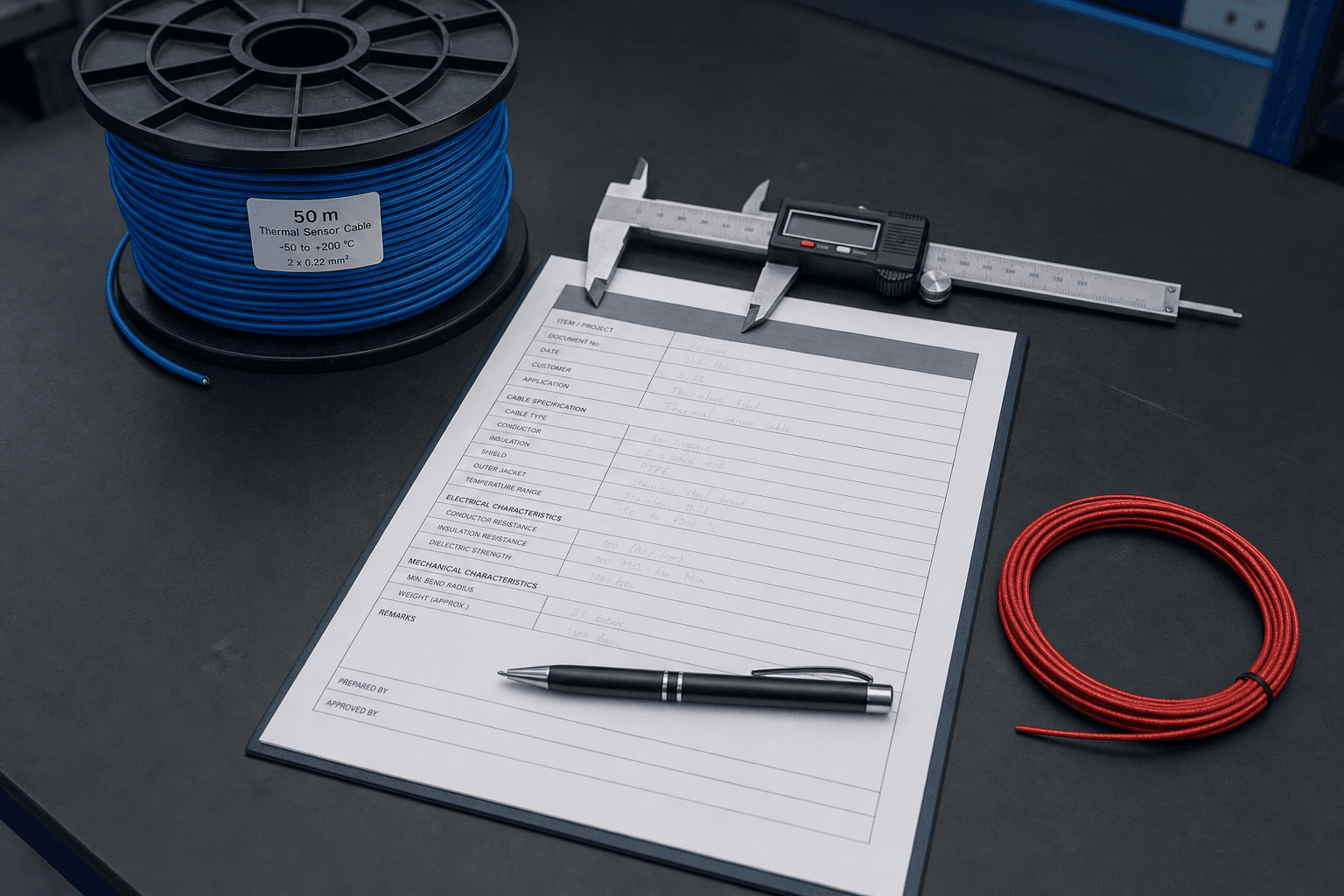
A spool is bulk cable: one continuous run wound on a reel, shipped with a single batch number and a single inspection report covering the whole length. It is inventory. Your line decides where to cut it, how long each piece is, and how the ends are prepared, and it can change those decisions from one build to the next without going back to the supplier. The flexibility is real, and so is the work — every metre that becomes a part passes through your cutting and end-preparation step, and every offcut becomes your scrap.
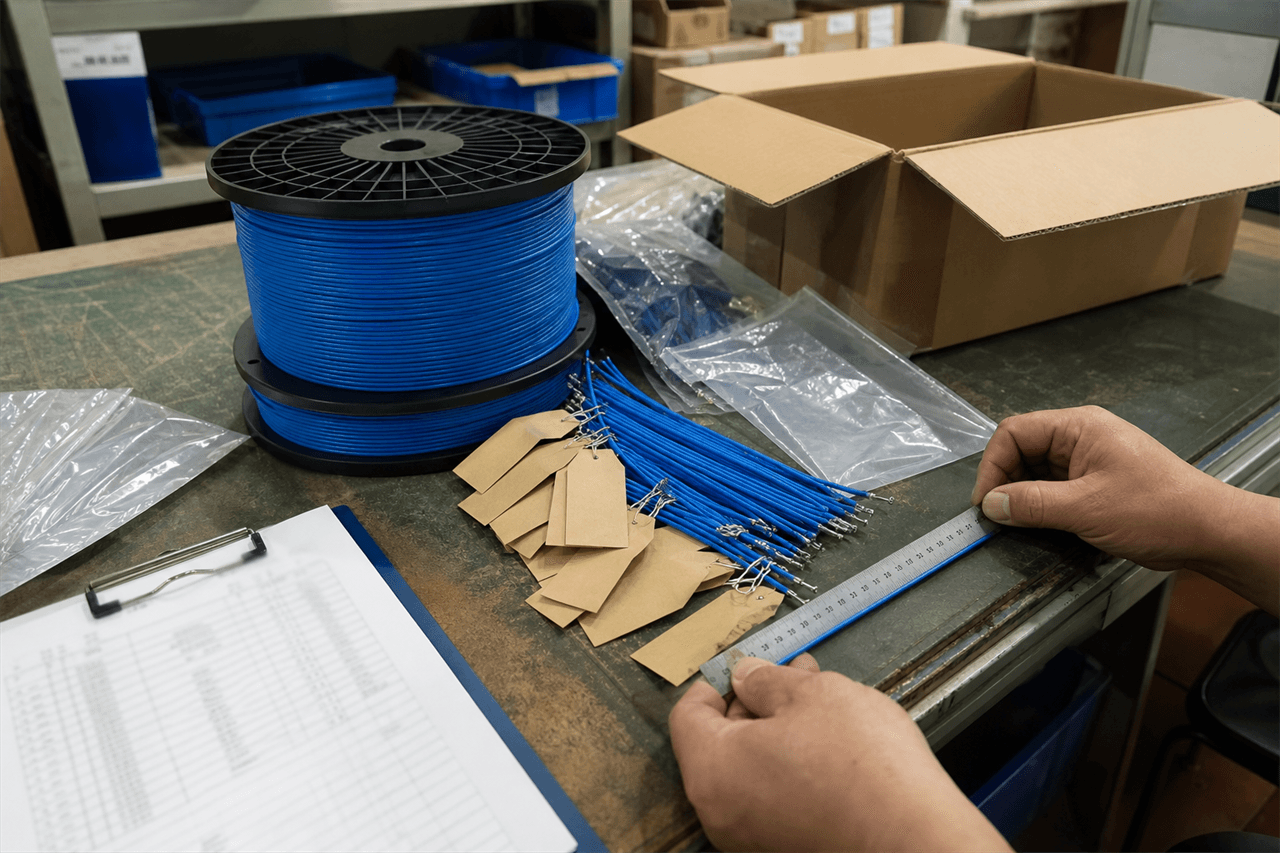
Cut-to-length moves that step upstream. The supplier cuts the cable into pieces of a stated length, normally to a stated tolerance, and — depending on what you ask for — prepares the ends, seals or crimps them, and labels each piece or each packed bag. What you receive is no longer a length of cable to convert; it is a part that maps directly to a line on the bill of materials. The cut, the end finish and the scrap have all happened before the cable reaches you. You are paying for that work and giving up the freedom to change the length on your own floor, in exchange for cable that arrives build-ready.
Who Owns the Cut
The real decision is not which format is better in the abstract — it is who is better placed to own the cut, your line or the supplier's. Four things settle that, and they are worth weighing one at a time rather than defaulting to whatever the last order used.
Whether your line already cuts and finishes cable accurately and repeatably. A line with a calibrated cut-to-length machine and a known end-preparation step can take spools and lose nothing. A line that would be cutting by hand against a tape measure will struggle to hold a tight length tolerance, and the cut quality at the ends — where the cable is terminated — becomes inconsistent. If the capability is not already there, buying it in for one cable rarely pays.
How many pieces per build, and how fast the line has to move. At high volume on a fixed length, a supplier sets the cut up once and repeats it, and your line skips a station entirely. At low volume, or where the line is not cycle-time constrained, the in-house cut costs little and a spool avoids a per-cut charge on every piece.
A build that uses one or two fixed lengths is a clean fit for cut-to-length — few part numbers, simple kitting. A build that uses many lengths, or whose lengths are still moving as the design settles, is usually better off on spools: in-house cutting keeps every length on tap without raising a new cut-to-length part number and a new minimum order for each one.
What the scrap is worth and where it lands. Cutting fixed lengths out of a continuous reel leaves a remnant at the end of each spool that may be too short to use; on a spool order that remnant is your loss, while on a cut-to-length order the supplier absorbs it across the run. The shorter your pieces relative to the reel length, the more this matters.
What a Cut-to-Length Line Item Has to State
A cut-to-length order is only as good as the line that defines the piece. “500 mm lengths” on its own leaves the supplier guessing at the tolerance, the end finish and how the pieces should be marked — and a guess priced into the first run gets re-priced when the parts do not fit the fixture or cannot be traced. A cut-to-length part number is a small spec of its own, and five things belong on it.
Cut-to-length pieces of the specified construction:
  - cut length and tolerance ........ e.g. 500 mm +/- 2 mm
  - end finish ...................... raw cut / sealed / crimped / tinned
  - per-piece or per-bag marking .... batch or lot number tied to the report
  - packaging ....................... loose / bagged in N / coiled and tied
  - quantity per length and batch ... so each part number maps to one lot
The length and its tolerance come first, because they decide whether the piece fits the enclosure and reaches its terminations — a piece cut a few millimetres long can foul a lid, one cut short can leave a termination under tension. Length is only one of the dimensions that has to clear the housing; the outer diameter, minimum bend radius and the rest of the mechanical envelope decide the fit just as much. The end finish matters next, since a thermosensitive cable is only useful once its ends are made off, and a sealed or crimped end ordered from the supplier is one your line does not have to produce. Marking and packaging are not afterthoughts: they are what keeps a tray of identical-looking pieces from becoming an untraceable pile, which is the subject of the next section.
Keeping Each Piece Traceable
On a spool, traceability looks after itself. The whole reel is one batch, it carries one batch inspection report, and any length you cut from it inherits that batch by definition. The link between a piece of cable and the test data for the run it came from is automatic, because there is only one run on the reel.
Cut the cable into a hundred short pieces and that automatic link breaks the moment the pieces are separated. Two pieces from two different batches look identical in a bin. So traceability on a cut-to-length order has to be carried deliberately: each piece, or each packed bag, is marked with the batch or lot number that ties back to the inspection report, so a piece pulled from a field return can still be traced to the production run and the test data behind it. This is worth specifying explicitly rather than assuming — ask for per-piece or per-bag batch marking, and confirm the batch inspection report quotes the same lot number, so the format you chose for convenience does not quietly cost you the traceability you would need if a build ever has to be investigated.
Spool or Cut-to-Length — When Each Wins
Because the decision is about who owns the cut rather than about the cable, it comes down to matching the format to how your line actually runs.
The build runs at volume on one or a few fixed lengths; the line is cycle-time constrained and dropping the cutting station saves takt; your line cannot hold the length tolerance or end quality the part needs; or the offcut from cutting fixed pieces out of a reel would be significant scrap. In those cases the per-cut charge buys build-ready, traceable parts and moves the scrap off your floor.
The design is still settling and the lengths are likely to change; the build uses many different lengths; your line already cuts and terminates accurately; or volume is low enough that a per-cut charge on every piece outweighs the in-house effort. Spools keep the lengths flexible and the unit price closer to the bulk cable, at the cost of owning the cut and its scrap.
On the supply side, both formats are things a manufacturer can offer rather than a promise about your build. The same construction can ship on a spool or cut to a stated length and tolerance for a given order, with the ends prepared and the pieces marked to the batch where that is specified — what the format cannot do is change the cable's behaviour, which stays a property of the construction and the batch. Decide who should own the cut first; specify the length, tolerance, end finish and marking second; and the delivery format stops being an afterthought that surfaces on the receiving dock.
A spool is bulk stock you convert into parts; cut-to-length pieces arrive as parts already. Choosing between them is a logistics decision — who owns the cut, the end preparation and the scrap — not an engineering one, because the cable trips where the batch says regardless of how it is cut. Decide who should cut, then write the length, tolerance, end finish and batch marking onto the line.
FAQ — Cut-to-Length vs Spool Thermosensitive Cable
What is the difference between buying thermosensitive cable on a spool and cut-to-length?
A spool is bulk cable shipped as one continuous run on a reel, which you then measure and cut on your own line; cut-to-length means the supplier cuts the cable into pieces of a stated length, usually to a stated tolerance and sometimes with the ends prepared and each piece labelled. The practical difference is where the cutting work and its scrap live. A spool is inventory you convert into parts; cut-to-length pieces arrive already as parts that map to a line on the bill of materials. The cable itself is identical between the two formats; what changes is who owns the cut, the end preparation and the per-piece labelling.
Should an OEM have the supplier cut thermosensitive cable to length or cut it in-house?
It depends on four things: whether your line already has accurate cutting and end-preparation tooling, the production volume, the number of distinct lengths you need, and what the offcut scrap is worth. High volume on a small number of fixed lengths usually favours supplier cut-to-length, because the cut is set up once and repeated and the scrap stays at the factory. A line that already cuts and terminates accurately, or one that needs many different or still-changing lengths, is often better served by spools, because in-house cutting keeps the lengths flexible and avoids paying a per-cut charge. There is no single right answer; it is a logistics and cost decision rather than an engineering one.
Does cutting a thermosensitive cable to length change its activation temperature?
No. The activation temperature and its tolerance are properties of the compound and the construction, set during manufacture, and they are shared by every length cut from the same production batch. Cutting a piece shorter or longer does not move where it trips. What the cut does affect is the mechanical fit and the termination: the cut-length tolerance has to be tight enough that the piece fits its enclosure and its terminations, and a fusible one-shot construction has to be cut and re-terminated correctly because a damaged end cannot simply be reset. The trip point belongs to the batch; the cut belongs to the fit.
How is traceability maintained when cable is shipped as cut pieces instead of a spool?
On a spool, traceability is easy because the whole reel is one batch with one inspection report. Once the cable is cut into many pieces, that link has to be carried deliberately, or it is lost the moment the pieces are separated. The supplier keeps it by labelling each piece or each packed bag with the batch or lot number that ties back to the inspection report, so any piece can be traced to the test data for the run it came from. A buyer who orders cut-to-length should specify per-piece or per-bag batch marking and confirm that the batch inspection report references the same lot, otherwise a field issue cannot be traced back to a specific production run.