Two heat detectors can watch the same ceiling and disagree about when to call a fire. One waits until the air around it actually reaches a set temperature. The other alarms the moment the temperature starts climbing quickly, long before it is hot. A third does not decide at all — it just reports the number and lets the panel choose. These are not brands or price tiers; they are three different detection modes, and picking the wrong one is how a project ends up with either late alarms or a detector that cries wolf every time a process heater cycles.
This note compares the three modes a specifying engineer actually chooses between — fixed-temperature, rate-of-rise and analogue — on what each one triggers on, how it behaves in a fast versus a slow fire, its exposure to nuisance alarms, and where the decision logic physically lives. It is a companion to our note on the three linear heat detection architectures, which compares detector structure (fusible, digital, fibre); this note is about the algorithm — the two questions are independent, and buyers routinely conflate them. A third, separate question — whether to use a continuous cable at all or a grid of spot / point heat detectors — is covered on its own.
Mode 1 · Fixed-Temperature — the Threshold
A fixed-temperature detector answers one question: how hot? It alarms when the sensed temperature reaches a preset absolute value — 68, 88, 105, 138 °C and so on — regardless of how quickly or slowly it got there. The decision is a level, not a trend.
The mechanism can be a eutectic pellet that melts, a bimetallic strip that snaps, an electronic setpoint on a thermistor, or — in our world — a fusible thermosensitive compound that collapses and shorts a pair of conductors. Whatever the mechanism, the behaviour is the same: nothing happens until the set point, then it acts.
- Triggers on: absolute temperature reaching the rated set point.
- Fast fire: reliable, but lags — it must wait for the mass around the element to physically reach the point.
- Slow fire: reliable — a slow rise still eventually crosses the threshold.
- Nuisance-alarm exposure: very low. Ambient swings below the set point are ignored by design.
- Where the logic lives: in the element or the compound — it is physics, not firmware.
The strength of fixed-temperature is its predictability. A 88 °C cable does not care whether the route runs warm in summer or the sun hits a bay in the afternoon — as long as those excursions stay below the set point, the detector stays quiet. That immunity is why fixed-temperature has the deepest code track record and why it dominates linear heat detection by volume. Its weakness is thermal lag: the element has to actually get hot, so on a fast flaming fire the detector waits while the room heats, and the fire may already be sizeable by the time the local air reaches the point.
Mode 2 · Rate-of-Rise — the Slope
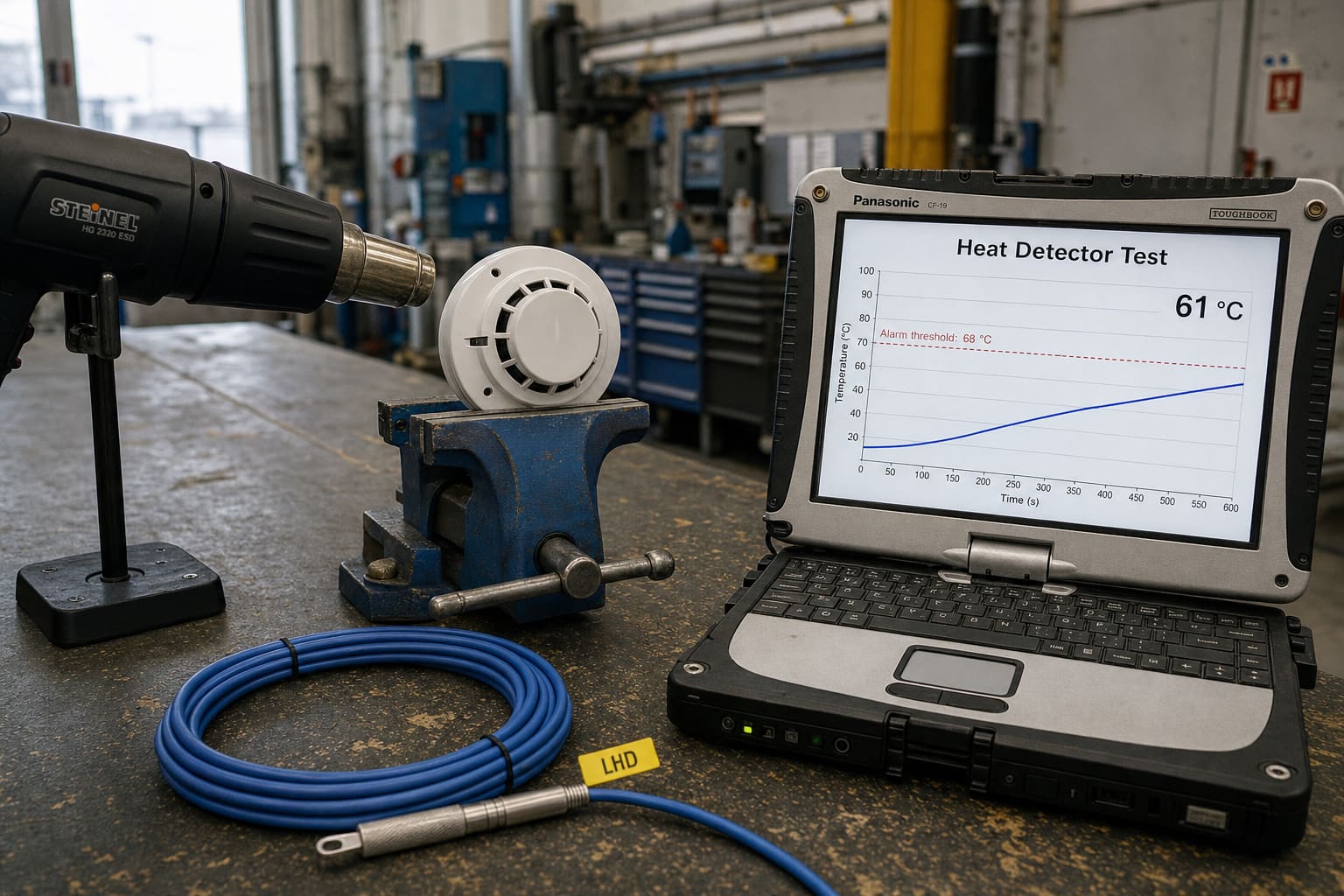
A rate-of-rise (RoR) detector answers a different question: how fast? It alarms when the temperature climbs faster than a set rate — the classic figure is about 8.3 °C per minute (15 °F per minute) — regardless of the absolute value at that moment. It responds to the slope of the temperature-versus-time curve, not the height.
This is the earliest-warning mode for fast-developing fires. A flaming fire drives local air temperature up far faster than 8.3 °C/min, so the rate channel trips while the air is still well below any fixed set point — often the difference between catching a fire small and catching it large.
- Triggers on: rate of temperature increase exceeding the set slope.
- Fast fire: earliest warning of the three modes.
- Slow fire: can under-respond — a gentle creep may never trip the slope (see the backstop below).
- Nuisance-alarm exposure: higher — a legitimate fast swing can look like a fire.
- Where the logic lives: in the detector mechanism or electronics.
Two refinements matter to a specifier. First, almost no one deploys a pure rate-of-rise element. The standard device is a combination detector that pairs the rate channel with a fixed-temperature backstop: the rate channel catches the fast fire, and the fixed channel still provides the alarm path once the absolute set point is reached — even if the rise was too slow to trip the slope. That combination closes the slow-smoulder gap that pure RoR leaves open.
Second, RoR is exposed to nuisance alarms wherever normal operation produces a genuinely fast temperature change: a process heater cycling on, an oven door opening, a truck exhaust passing under a detector, morning sun on a metal roof deck. In those settings a plain rate channel can trip on a non-fire event, which is why placement, set slope and rate compensation (next section) all have to be engineered rather than assumed.
The Refinement Everyone Confuses With Rate-of-Rise · Rate Compensation
A rate-compensated detector is not the same as a rate-of-rise detector, though the names invite the mix-up. A rate-compensated device alarms at a fixed temperature, but it corrects for its own thermal lag so that it alarms when the surrounding air reaches the set point — not later, once the detector's own mass has caught up. In a fast fire, an uncompensated fixed detector alarms late because the element trails the air; rate compensation removes most of that lag while keeping the clean, nuisance-resistant behaviour of a fixed threshold. If your goal is fast-fire responsiveness without the nuisance exposure of a true rate channel, rate compensation is often the better tool than rate-of-rise — and it is worth naming explicitly on a datasheet review so you know which one you are buying.
Mode 3 · Analogue / Addressable — the Curve
An analogue (analogue-addressable) detector does not decide anything on its own. It reports a continuous temperature value back to the control panel, and the panel software applies whatever logic the designer configured — a fixed threshold, a rate-of-rise slope, a pre-alarm investigation stage, drift compensation, multi-sensor voting. The sensing element supplies the number; the algorithm lives in the panel.
- Triggers on: whatever rule the panel is programmed with — configurable in software.
- Fast fire: configurable, and can be the earliest of all with a rate rule plus pre-alarm staging.
- Slow fire: configurable, with trending and drift compensation available.
- Nuisance-alarm exposure: lowest when properly tuned — multi-criteria logic can distinguish a fire from a known operational swing.
- Where the logic lives: in the panel firmware and its commissioning configuration.
This is the flexible, tunable end of the spectrum. Because the rule is software, a single hardware install can carry per-zone thresholds, a two-stage pre-alarm that sends someone to investigate before evacuating, and temperature trending for maintenance. In linear detection this is the territory of digital addressable cable and distributed fibre-optic (DTS) systems, both of which report temperature along their length rather than a single short. The cost is real: an addressable panel, a commissioning team to configure the logic, and a maintenance model that understands software as well as cable.
Side-by-Side, at Specification Scale
The three modes on the variables that decide a specification:
Fixed-Temperature
Asks “how hot?” · a threshold
- Triggers on
- Absolute set point
- Fast fire
- Reliable but lags
- Slow fire
- Reliable
- Nuisance risk
- Very low
- Logic lives in
- Element / compound
- Cost
- 1× (baseline)
Rate-of-Rise
Asks “how fast?” · a slope (+ fixed backstop)
- Triggers on
- ~8.3 °C/min slope
- Fast fire
- Earliest warning
- Slow fire
- Covered by backstop
- Nuisance risk
- Higher (fast swings)
- Logic lives in
- Detector electronics
- Cost
- Medium
Analogue / Addressable
Reports the curve · panel decides
- Triggers on
- Software rule
- Fast fire
- Configurable / earliest
- Slow fire
- Configurable + trending
- Nuisance risk
- Lowest when tuned
- Logic lives in
- Panel firmware
- Cost
- Highest (panel + commissioning)
Read the table across, and the trade is clear: predictability and cost on the left, responsiveness and tunability on the right, with rate-of-rise sitting in the middle as the classic early-warning compromise. None of the three is “better” in the abstract — the right one is the one that matches the fire you are worried about and the false alarms you cannot tolerate.
The diagram is the whole argument in one picture. Both fires eventually cross the fixed set point, so a fixed-temperature detector alarms on both — earlier on the fast fire, later on the slow smoulder. A rate-of-rise channel reacts where the fast curve's slope turns sharp, well before the air is hot, which is the warning time it buys on a fast fire. An analogue system watches the whole curve, so it can be told to raise a pre-alarm in the band just below the set point and the alarm at the set point itself.
Which Mode Does Your Application Actually Need?
The mode should follow the risk and the environment, not the other way round. A few common cases:
| Situation | Usually the right mode | Why |
|---|---|---|
| Cable tray, tunnel, conveyor, warehouse — large linear runs | Fixed-temperature (fusible LHD) | Predictable, code-accepted, immune to ambient noise, lowest cost per metre. |
| Rooms with fast, real temperature swings (kitchens, heater bays, sun-loaded decks) | Fixed-temperature set high, or RoR with compensation | A plain rate channel nuisance-trips on normal operation; a fixed point above the working range separates fire from routine. |
| Spaces where a fast flaming fire must be caught early | Rate-of-rise (combination) or rate-compensated | The slope trips before the air reaches a fixed point; the backstop still covers a slow fire. |
| High-value assets needing pre-alarm staging and hotspot location | Analogue / addressable | Software logic supports pre-alarm, per-zone thresholds and trending — worth the panel cost. |
| Deep-seated, slow smouldering risk | Low fixed set point (fixed or combination backstop) | A gentle rise may never trip a rate slope; the absolute set point is what provides the alarm path. |
The recurring theme: survey the real temperature-versus-time behaviour of the protected space before choosing a mode. A rate channel only earns its place where fires rise faster than normal operation; a fixed point only protects if it sits above the working ambient with margin. That headroom decision is the same one behind selecting the activation temperature and reading the working ambient a cable has to live with.
Where Thermosensitive LHD Cable Sits — an Honest Answer
Because we manufacture fusible thermosensitive cable, buyers often ask us directly: is your cable rate-of-rise? The honest answer is no, and it is worth being precise about why. Fusible thermosensitive LHD cable is fixed-temperature by physics. The compound between the conductors is engineered to stay a stable insulator below the rated point and to collapse at it, shorting the loop. There is no slope calculation inside the cable — it responds to the absolute temperature at the hottest point along its length. The mechanism is covered in more depth in how a thermosensitive cable is built and triggers.
That is a feature, not a limitation, for most linear detection duty. A fusible run gives the panel a clean, unambiguous dry-contact short at the set point — no firmware, no drift, no algorithm to commission — and the non-resettable behaviour means a short is a real event, not a sensor that talked itself into a trip and reset before anyone looked. Two cables can still alarm seconds apart at the same set point, and the reason is insulation and jacket wall, which is the subject of how insulation shapes response time.
If a project genuinely needs a rate channel or continuously reported temperature along a line, that requirement points away from fusible cable and toward a digital addressable or fibre-optic architecture — which is exactly the structural choice laid out in the three-architectures comparison. Detection mode and detector structure are two separate specification lines; a clean spec answers both, rather than assuming one implies the other.
Getting the Mode Onto the Spec and the RFQ
Detection mode is a specification field in its own right, and it maps onto the fire-detection standards a buyer should know how to read. Under the European heat-detector standard EN 54-5, devices are graded into temperature classes (A1, A2, B and so on) with a suffix that tells you the mode: an R-class detector has a rate-of-rise characteristic with a defined minimum static response temperature, while an S-class detector is static — a fixed-temperature device with a high response point and no lower rate requirement. In North American practice, NFPA 72 is where the ~15 °F/min (8.3 °C/min) rate figure and the fixed/rate/combination definitions live, and UL 521 lists the heat detectors; in Europe, line-type LHD cable is split across EN 54-22 (resettable) and EN 54-28 (non-resettable line-type, where fusible cable sits). Reading those class letters correctly — and confirming what a certificate actually covers versus what a datasheet merely claims — is the subject of our buyer-side compliance map for EN 54-22, UL 521 and FM 3210.
On the RFQ, that translates into naming the mode explicitly rather than leaving it implied: fixed-temperature, rate-of-rise with fixed backstop, rate-compensated, or analogue-addressable; the set point and, for a rate device, the rate threshold and any compensation; and the EN 54-5 class or NFPA 72 type you expect the documentation to support. Where the cable terminates into a panel, the mode also has to match what the panel is built to read — the interface side of that is covered in why panel compatibility is four separate matches, not a yes-or-no.
Fixed-temperature asks how hot; rate-of-rise asks how fast; analogue reports the curve and lets the panel ask both. Choose the question that separates your fire from your normal day — then set the number with margin.
Closing Note
If you are specifying detection and are not sure whether the answer is a fixed-temperature fusible run, a combination rate device, or a fully addressable system, send us the picture — protected space, the normal temperature-versus-time behaviour, the fire you are most worried about, the panel and the standard you are held to. We will come back with a recommended mode, a set point and a draft spec line — turnaround scheduled subject to project scope and engineering review. Start a conversation.
FAQ — Fixed-Temperature vs Rate-of-Rise vs Analogue
What is the difference between a fixed-temperature and a rate-of-rise heat detector?
A fixed-temperature detector asks how hot: it alarms when the sensed temperature reaches a preset absolute value, such as 68 °C or 88 °C, no matter how quickly or slowly it got there. A rate-of-rise detector asks how fast: it alarms when the temperature climbs faster than a set rate — commonly around 8.3 °C per minute (15 °F per minute) — regardless of the absolute value at that instant. Fixed-temperature is predictable and immune to normal ambient swings but waits until the set point is physically reached; rate-of-rise gives earlier warning on fast-developing fires but is more exposed to nuisance trips. Most rate-of-rise detectors also carry a fixed-temperature backstop so a slow fire still alarms when it eventually reaches the set point.
How fast does the temperature have to climb to trip a rate-of-rise detector?
The classic rate-of-rise threshold used in most codes and datasheets is about 8.3 °C per minute, which is 15 °F per minute. A detector rated to this figure ignores slow, steady warming — sunlight on a roof, a process ramping over an hour, seasonal drift — and reacts only when the rate of increase exceeds the set slope. The exact figure and any averaging window belong to the specific detector, so read it off the datasheet rather than assuming the nominal 8.3 °C/min. Because a genuine flaming fire raises local air temperature far faster than that, the rate channel typically alarms well before the air reaches a fixed set point.
Can a rate-of-rise detector miss a slow, smouldering fire?
A pure rate-of-rise element can under-respond to a very slow smoulder, because the temperature may creep up more gently than the rate threshold. This is why standalone rate-of-rise is rarely specified on its own: the common device is a combination detector that pairs the rate channel with a fixed-temperature backstop. The rate channel catches fast fires early; the fixed channel still provides the alarm path once the absolute set point is reached, even if the rise was too gradual to trip the slope. If your risk is dominated by slow, deep-seated smouldering, the fixed set point matters more than the rate channel.
Is thermosensitive LHD cable fixed-temperature or rate-of-rise?
Fusible thermosensitive linear heat detection cable is fixed-temperature by physics. Two conductors are separated by a heat-sensitive compound engineered to collapse at a rated activation point; below that point it is a stable insulator, and at that point it softens and the conductors short. There is no rate channel in the cable itself — it responds to the absolute temperature at the hottest point along its length. Rate-of-rise and analogue behaviour come from the sensing element or the panel algorithm, not from a fusible cable. If a project needs a rate channel or continuously reported temperature along a line, that points toward a digital addressable or fibre-optic architecture rather than fusible cable.
What is an analogue or addressable heat detector, and when do I need one?
An analogue (also called addressable or analogue-addressable) detector does not decide on its own. It reports a continuous temperature value back to the control panel, and the panel software applies the alarm logic — a fixed threshold, a rate-of-rise slope, a pre-alarm investigation stage, drift compensation, or multi-sensor voting. The advantage is that the decision lives in software and can be tuned per zone, staged and trended without changing hardware. You need it when you want early pre-alarm staging, per-zone thresholds, hotspot location or algorithmic nuisance suppression — and when the project funds a compatible addressable panel and commissioning. For a simple dry-contact zone alarm, a fixed-temperature device is cheaper and sufficient.
Which detection mode should I specify near ovens, kitchens or process heaters?
Environments with large, legitimate, fast temperature swings — commercial kitchens, near ovens, process-heater bays, sun-loaded roof decks — are where a pure rate-of-rise channel is most likely to nuisance-trip, because normal operation can look like a fast rise. In those places a fixed-temperature device set above the highest expected working temperature, or a rate-of-rise device with rate compensation and a suitable fixed backstop, is usually the better answer. The general rule is to survey the real temperature-versus-time profile of the space first, then choose the mode and set point that separates a fire from normal operation with margin.