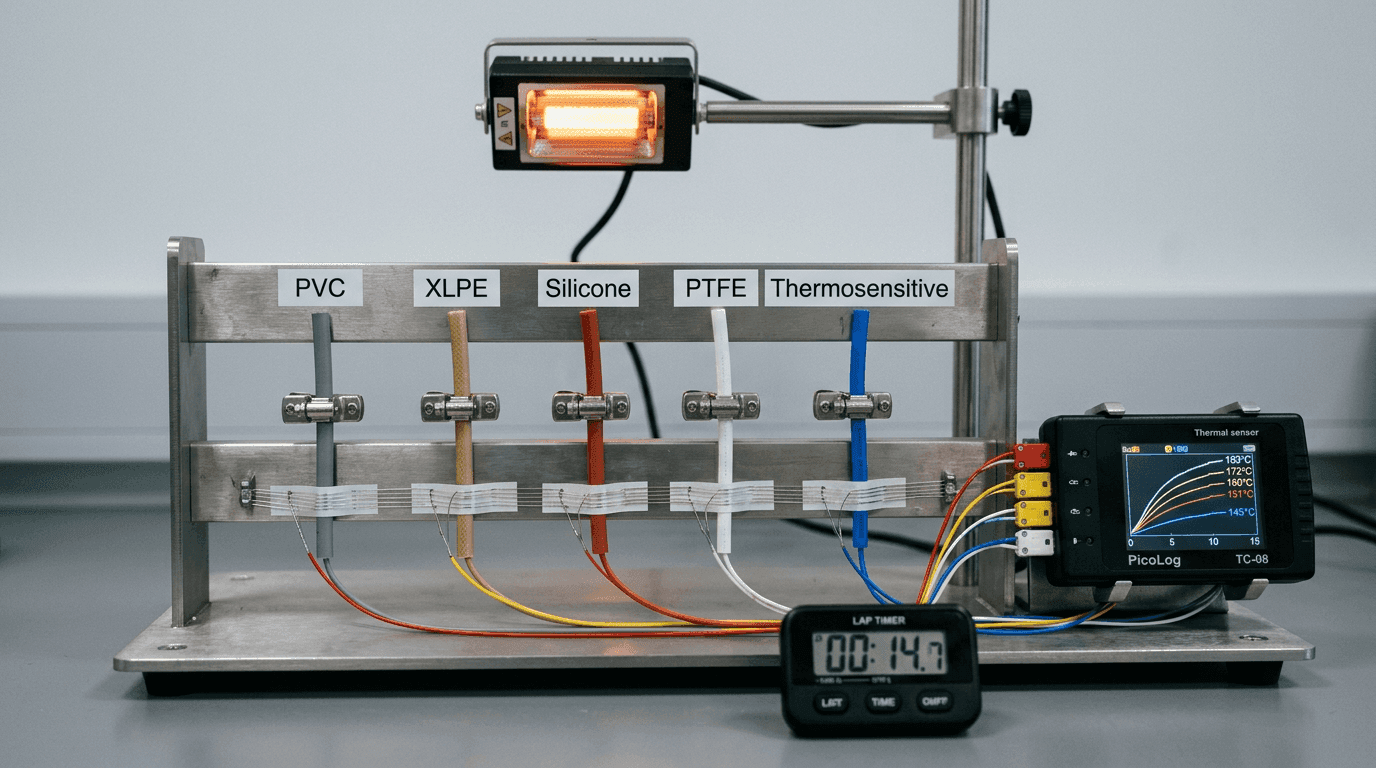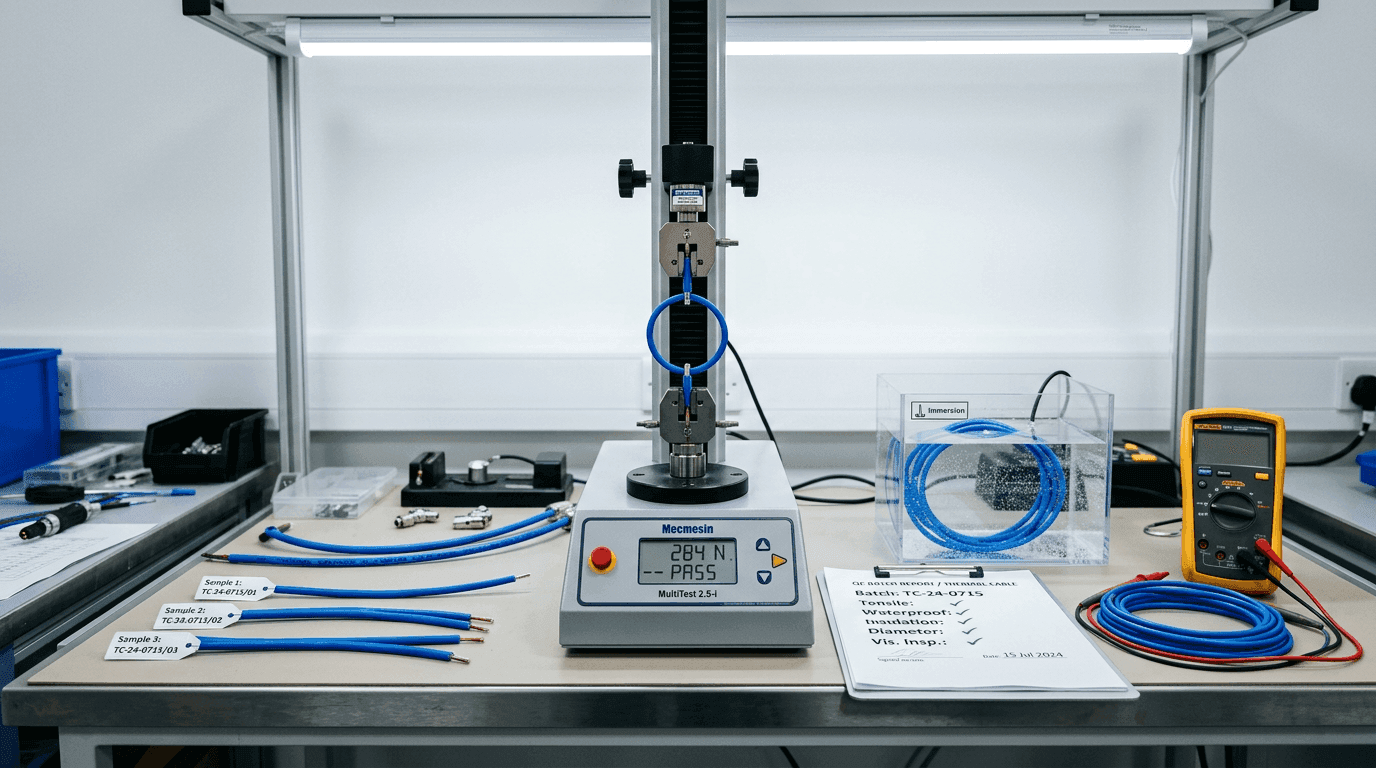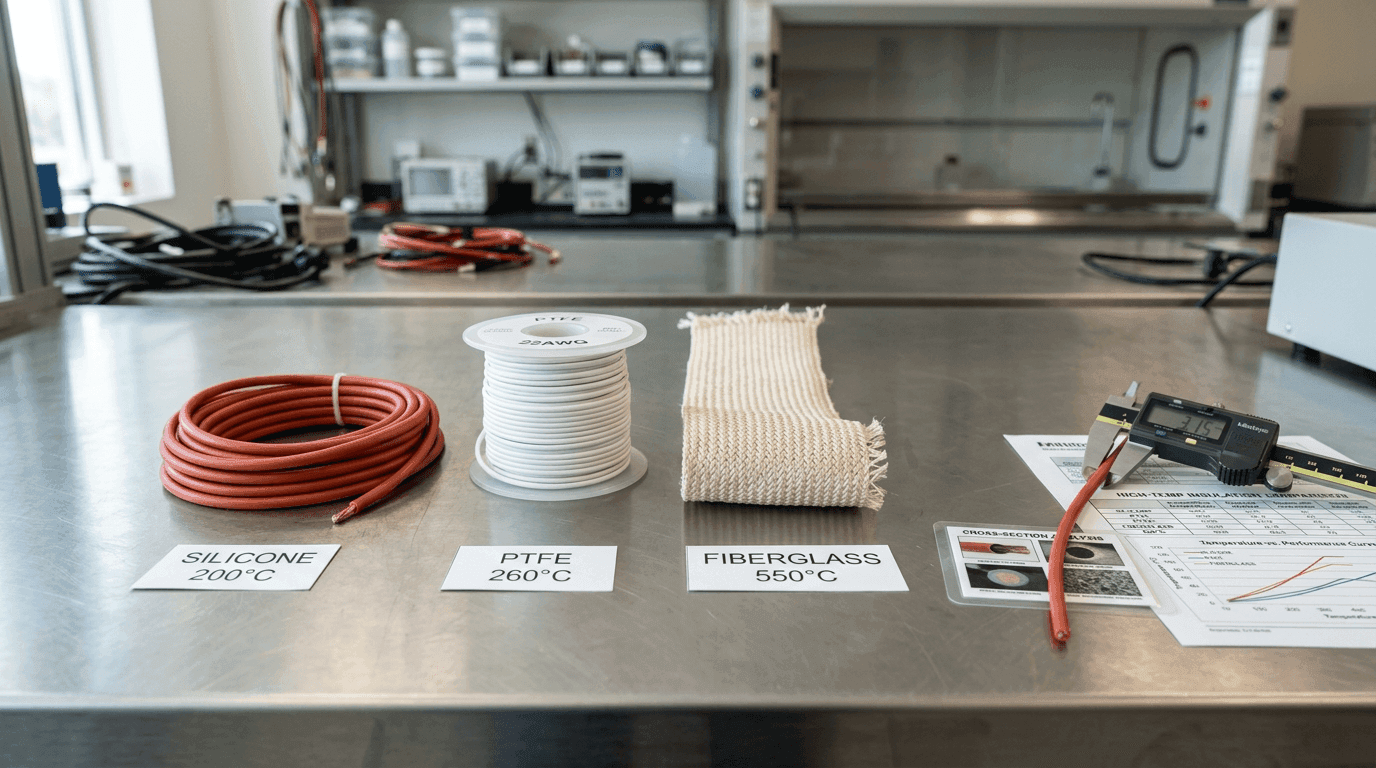
Three insulation families turn up on almost every thermal-cable spec sheet: silicone rubber, fluoropolymers (PTFE, FEP, PFA) and fiberglass braid. They look similar on a data sheet — all three will survive temperatures that destroy a PVC jacket — and that superficial similarity is where procurement mistakes start. The materials behave differently in fire, in flex, in solvents and, crucially, in the maintenance budget two years after installation.
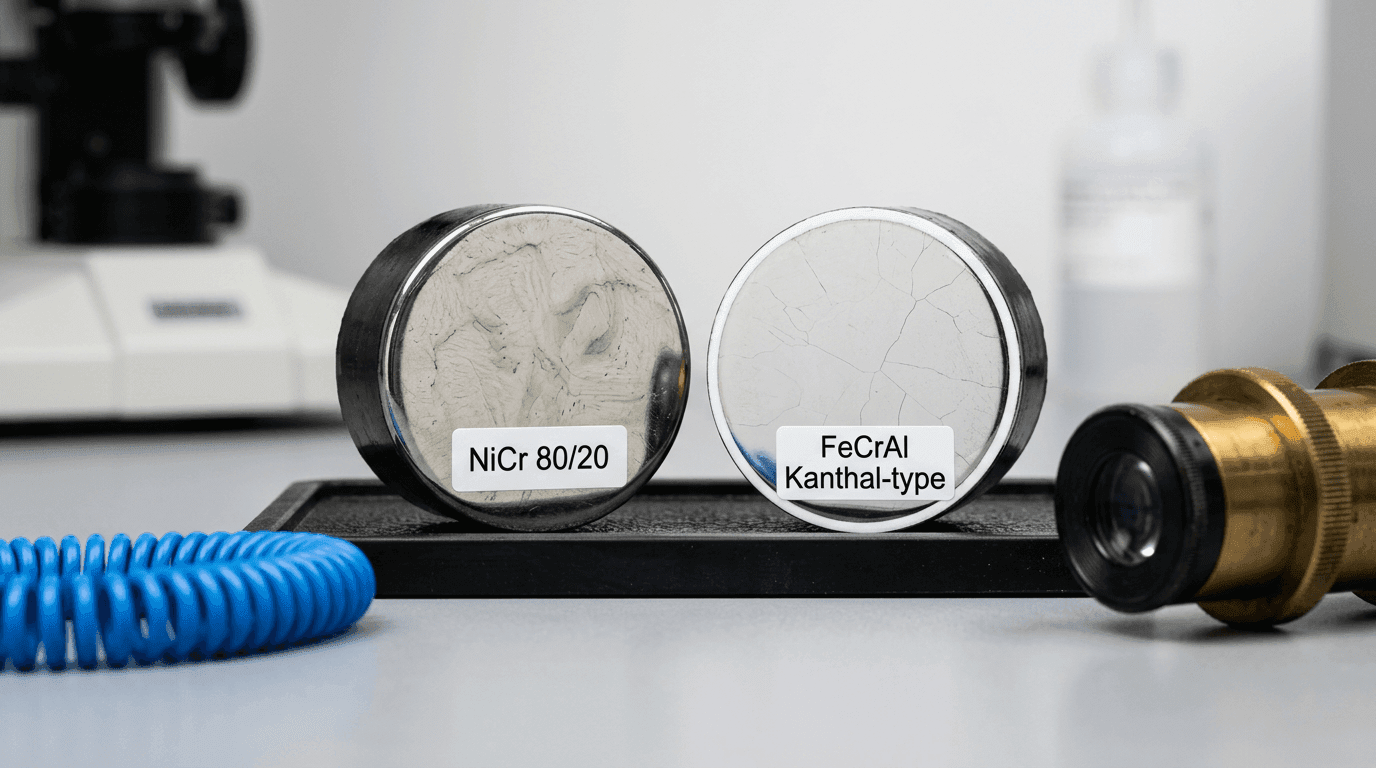
This note puts the three families side by side on the parameters that actually decide service life: ceiling temperature, chemical resistance, flex and fatigue, flame behaviour and delivered cost. It closes with a one-page pick-list by application so the decision doesn't hang on a single datapoint. The thermal-physics side of the same trade-off — how diffusivity and wall thickness set alarm response time — sits in engineering the response time of a thermosensitive cable; the conductor that lives inside this jacket is treated separately in our conductor alloy framework for thermal sensor cables.
1. Thirty-Second Summary
| Property | Silicone Rubber | PTFE / FEP / PFA | Fiberglass Braid |
|---|---|---|---|
| Continuous temperature | −60 to 200 °C | −200 to 260 °C (PTFE/PFA) | −70 to 550 °C (bare) |
| Short-excursion ceiling | ~300 °C (minutes) | ~310 °C (PTFE) | >800 °C |
| Dielectric strength | 20–25 kV/mm | 60–80 kV/mm | 5–10 kV/mm (porous) |
| Chemical resistance | Fair — swells in oils & aromatics | Excellent — inert to nearly everything | Depends on impregnation |
| Flex / fatigue life | Excellent — low modulus, high elongation | Good — but cold-flows under clamping | Poor — filaments abrade and shed |
| Flame / smoke | Self-extinguishing, leaves insulating ash | Non-flammable, LOI > 95% | Non-combustible glass, binder can burn |
| Indicative delivered cost | 1× (baseline) | 3–5× (PTFE), 2.5–4× (FEP) | 0.6–0.8× (bare braid) |
Those are starting numbers. Real specifications move 15–30% either side depending on grade, wall thickness and braid density. The rest of the note explains how to interpret the row that matters for your application.
2. Silicone Rubber — The Flexible Workhorse
Silicone elastomer (polydimethylsiloxane, usually peroxide- or platinum-cured) is the default jacket for appliance lead-wires, robotic cable, thermosensitive cables in home appliances and anything that needs to flex thousands of times without failure. Three reasons dominate the choice:
- Low modulus, high elongation. Typical Shore A 50–70, elongation at break 300–600%. A silicone-jacketed cable can be bent around a 4× OD radius a million times in a machine-tool drag chain without a visible crack.
- Low-temperature performance. Silicone stays rubbery to −60 °C and below. PTFE gets noticeably stiffer around −70 °C and shatters on impact by −100 °C.
- Safe burn products. When silicone burns it leaves a white silica ash that is still dielectrically useful. A silicone-jacketed cable in a fire will often maintain circuit continuity long enough for a fire-alarm system to operate — a property codified in IEC 60331 circuit-integrity tests.
What silicone is bad at is chemistry. Aromatic solvents (toluene, xylene), mineral oils and hot concentrated acids swell it, leach out silicone oils, or harden the surface. Long-term exposure to steam at > 150 °C causes reversion. If the cable is going anywhere near a fuel vapour, a hydraulic line or a solvent cleaning station, silicone is the wrong first choice. Cost-wise, silicone is the cheapest of the three when you need a true high-temperature polymer — typically 1× the baseline in this comparison.
3. PTFE, FEP and PFA — The Inert Family
Polytetrafluoroethylene (PTFE) and its melt-processable cousins FEP and PFA form the most chemically inert polymer class in production. The fluorine–carbon bond is among the strongest single bonds in organic chemistry; almost nothing attacks it below 260 °C. That alone explains why every semiconductor fab, every pharma clean-room, every offshore wellhead and every LHD loop inside a chemical plant is wired in a fluoropolymer thermal cable. The conductor alloy that pairs with that jacket is the upstream choice — see our Ni80Cr20 vs Kanthal A1 conductor alloy decision for which alloy holds resistance stability under chemical service.
The trade-offs to know:
- PTFE is paste-extruded and sintered. It is the toughest of the three, with the highest continuous rating (260 °C). It is not melt-processable, so wall thickness is limited to what a tape-wrap or paste-extrusion line can hold (typically 0.15–0.40 mm).
- FEP is melt-extruded, which means cheaper processing and thinner walls (down to 0.08 mm) but a lower ceiling (200 °C continuous). FEP is the usual choice when response speed matters more than raw temperature.
- PFA splits the difference — melt-processable like FEP, temperature rating of 260 °C, cleaner surface for semiconductor duty.
All three are essentially non-flammable (limiting oxygen index above 95%, versus 21% for air), but in a fire they can release small quantities of HF gas above ~400 °C. For plenum installations check the smoke density and acid-gas tests separately; "PTFE equals safe" is a simplification that the local AHJ will not accept.
Cost is the honest objection. A PTFE-jacketed thermal cable typically lands at 3–5× the delivered price of the same cable with a silicone jacket. FEP is a bit cheaper. When the cable will see steam, solvents, aggressive cleaning chemistry or more than 200 °C for the life of the plant, that premium is the cheapest insurance you will ever buy.
4. Fiberglass Braid — Raw Temperature, With Caveats
Bare E-glass fiberglass braid keeps its geometry up to around 550 °C continuously and survives brief excursions above 800 °C — numbers a polymer cannot touch. That is why fiberglass is the standard insulation on open coil elements in electric kilns, tube-furnace feed-throughs, thermocouple extension wires and high-end heating appliances. It is also the cheapest of the three if you leave the braid bare.
The caveats are why fiberglass is rarely used alone on a sensing cable:
- Porosity. A braid is not a continuous dielectric. Moisture, dust, solvent vapour and carbon residue can migrate through the weave and short the conductors. Dielectric strength of bare braid is 5–10 kV/mm versus 60–80 kV/mm for PTFE — and both figures are room-temperature values that decline as the cable heats, a temperature dependence covered in the dielectric behaviour versus temperature note.
- Abrasion. Glass filaments are hard but brittle. Repeated rubbing against a metal edge sheds fibres and progressively reduces wall thickness. A fiberglass lead-wire in a moving arm will not last; in a fixed installation inside a heater it will last decades.
- Irritation & handling. Installers need gloves and respiratory protection; bare-fibre airborne particles are a health hazard. Most OEM-facing suppliers specify an impregnated grade (silicone- or PTFE-treated fiberglass) partly for this reason.
In practice fiberglass shows up in two roles. As primary insulation on heating-element lead-wires, feed-throughs and appliance thermal fuses where the temperature is the priority and mechanical protection comes from the chassis. As a reinforcement layer braided over a silicone or PTFE core to add abrasion resistance without pushing the temperature ceiling up — the construction you see on oven gaskets, kettle lead-wires and high-end industrial heater tails.
5. Chemical & Moisture Attack — What Actually Fails First
Ceiling temperature is the parameter everyone checks. Chemistry is the one that kills the cable early. A short field guide:
| Environment | Silicone | PTFE/FEP/PFA | Fiberglass (impregnated) |
|---|---|---|---|
| Mineral oils, hydraulic fluid | Swells, leaches | OK | Silicone-impregnated fails; PTFE OK |
| Aromatic solvents (toluene) | Not recommended | OK | PTFE-impregnated only |
| Strong acids (H₂SO₄, HCl) | Attacked at > 80 °C | OK to 260 °C | PTFE-impregnated OK; bare glass attacked by HF only |
| Steam / superheated water | Reversion above 150 °C | OK | Binder can hydrolyse |
| Salt fog / coastal atmosphere | OK | OK | Moisture wicks through braid — avoid |
| Ozone / UV exposure | Excellent | Excellent | Glass OK; binder UV-sensitive |
Field rule: if the atmosphere is wet, do not spec bare fiberglass. If the atmosphere is solvent-heavy or acidic, do not spec plain silicone. Anywhere a PTFE-jacketed cable is affordable, it is the safe answer on chemistry.
6. Flex Life & Mechanical Fatigue
The number that matters for a moving cable is cycles to failure at a defined bend radius. Rough in-house numbers from our cable-endurance rig, 50 mm radius, full reverse bend, 60 cycles per minute:
- Silicone jacket, 3 mm OD: 5–10 million cycles before conductor damage. Sector winner for repetitive flex duty.
- PTFE jacket, 3 mm OD: 0.5–2 million cycles. Cold-flow under clamping at the bend point is the usual failure mode.
- Fiberglass braid over PTFE core: 0.2–1 million cycles. Fibre shedding raises the apparent OD and the braid loosens.
For fixed installation — a cable cable-tied to a tray and never moved — flex life does not matter, and the ranking collapses. But for any duty in a drag chain, robotic arm, articulating cover or appliance door, silicone wins and the gap is large.
7. Flame Survival & Circuit Integrity
In a fire, the question is not whether the insulation burns. The question is whether the cable continues to carry signal long enough for the life-safety system to act. On that test (IEC 60331, BS 6387 category CWZ, UL 2196):
- Silicone converts to a silica ash that retains dielectric properties; a silicone-glass composite can hold 30 minutes at 950 °C under flame with water spray and still pass insulation resistance.
- PTFE does not burn, but softens and drips out of a vertical flame above 400 °C — leaving the conductors exposed. PTFE-jacketed cable rarely meets CWZ alone; it is normally combined with a mica or fiberglass layer when fire-integrity is required.
- Fiberglass does not burn at all and is the classic fire-survival layer under every other insulation. A mica tape plus fiberglass reinforcement is the industry answer to the hardest circuit-integrity specs.
For life-safety loops a composite is typically the right answer — fire-protection thermal cables usually stack a mica-glass tape under a fluoropolymer or silicone jacket to hit both chemistry and fire-survival requirements.
8. Delivered Cost — Beyond the Data Sheet
Raw material cost is only part of the number on the invoice. The wall thickness that hits the dielectric target, the braid density that survives the install, the certification paperwork that lets the cable through procurement — all three drive cost more than the polymer price index.
Typical delivered pricing for a three-conductor, 18 AWG cable at 100 m order size:
- Silicone-jacketed: 1.0× baseline
- Silicone over fiberglass braid: 1.1–1.3×
- FEP extruded: 2.5–4× — thinnest wall, cleanest surface finish
- PTFE tape-wrap: 3–5× — highest temperature, widest chemical window
- Fiberglass braid only, no polymer: 0.6–0.8× — cheapest on paper, rarely fit-for-purpose on its own
The procurement mistake we see most often is comparing silicone and PTFE on price-per-metre and choosing silicone, then paying three times for jacket replacement over ten years. If the application is permanent, buy the material that lasts the plant life — not the one that looks cheap on an annual PO.
9. A One-Page Pick-List by Application
| Application | First Pick | Why |
|---|---|---|
| Home-appliance thermosensitive cable (kettles, ovens, dryers) | Silicone rubber | Flex, flame-safety, low cost. Chemistry is not an issue inside the appliance. |
| LHD loop in a chemical or petrochemical plant | PTFE or PFA over thermosensitive core | Solvent, acid and steam exposure. Silicone will not survive ten years; bare fiberglass wicks moisture. |
| Tunnel or data-centre LHD | Fluoropolymer jacket over mica-glass fire barrier | Circuit integrity in fire; inert to cleaning chemicals. |
| Industrial furnace / heater lead-wire | PTFE-impregnated fiberglass | Temperatures above 260 °C rule out polymer-only; impregnation stops moisture ingress. |
| Semiconductor / pharma clean-room sensing | PFA | Clean surface, inert, out-gassing qualified; silicone releases siloxanes. |
| Robotic drag-chain & articulating machine cable | Silicone | Flex cycles dominate; no chemical exposure. |
| Kiln & open-coil heater | Bare fiberglass braid | Temperatures far above polymer ceilings; protected by structure. |
| Subsea, cryogenic or arctic cable | Silicone (cold-flex) | PTFE goes brittle below −70 °C; fiberglass wicks water. |
10. Five Mistakes We See Repeatedly
- Choosing silicone for a solvent-heavy plant. The cable looks fine for a year, then the jacket cracks on every drip tray.
- Specifying bare fiberglass braid outdoors. Three rainy seasons later, the insulation resistance is lying on the floor.
- Treating PTFE as fire-safe on its own. It does not burn, but it drips. Fire-integrity loops need a mica or fiberglass companion.
- Under-specifying wall thickness on FEP. Melt-extruded thin walls save money but fail the first dielectric test after handling damage.
- Ignoring low-temperature duty. A cable that will see −40 °C in winter needs silicone, not PTFE — the 260 °C ceiling is irrelevant once the jacket shatters on a cold start.
11. Closing Thought
There is no universal winner — and that is the whole point. Silicone leads on flex and price. PTFE leads on chemistry and temperature. Fiberglass leads on raw heat and loses on everything a wet environment cares about. The correct question is not "which material is the strongest across every duty?" but "which combination survives the atmosphere, temperature, flex count and fire duty I will face for the next ten years?". The companion jacket material decision matrix extends the three families compared here to the full five — adding PVC and LSZH for the indoor and code-regulated routes that the three-material comparison above does not cover; the upstream cable-internal architecture decision the insulation choice slots inside — metal-core vs non-metal-core — is in our cross-section comparison of metal-core and non-metal-core architectures. If you want an outside opinion on an active specification, send the operating conditions to our engineering desk. We will come back with a material stack, a wall-thickness call-out and — if useful — a qualification sample (subject to availability and project review) against your specification.
FAQ — Silicone, PTFE & Fiberglass
Which insulation runs hottest — silicone, PTFE or fiberglass?
Raw fiberglass braid holds 450–550 °C continuously and survives brief excursions above 800 °C — higher than both silicone (200 °C) and PTFE (260 °C). But fiberglass alone is porous and mechanically fragile, so it is usually paired with a silicone or PTFE impregnation that pulls the practical ceiling back to the polymer's limit.
For chemical plants, should I pick silicone or PTFE?
PTFE or PFA. Silicone is not resistant to aromatic solvents, strong acids, or mineral oils — they swell or leach plasticisers out. PTFE is inert to virtually everything below 260 °C and is the default for chemical, petrochemical and semiconductor plants.
Is a silicone cable usually more flexible than a PTFE cable?
For repeated flexing at low cycle rates, yes — silicone's low modulus and high elongation give it excellent fatigue life in robotic cables and appliance harnesses. PTFE is stiffer and can cold-flow under clamping pressure. In sub-zero service silicone is the clearer choice because PTFE embrittles below roughly −70 °C.
Where does fiberglass-only insulation still make sense?
Open industrial heating elements, tube-furnace feed-throughs and appliance lead-wires where temperatures exceed 300 °C and mechanical protection is provided by the surrounding structure. Fiberglass braid is also the normal reinforcement layer over silicone or PTFE where abrasion resistance is a priority.