The conductor inside a thermal sensor cable is quiet until the day it has to prove the whole system works. It may sit for 15–25 years in a tunnel, cable tray, motor slot or appliance enclosure before the thermosensitive compound collapses and the loop signals alarm. During that time the conductor has to hold resistance stability, ductility, termination integrity and corrosion resistance while the jacket fights the outside world.
Below is the six-factor framework we use when choosing conductor alloy for thermal sensor cables — NiCr, FeCrAl and nickel superalloy compared on the properties that matter in LHD and TS cable duty. Heating-element examples appear only as boundary cases; the decision target here is sensing cable reliability.
The Three Alloy Families Inside a Sensing Cable
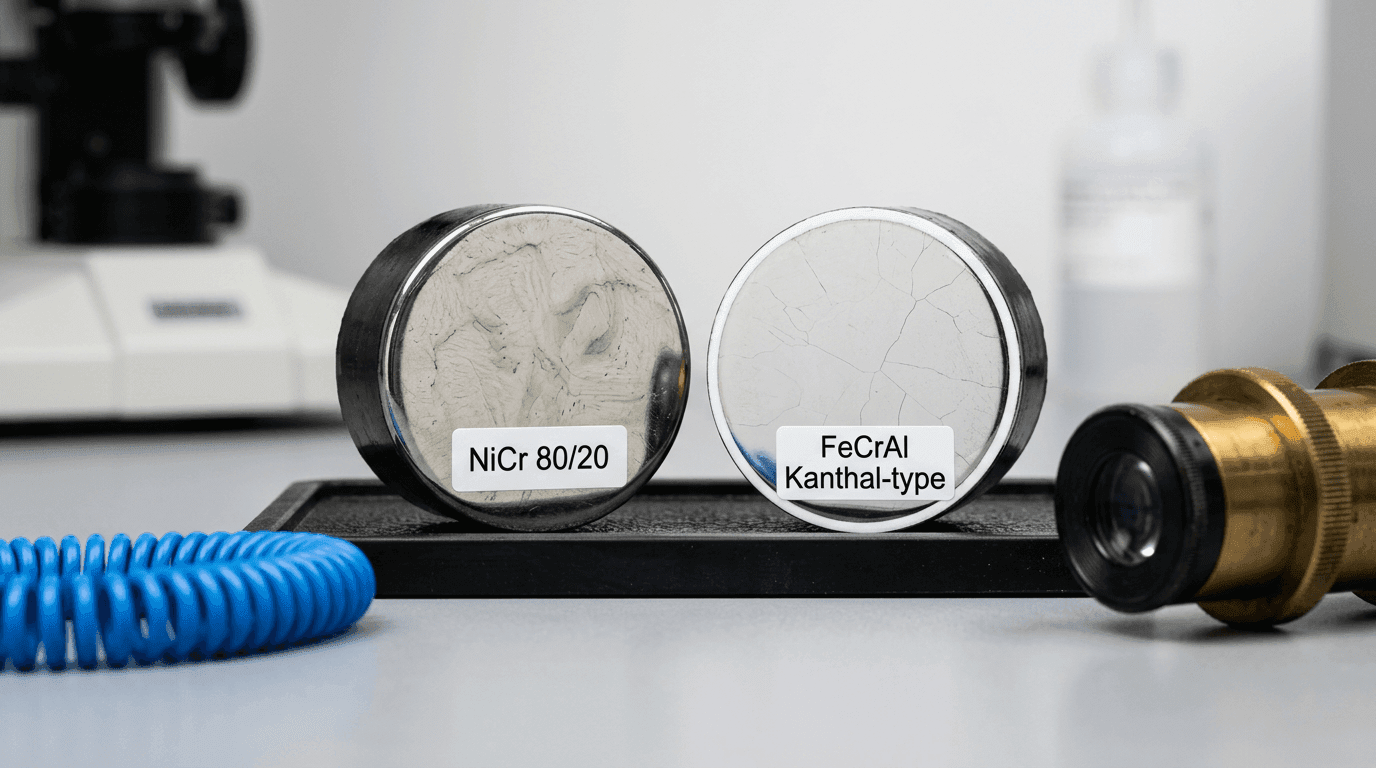
1. Nichrome (Ni80Cr20, Ni60Cr15). The default conductor for fire-protection LHD loops, appliance TS cut-off cables and motor-slot thermal cables. Resistivity ~1.09 μΩ·m, low long-term drift in dry oxidising air, protected by a self-healing Cr₂O₃ layer that survives the slow chloride and humidity ingress every cable jacket eventually allows. The conductor never reaches its 1,150 °C metallurgical ceiling in a sensing role — what matters is decade-scale resistance stability, ductility through thermal-mechanical cycling, and the well-characterised TCR that addressable fire panels read as "loop healthy". The head-to-head between Nichrome and the FeCrAl default (Kanthal A1) is the subject of our Ni80Cr20 vs Kanthal A1 conductor alloy decision.
2. FeCrAl-cored (Kanthal A1, AF). The specialist conductor for sensor cables that have to live in sulfur-bearing flue gas, refinery boiler-house atmospheres, sour-gas processing or coastal salt-aerosol routes. The Al₂O₃ skin that hurts heater spec life on cyclic duty is exactly the property that protects an LHD conductor against years of slow sulfidation. Trade-offs: harder to terminate (it work-hardens on bending), poorer in genuinely reducing atmospheres, and cost-attractive only when the atmosphere case justifies it.
3. Nickel-based superalloys (Inconel 600/601, Haynes 214). Premium and rare in sensor cables. Specified only when the cable platform itself has to survive vacuum, hydrogen, carburising or nitriding atmospheres — process plant under-floor sensors, semiconductor tool monitoring, aerospace test stands. Superior creep and very stable termination joints justify the cost where neither NiCr nor FeCrAl can hold resistance baseline over the design life.
Side-by-Side Card — Sensing-Cable Properties That Matter
The card below replaces the heater datasheet (1,150 °C / 1,400 °C ceilings) with the properties that decide whether a sensor cable will still meet panel specification at year 15. The conductor in a thermosensitive or LHD cable rarely sees more than 200 °C in normal life — it is judged on stability, drift and termination behaviour.
| Property | Nichrome (Ni80Cr20) | FeCrAl (Kanthal A1) | Nickel Superalloy |
|---|---|---|---|
| Resistivity (20 °C) | 1.09 μΩ·m | 1.39–1.45 μΩ·m | 1.08–1.13 μΩ·m |
| TCR consistency (panel-friendly) | Excellent — calibrated for addressable LHD | Good — broader part-to-part spread | Excellent |
| Long-term resistance drift (20 yr cable life) | <0.5% in clean dry routes | <1% in sulfur/saline routes; higher in reducing atmospheres | <0.3% in vacuum/reducing service |
| Behaviour after chloride / humidity ingress | Cr₂O₃ self-heals slow attack | Al₂O₃ resists sulfur but suffers in chloride condensate | Strongest of the three in this comparison; very slow attack |
| Ductility for crimp/spring termination | Good — bends and crimps cleanly | Poor after aging — work-hardens, brittle at terminations | Very good |
| Reducing atmosphere tolerance | Good | Poor | Excellent |
| Sulfur / sour-gas tolerance | Moderate | Excellent | Good |
| Relative cost per loop-metre | Medium (industry default) | Lower per-kg, higher per-loop after termination loss | High — reserved for atmosphere case |
The Six-Factor Framework for Sensor Cable Conductors
Picking the alloy family is step one; the conductor still has to match the cable's panel topology, jacket, route chemistry and design service life. Six factors close that gap.
- Cable route temperature and activation point. The conductor sits at the cable's normal route temperature for 99% of its life — typically 20–120 °C. The activation compound, not the conductor, decides the trip; the conductor only needs a stable, well-characterised resistance baseline at that route temperature. NiCr is the default because its resistance-vs-temperature curve is what fire panels are calibrated against; FeCrAl is a deliberate choice driven by atmosphere, not by temperature.
- Atmosphere reaching the conductor through the jacket. No jacket is hermetic over 15–20 years. Chloride from coastal air, sulfur from combustion plants, ammonia from refrigeration leaks and humidity from off-cycle dew all reach the conductor eventually. Match the alloy to what the jacket cannot block, not to clean-air datasheet conditions. For atmosphere-driven decisions, run our pre-specification atmosphere audit against the cable route before ordering.
- Resistivity and loop budget. Long LHD runs (200–500 m) need every milliohm of headroom they can find on the panel's loop budget. NiCr's lower resistivity (1.09 μΩ·m vs FeCrAl's 1.45 μΩ·m) leaves room for longer loops at the same conductor gauge — the inverse of the heater argument, where higher resistivity is preferred. Document the loop length and panel input resistance before locking the conductor.
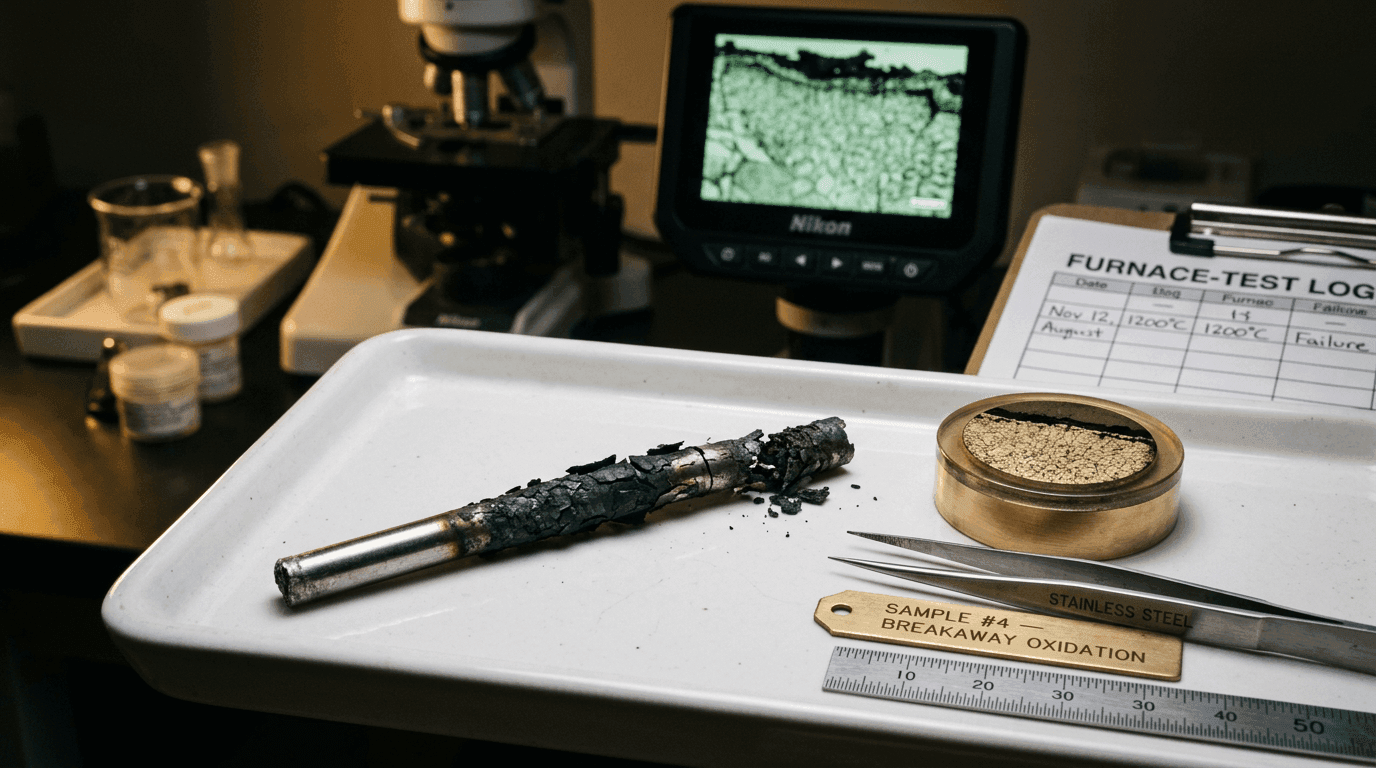
- Long-term drift and panel calibration. Addressable LHD panels read loop resistance as "healthy" within a tight tolerance. A conductor that drifts more than ~1% over 10 years will start producing fault flags that look like real cable degradation. Specify drift class on the conductor mill certificate; reject lots that did not pass the long-soak qualification at the conductor mill. The five oxidation mechanisms behind premature drift — and how to read them on a returned sample — are catalogued in why thermal wire burns out early — the metallurgy of rapid oxidation.
- Termination integrity. Most sensor-cable failures localise at the gland, splice or end-of-line resistor — not in the middle of the run. NiCr crimps and springs cleanly; FeCrAl needs careful annealing and a transition ferrule; superalloys take any termination but cost the most. Match the termination method to the conductor before signing the spec, and confirm with a pull-test on the production batch.
- Gauge and stranding. Choose the gauge that gives the panel a usable resistance per metre at the design loop length, then pick stranding for flexibility (single-strand for fixed installation, multi-strand for routes with vibration or service-loop flex). Surface watt load is irrelevant here — the conductor is not driven to temperature.
Application Playbook for Sensor Cable Duty
| Sensor Cable Application | Recommended Conductor | Key Reason |
|---|---|---|
| Fire-protection LHD loop, indoor plant | Nichrome Ni80Cr20 | Calibrated TCR for addressable panels, low long-term drift in dry atmospheres |
| Coastal LHD loop or salt-aerosol exposure | FeCrAl-cored with sealed jacket | Al2O3 skin resists slow sulfidation through compromised jackets |
| Petrochemical / sour-gas LHD route | FeCrAl (Kanthal APM equivalent) | Survives H2S ingress that strips nickel-based conductors |
| Appliance TS cut-off (motor / heater enclosure) | Nichrome Ni80Cr20 | Stable resistance under repeated thermal cycling, easy crimp termination |
| Battery thermal monitoring (cell pack, BMS) | Nichrome Ni60Cr15 or Ni80Cr20 | Low TCR drift over thousands of charge cycles, fine-gauge crimp tolerant |
| Vacuum or hydrogen-process tool sensing | Nickel superalloy (Inconel 601) | Only family that resists reducing atmosphere drift over 10+ years |
| Tunnel and metro LHD routes (LSZH jacket) | Nichrome Ni80Cr20 | Long-loop budget benefits from low resistivity; conductor matches LSZH crimp glands |
Three Conductor-Spec Mistakes We See Repeatedly
- Specifying the conductor on heater logic. Treating "FeCrAl handles 1,400 °C" or "FeCrAl resists sulfur" as the headline argument inside a sensor cable. The conductor is at 25 °C in a coastal cable tray — the right question is which alloy holds resistance baseline through chloride condensate over 15 years, not which one survives 1,400 °C.
- Ignoring termination physics. A NiCr-spec cable retrofitted with a FeCrAl-cored conductor often fails first at the EOLR or panel input. FeCrAl work-hardens on bending; the spring-tension joint that worked for ten years on NiCr loosens within months on FeCrAl unless the gland and ferrule are redesigned. Match the conductor to the termination method, not just the atmosphere.
- Buying on $/kg instead of $/loop-life. FeCrAl-cored conductor is cheaper per kilogram, but the saving evaporates if the cable has to be re-glanded twice in the design life or if the panel has to be re-calibrated for a different TCR. The correct cost metric is total cost per metre of installed loop over the asset's service life, not raw material price.
Why Cable Conductors Are Not Heater Elements
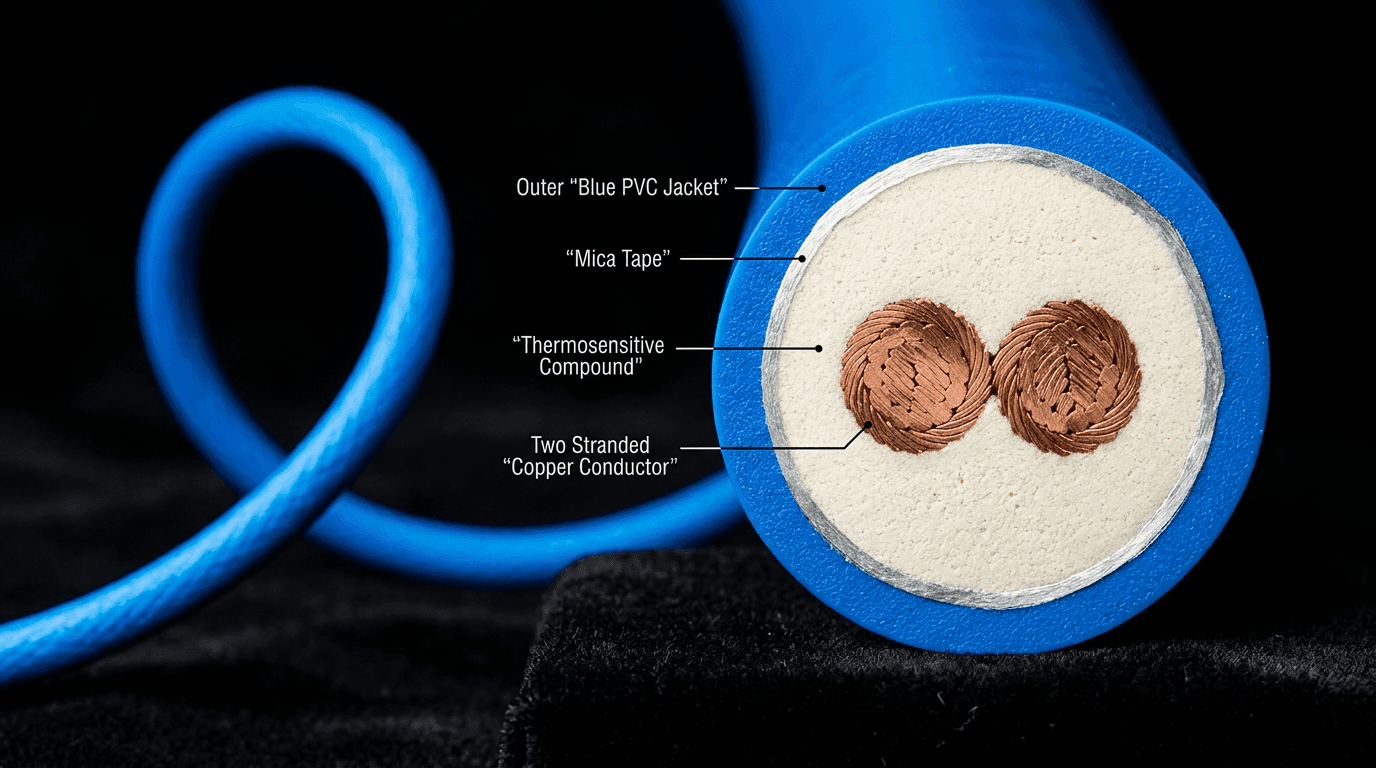
Inside a thermal sensor cable the resistance wire is not a heater — it is the sensing element. Two wires sit across a thermosensitive compound; at 68, 88 or 105 °C the compound softens, the pair contacts, and the loop resistance collapses to zero. That is the alarm.
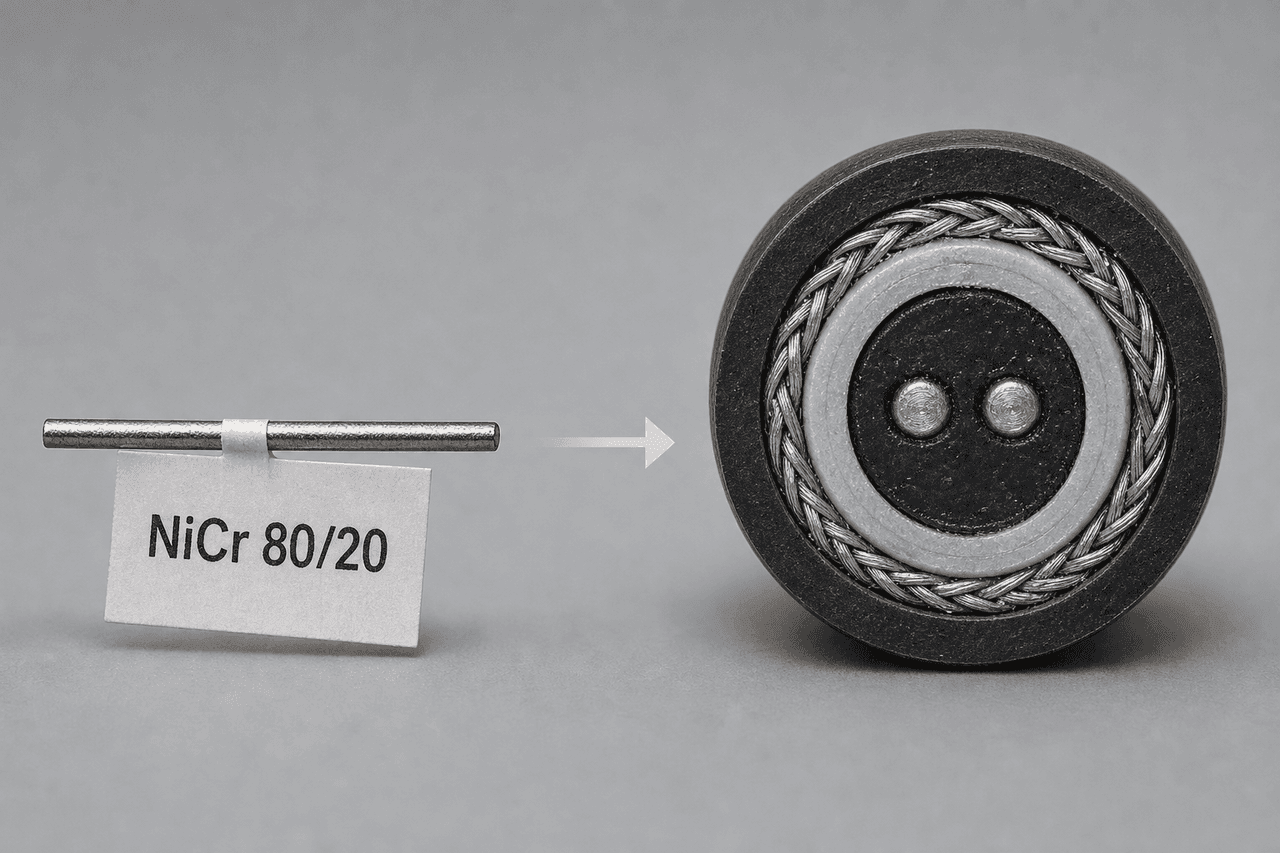
For this duty the selection axes flip: long-term resistance stability, internal corrosion resistance inside a sealed jacket for 15–20 years, uniform spring tension along the run, and a well-characterised TCR for digital addressable panels. This is why serious thermal sensor cable manufacturers specify Ni80Cr20 resistance wire as the default LHD conductor. Decades of stability, not cents per metre, is the KPI. If your project actually needs the finished sensing cable rather than bare wire, see our LHD Series datasheet for fire-protection loops or the TS Series for OEM and appliance cut-off — both built on Ni80Cr20 conductors specified to the principles above.
Working With Our Desk
Specifying a new fire-detection loop, appliance cut-off cable or heater-adjacent thermal alarm? Send us the requirement — cable route, activation point, atmosphere, jacket constraints and panel topology — and we'll come back with a conductor alloy, jacket recommendation, batch-test requirements and validation sample (subject to availability and project review).
FAQ — Conductor Alloy Framework
Why is NiCr usually the default conductor alloy in thermal sensor cable?
NiCr (especially Ni80Cr20) is usually the default because LHD and thermosensitive cables care more about long-term resistance stability, ductility after installation bends, corrosion resistance inside a jacket and predictable TCR than peak temperature. The cable normally operates far below the alloy's maximum temperature; drift and termination reliability decide service life.
When does FeCrAl make sense inside a thermal sensor cable?
FeCrAl makes sense in a narrower set of cable projects: chronic sulfur or H2S exposure, cost-sensitive indoor runs where the mechanical envelope is gentle, or specialty high-temperature sensing where its alumina scale is useful. It is not the default because aged FeCrAl is more brittle and can drift more in resistance-based detection loops.
What conductor property matters most for LHD loop accuracy?
Long-term resistance stability matters most. A fusible LHD cable may sit in the field for 15 to 25 years before it ever sees an alarm event, and analog panels can use loop resistance to infer location. If the conductor drifts from corrosion, thermal aging or termination instability, the panel reading can move even though the cable looks healthy from the outside.
How does the cable jacket affect conductor-alloy choice?
The jacket decides what reaches the conductor over time. PVC or LSZH is enough for clean indoor service; silicone handles high ambient but lets more vapour through than fluoropolymer; PTFE/FEP protects the conductor from chemical and oil-mist environments. A premium alloy inside the wrong jacket still fails, so conductor and jacket are specified as a pair.
Should conductor alloy be chosen by peak temperature?
No. Peak temperature is usually not the limiting factor in thermal sensor cable because the cable is not a powered heating element. Choose the alloy by resistance stability, atmosphere compatibility, installation bend fatigue, termination method and the panel's sensing topology. Peak activation temperature only enters after those service-life variables are understood.
How is this framework different from the NiCr vs FeCrAl deep-dive?
This page is the broad framework: what variables decide conductor alloy for LHD and thermosensitive cable duty. The NiCr vs FeCrAl article is the deep comparison between two alloy families. Use this framework to decide which variables matter on your project; use the comparison article when the choice has narrowed to Ni80Cr20 versus Kanthal-type FeCrAl.