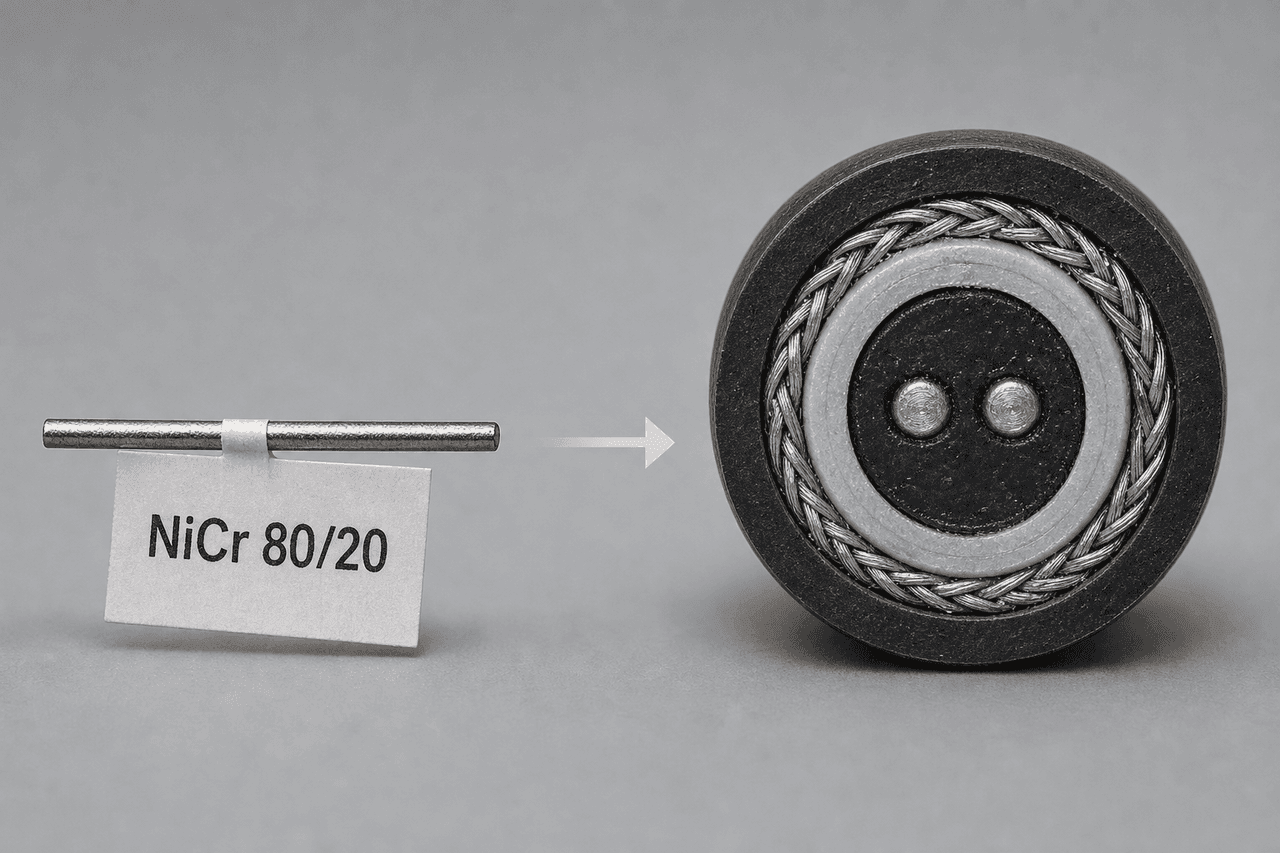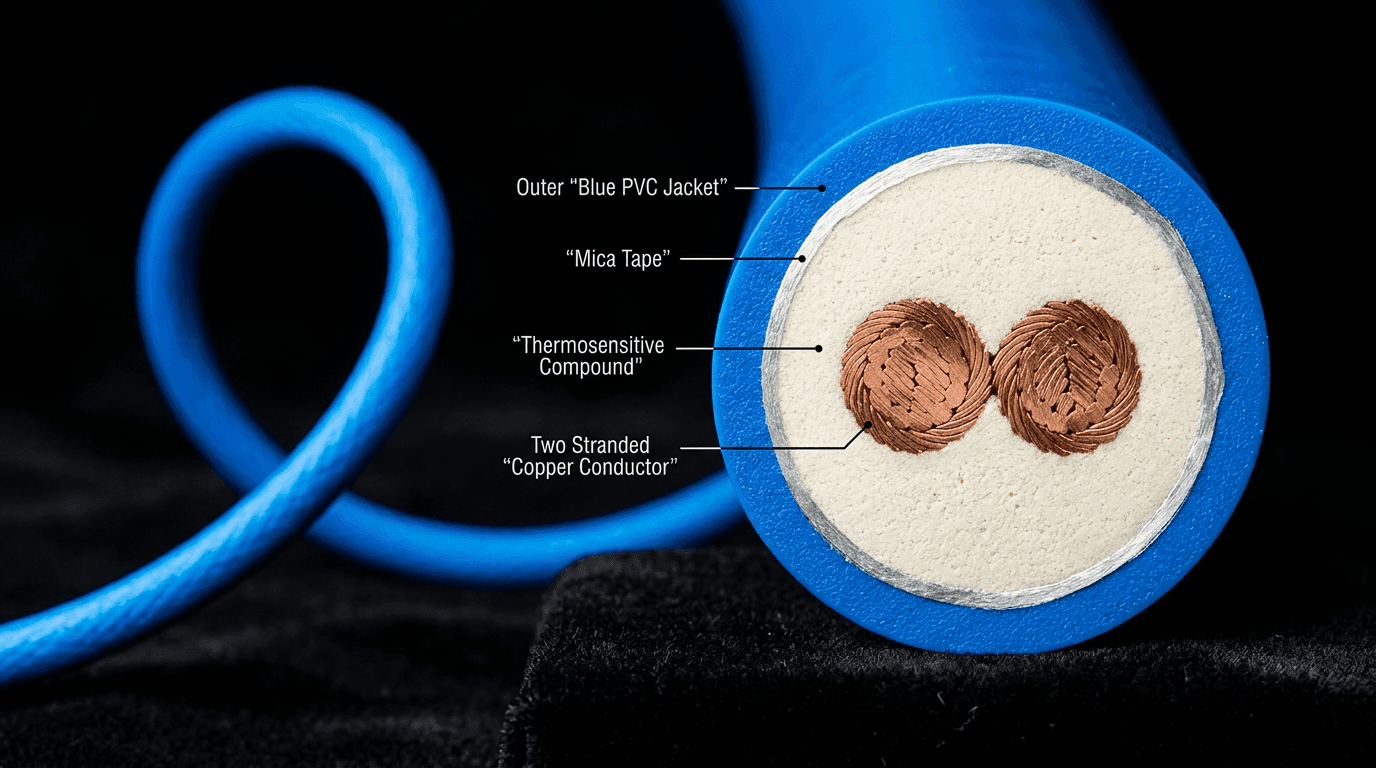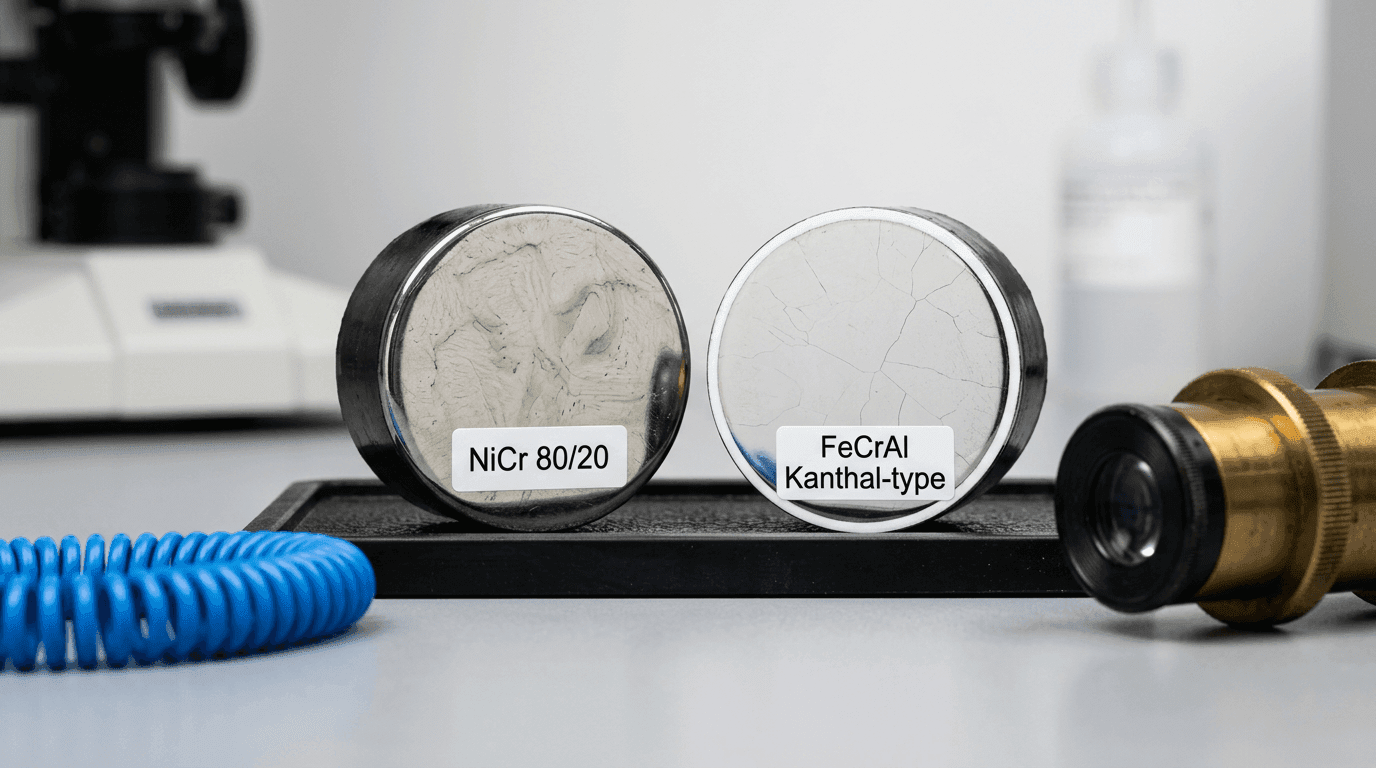
The most consequential metallurgy call on a thermal sensor cable spec sheet sits two layers in from the jacket. Under the thermosensitive compound, twin conductors carry the loop signal. They are most commonly drawn from one of two alloy families — nickel-chromium (Ni80Cr20, sold as Nichrome) or iron-chromium-aluminium (Kanthal A1, a FeCrAl variant). Datasheets list the two as interchangeable. In a real Ni80Cr20 vs Kanthal A1 thermal sensor cable decision, they are not.
The Short Answer
- Specify Ni80Cr20 on roughly nine out of ten thermal sensor cable and LHD projects — fire protection, tunnels, warehouses, non-H₂S chemical plants, marine, infrastructure, appliance cut-off, and any panel using resistance-based zone location.
- Reach for Kanthal A1 in three narrow cases: chronic H₂S exposure, specialty >300 °C activation cables, or large cost-critical installations with mild indoor atmosphere and a short expected service life.
The Two Alloy Families
NiCr and FeCrAl are the two production answers to a wider question — what alloy framework should a thermal sensor cable conductor sit inside in the first place? Our conductor alloy framework for thermal sensor cables covers that upstream framing (NiCr, FeCrAl and nickel superalloy compared on resistance stability, atmosphere compatibility, drift, termination and service life). The note in front of you is the head-to-head between the two production defaults.
Ni80Cr20 is built on a nickel matrix with ~20% Cr. The protective layer is a thin, dense, self-healing Cr₂O₃ skin that tolerates humidity and chloride and stays dimensionally stable for decades. The austenitic (FCC) microstructure keeps aged wire ductile — it still takes a tight bend without cracking. Thriftier Ni60Cr15 (60% Ni, balance Fe) lives in cost-critical projects below ~900 °C.
Kanthal A1 (≈22% Cr, 5.8% Al, balance Fe) trades nickel for iron. An Al₂O₃ layer resists sulfur better than Cr₂O₃ and survives 1,400 °C continuously — which is why FeCrAl dominates kiln heating-element duty. The trade-offs are real: after thermal aging the wire suffers intergranular embrittlement, the Al₂O₃ layer disintegrates in reducing atmospheres (H₂, cracked ammonia, CO), and the ferritic (BCC) structure is more creep-prone than austenitic nickel alloys.
Composition Card
The behaviour differences trace straight back to what is in the wire:
| Element / Property | NiCr — Ni80Cr20 | FeCrAl — Kanthal A1 |
|---|---|---|
| Nickel (Ni) | 78–80% | 0% (nil) |
| Chromium (Cr) | 19–21% | 20–23% |
| Aluminum (Al) | 0–0.5% (trace) | 5.5–6.0% |
| Iron (Fe) | <1% (balance) | ~72% (balance) |
| Silicon (Si) / Mn | 0.5–1.5% | <0.7% |
| Protective Oxide | Cr₂O₃ | Al₂O₃ |
| Crystal Structure | Austenitic (FCC) | Ferritic (BCC) |
| Melting Point | 1,400 °C | 1,500 °C |
The Three Numbers That Actually Matter
A thermal sensor cable is not a heating element. What matters is the precision and stability of the loop signal over 15–25 years.
Resistivity. Ni80Cr20 = 1.09 μΩ·m at 20 °C; Kanthal A1 = 1.45 μΩ·m (~33% higher). Both are workable — the panel is designed around a defined end-of-line resistance and the conductor just shifts the constant. It only becomes the decider when drum size forces a thinner FeCrAl conductor, which cascades into everything else.
TCR (temperature coefficient of resistance). Ni80Cr20 sits at ~85–110 ppm/°C, highly linear from 0–300 °C. Kanthal A1 sits at ~50–100 ppm/°C but loses linearity above 150 °C and shows hysteresis. Linearity beats magnitude in sensing duty: Ni80Cr20 gives analog LHD panels sub-metre zone accuracy, while aged Kanthal A1 can shift a reported hotspot by several metres — unacceptable in a 600 m tunnel run.
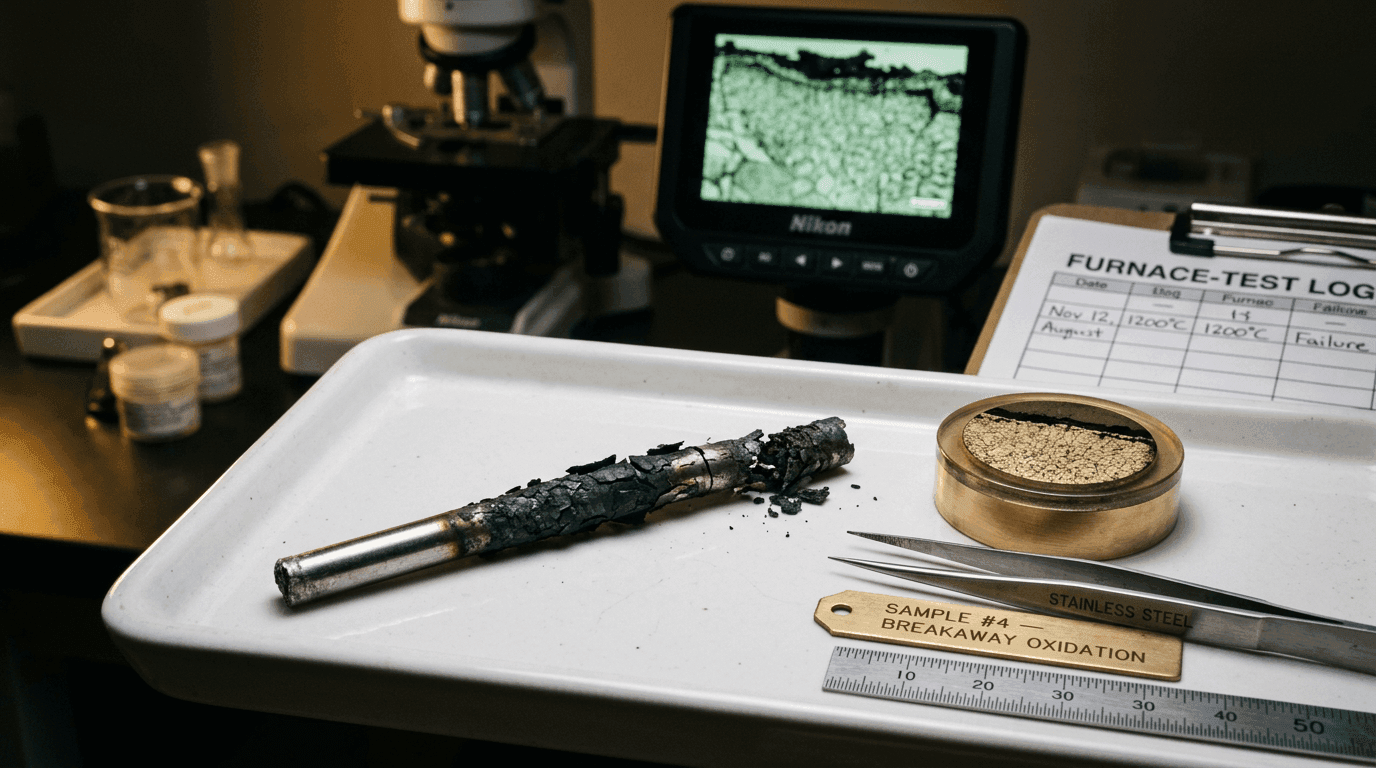
Long-term drift. Ni80Cr20 drift stays under 2% over 20 years in normal ambient — the Cr₂O₃ layer is chemically stable. Kanthal A1 drifts 3–7% over 10–15 years, driven by Al₂O₃ thickening, grain coarsening and trace iron migration. Humid or salt-laden service accelerates the curve. The five oxidation mechanisms behind that drift — and how they appear on a returned sample — are catalogued in why thermal wire burns out early — the metallurgy of rapid oxidation.
Mechanical & Atmosphere Behaviour
A thermal sensor cable is not pampered in service. The conductor has to survive pulling, bending, acid mist and condensate without breaking or drifting out of spec.
| Property | NiCr (Ni80Cr20) | FeCrAl (Kanthal A1) |
|---|---|---|
| Continuous Temperature | 1,150 °C (2,100 °F) | 1,400 °C (2,550 °F) |
| Density | 8.4 g/cm³ | 7.1 g/cm³ |
| Tensile Strength (annealed) | 650–750 MPa | 680–780 MPa |
| Elongation at Break | 30–40% | 20–28% |
| Ductility After Aging | Good — still bendable | Poor — brittle, may crack |
| Oxidation Resistance | Excellent (Cr₂O₃) | Excellent (Al₂O₃) |
| Sulfur / H₂S Resistance | Moderate | Excellent |
| Chloride / Salt Spray | Good | Moderate |
| Reducing Atmosphere (H₂, CO) | Good | Poor |
| Humidity / Marine Environments | Excellent | Moderate (pitting risk) |
| Flex / Fatigue Life | High | Lower, declines with age |
| Weldability / Soldering | Easy (standard fluxes) | Difficult (Al₂O₃ barrier) |
| Magnetic Behavior | Non-magnetic | Weakly magnetic |
Two rows deserve extra weight. Termination: Ni80Cr20 takes standard rosin solder fluxes; Kanthal A1's insulating Al₂O₃ skin requires silver brazing or active flux, and field splices fail more often. Post-aging ductility: aged Ni80Cr20 still takes a 3× wire-diameter bend; aged Kanthal A1 can fracture at the same radius, creating an invisible open-circuit that surfaces weeks later as a phantom zone fault.
Total Cost of Ownership
Kanthal A1 is 40–55% cheaper per kg than Ni80Cr20 — no nickel in the mix. That advantage collapses once you walk it through to the finished cable and the 20-year horizon:
| Cost Component | NiCr Version | FeCrAl Version | Delta |
|---|---|---|---|
| Conductor alloy (raw) | 100% | 40–55% | −45% |
| Wire drawing / anneal | 100% | 95% | −5% |
| Thermosensitive insulation | 100% | 100% | 0% |
| Outer jacket + reinforcement | 100% | 100% | 0% |
| Termination / splice kits | 100% | 120% (harder to terminate) | +20% |
| Certification / testing | 100% | 100–110% | +0–10% |
| Finished cable cost | 100% | 88–93% | −7 to −12% |
| Total cost of ownership (20 yr) | 100% | 110–130% (earlier replacement + rework) | +10–30% |
A 50% raw-material saving collapses to under 12% at the finished-cable level once termination, certification and the rest of the BOM are included. Layer on the higher long-term drift and shorter practical service life, and FeCrAl routinely costs more on a 20-year TCO basis — even when it was the cheaper line on the quote. See our note on choosing the right thermal sensor cable.
Certification Bias
Regulated markets quietly encode alloy preferences. UL 521 requires <5% resistance drift over accelerated aging (NiCr passes easily, FeCrAl needs tight control). EN 54-28, FM 3210 and LPCB/VdS tolerances all favour stable NiCr conductors. A cable destined for multiple regulatory regions is lower-risk with a Ni80Cr20 conductor — re-qualification failures between jurisdictions are rare on Ni80Cr20 and not uncommon on FeCrAl.
Decision Matrix — Application to Alloy
How to Verify What's Inside a Delivered Cable
Not every supplier tells the truth about the conductor. Four field-practical checks: a neodymium magnet distinguishes ferritic FeCrAl from non-magnetic NiCr; density is 8.4 g/cm³ (NiCr) vs 7.1 g/cm³ (FeCrAl); resistance-per-metre reads ~33% higher on FeCrAl for the same gauge; XRF or spark spectroscopy gives definitive elemental analysis in minutes.
For bulk orders, ask for a mill certificate naming grade, composition, resistivity and TCR. A serious factory ships it by default as part of the nine-parameter QC pass.
Closing Thought
Ni80Cr20 and Kanthal A1 are both excellent alloys, engineered for different missions. Kanthal was built to heat industrial kilns to 1,400 °C; Ni80Cr20 was built to sense subtle resistance changes and hold calibration for decades. A thermal sensor cable sits firmly in the second mission. The upstream architecture decision that determines whether a conductor alloy is even on the table sits in our cross-section comparison of metal-core and non-metal-core architectures; non-metal-core cable has no continuous conductor pair and so does not raise the alloy question at all.
Specified correctly, the conductor is invisible — the cable simply works exactly as the commissioning engineer calibrated it. Specified incorrectly, the next decade becomes a slow accumulation of drift and phantom alarms. Need a second opinion on an existing spec, or help drafting a new one? Message the engineering desk — we'll come back with a recommendation that will outlast the installation.
FAQ — NiCr vs FeCrAl Conductor Decision
What is the main difference between NiCr and FeCrAl alloys in thermal cables?
NiCr (nickel-chromium, e.g. Ni80Cr20) is a nickel-based alloy with excellent ductility, stable resistivity and superior corrosion resistance, making it the preferred conductor material for most thermal sensor cables and linear heat detection cables. FeCrAl (iron-chromium-aluminum, e.g. Kanthal A1) is an iron-based alloy with a higher temperature ceiling (up to 1,400 °C) and ~30% higher resistivity, but it is brittler after thermal aging and more sensitive to reducing atmospheres. In thermal cable applications, NiCr dominates because long-term resistance stability and flex-fatigue life matter more than peak temperature.
Why is NiCr preferred over FeCrAl as a thermal cable conductor?
Thermal sensor cables typically operate below 250 °C, well within the capability of both alloys. At that range, FeCrAl's higher temperature ceiling offers no practical benefit, while NiCr's advantages — better ductility, lower and more linear temperature coefficient of resistance (TCR), superior corrosion resistance, and stable long-term resistivity — directly improve detection accuracy and cable service life. NiCr also tolerates repeated bending during installation, while aged FeCrAl can crack.
Can FeCrAl be used inside a linear heat detection (LHD) cable?
Yes, FeCrAl can technically function as an LHD cable conductor and is sometimes chosen for cost reasons — especially in large installations where raw material cost dominates. However, FeCrAl's intergranular embrittlement after thermal cycling and its sensitivity to reducing atmospheres make it less reliable in petrochemical, tunnel, and outdoor applications. For analog LHD systems that use resistance measurement to locate the fire, FeCrAl's larger TCR drift can also reduce positioning accuracy.
What are the typical compositions of NiCr and FeCrAl alloys used in thermal cables?
For thermal cable conductors, the most common NiCr grades are Ni80Cr20 (80% Ni, 20% Cr) and Ni60Cr15 (60% Ni, 15% Cr, balance Fe). Typical FeCrAl grades are Kanthal A1 (~22% Cr, 5.8% Al, balance Fe) and Kanthal D (~22% Cr, 4.8% Al). For sensing applications where long-term resistance stability matters most, Ni80Cr20 is by far the most widely specified.
How does the temperature coefficient of resistance (TCR) differ between NiCr and FeCrAl?
NiCr alloys have a low and highly linear TCR (~85–110 ppm/°C for Ni80Cr20), which makes them ideal for analog LHD systems that rely on resistance-to-temperature mapping. FeCrAl alloys have a higher TCR (~50–100 ppm/°C for Kanthal A1, but less linear at elevated temperatures) and show greater drift after prolonged aging, which can cause false-zone errors in resistance-based detection systems.
Is FeCrAl cheaper than NiCr for thermal cables?
Yes, FeCrAl is typically 40–60% cheaper than NiCr per kilogram because it contains no nickel. However, the conductor accounts for only a small fraction of the total cost of a finished thermal sensor cable. Once you factor in thermosensitive insulation, jacket material, reinforcement, certification, and installation, the delta between NiCr and FeCrAl cable versions is usually less than 10–15%. Most engineers choose NiCr because the reliability premium is worth the modest cost increase.