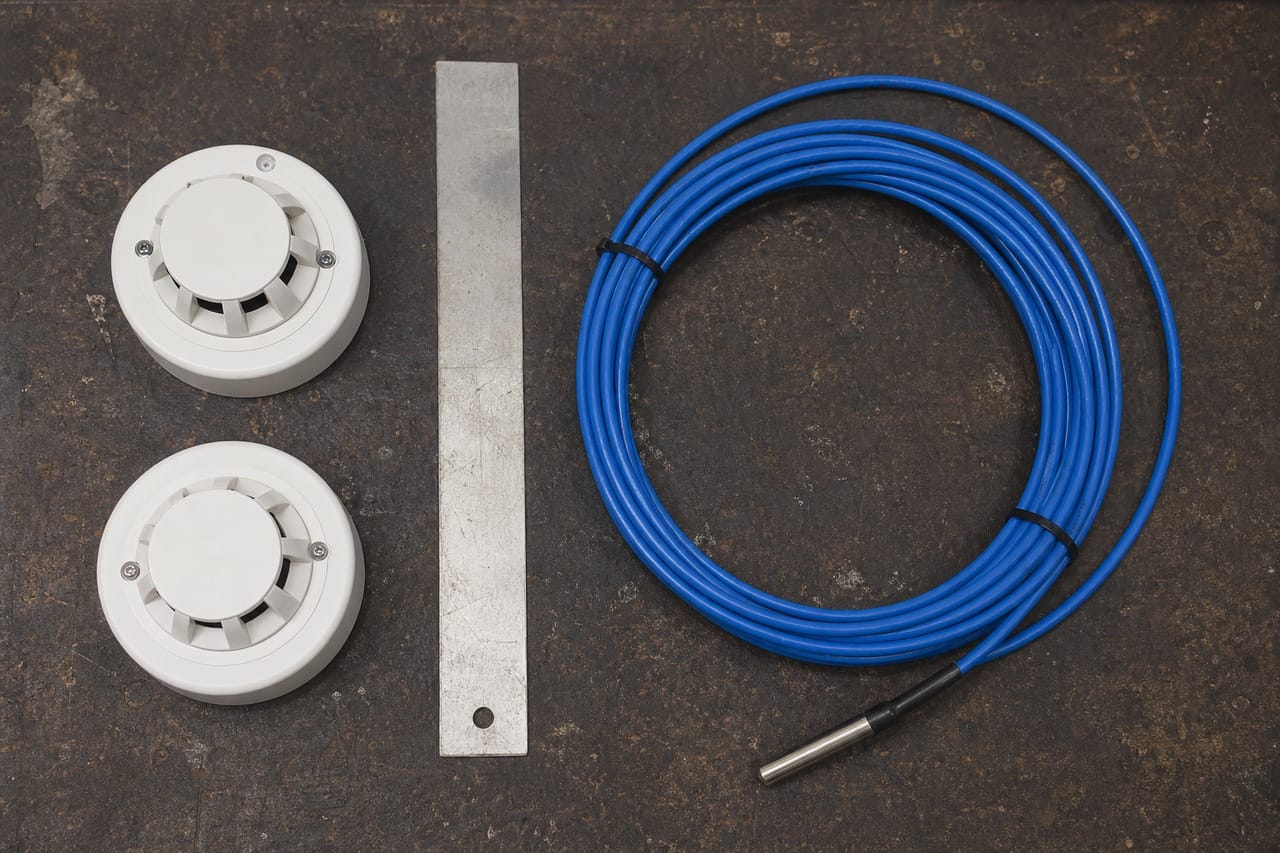
Stand under a ceiling you have to protect from fire and you have two fundamentally different ways to watch it. You can hang a grid of dots — discrete spot detectors, each guarding a circle of ceiling, spaced so their circles tile the area. Or you can run one continuous line — a linear heat detection cable where every centimetre is a sensor, reacting to the hottest point anywhere it passes. The choice is not a brand or a budget tier; it is a decision about the shape of the coverage, and getting it wrong is how a project ends up over-populating an unreachable ceiling with heads that each have to be individually maintained, or snaking a length of cable through a small room that a single point detector would have covered for a fraction of the cost.
This note compares the two device classes a specifying engineer actually chooses between — spot (point) heat detectors and linear heat detection (LHD) cable — on coverage geometry, location resolution, false-alarm behaviour, access and maintenance, environment tolerance, cost model and the standards that govern each. It is deliberately even-handed: linear detection is what we make, but it is the wrong answer in plenty of rooms, and this note says where. Two things worth flagging up front so you do not conflate them: this is a comparison of point versus line, which is separate from the detection mode a device uses (fixed-temperature, rate-of-rise or analogue), and separate again from which linear architecture you pick if you do go linear (fusible, digital addressable or fibre-optic). A clean specification answers all three.
Two Ways to Watch a Ceiling
A spot (point) heat detector is a discrete device mounted at a single ceiling location. It senses the temperature of the air around that point and raises an alarm when its element crosses a set point or a rate condition. Because each device only watches its own neighbourhood, code sets a maximum spacing, and you tile the ceiling with a grid of them so their coverage circles overlap enough to leave no unprotected gap. The alarm tells you a detector fired; on an addressable panel it tells you which detector, and therefore roughly where.
A linear heat detector is a continuous sensing element — a cable — that responds along its whole length. There is no grid of discrete devices: instead you route the cable through, over or along the thing you are protecting, and every part of the run is live. The design work does not disappear — it shifts from spacing out a grid of heads to routing and zoning a line — but it takes a different shape. A fusible thermosensitive cable, for instance, is built so that a heat-sensitive compound between two conductors collapses and shorts the pair at the rated temperature, at whatever point along the cable gets hot first — the mechanism is covered in how a thermosensitive cable is built and triggers. The cable does not care where along its length the heat appears; it reacts to the hottest point.
That single structural difference — a set of points versus a continuous line — drives almost every downstream trade-off. It decides how coverage is shaped and laid out, how the two behave in a fast draughty space, how much there is to maintain, and how the cost scales with the size and shape of the risk.
What Each One Actually Covers
The clearest way to see the difference is to draw the coverage on the same ceiling.
Read the two panels and the trade is visible. The point layout gives you discrete, individually addressable devices, but every one is spacing-critical and has to be reached for testing and cleaning, and its real-world weak spots are obstructions, beams, high ceilings and stratification rather than the grid itself. The line gives you one continuously sensing element, but its coverage is exactly the route — a corner the cable is not taken to is not protected, so the routing is the coverage design. Both are engineered to cover the space; they differ in how, and the right one depends on whether your risk is a set of discrete, accessible spots or a line and a large or awkward area.
The Axes That Decide It
Point and linear detectors trade off across a small number of engineering axes. The two side by side:
Spot / Point Detectors
A grid of discrete devices
- Coverage
- Overlapping spacing grid
- Design work
- Spacing-grid layout
- Location
- Per-device (addressable)
- Access to maintain
- Every head, individually
- Harsh environments
- Many types derate
- Cost scaling
- Per device × spacing
- Typical fit
- Small / discrete rooms
Linear Heat Detection
One continuous sensing line
- Coverage
- Continuous along the cable
- Design work
- Cable routing & zoning
- Location
- Zone, segment or ~1 m by architecture
- Access to maintain
- Mostly terminations and panel
- Harsh environments
- Set by jacket choice
- Cost scaling
- Per metre of run
- Typical fit
- Lines, large / harsh areas
The pattern in the table is that point detectors win on discrete location and small clean spaces, and linear detection wins on continuity, reach and harsh or hard-to-access geometry. The two axes that most often decide it in practice are how the risk is shaped — a scatter of rooms versus a line or a big area — and how reachable and how harsh the ceiling is.
Where Spot / Point Detectors Are the Right Choice
It would be dishonest to pretend linear cable is the answer everywhere, so here is where a point detector is usually the better specification. In a small, self-contained room with a reachable ceiling — an office, a plant room, a switch cupboard, a hotel bedroom — one or two point detectors cover the space more simply and more cheaply than routing, clipping and terminating a length of cable with an end-of-line resistor. Where you need exact per-location identification — a large building where the panel must announce the specific room in alarm — addressable point detectors give that by design, one address per device. Point detectors are also the mature, code-default answer for ordinary commercial ceilings, and they suit spaces where individual devices need to be tested, cleaned or swapped as routine maintenance and the ceiling is easy to stand under.
The common thread is discrete, accessible, benign: the risk sits in separable rooms, the ceiling is reachable, the environment is clean, and knowing exactly which device fired is worth more than continuity of coverage.
Where Linear Heat Detection Tends to Win
Linear detection earns its place when the risk stops being a set of discrete spots. The strongest cases:
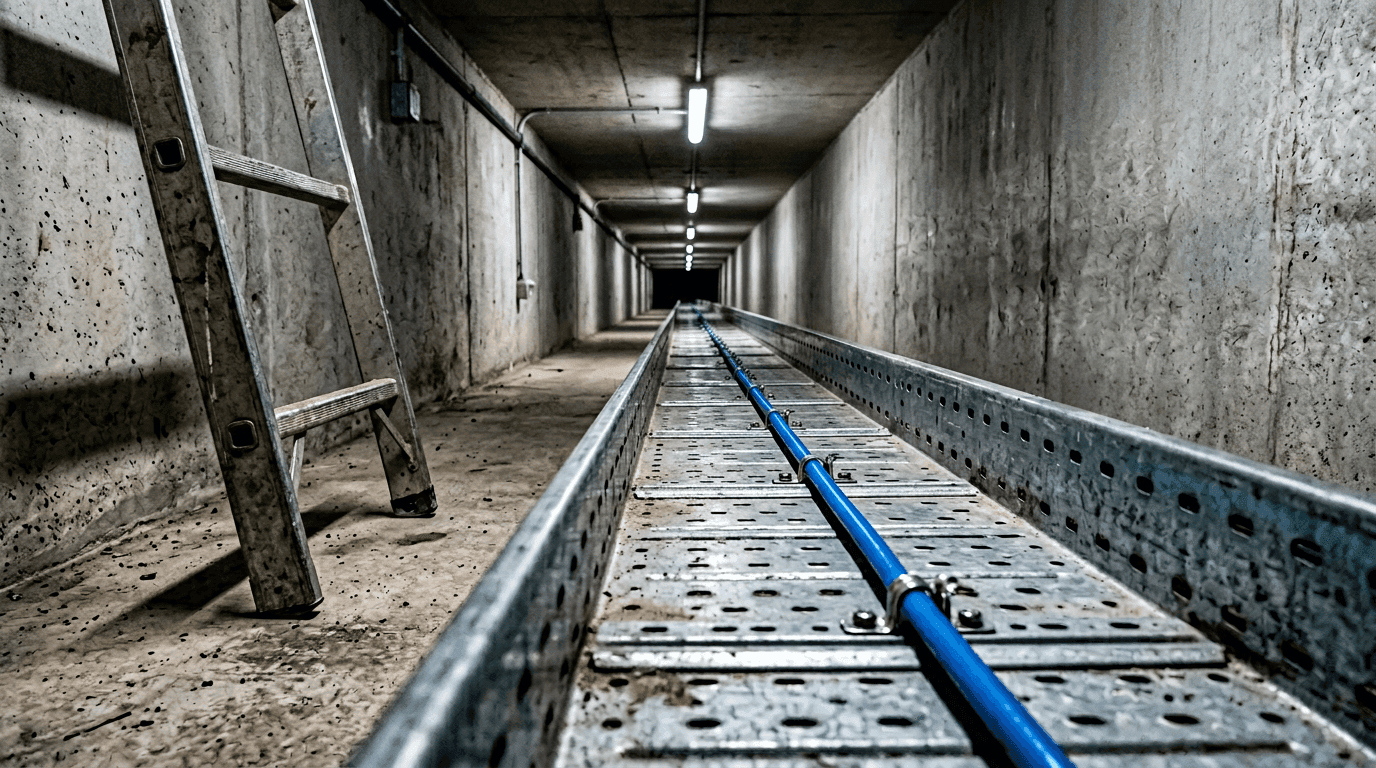
- The risk follows a line. Cable trays, conveyors, escalators, pipe racks, transformer bays, cable galleries — the hazard runs along a path, so a sensor routed along the same path fits the geometry more naturally than a spacing grid over the top of it.
- The area is large and continuous. Warehouses, hangars, car-park decks, atria — spaces where a point grid would need a large number of spacing-critical devices, and a single continuous run can replace much of that array; the cable still has to be routed and zoned to cover the space, but there are far fewer discrete devices to lay out and maintain.
- The ceiling is hard to reach. Tunnels, bridge cavities, under-floor voids, mine galleries — where every point detector would be a maintenance liability, non-resettable linear cable keeps most of what needs periodic access, the terminations and the panel, at the ends, with far less in-field hardware to service along the run. The one honest caveat is that a genuine activation is not resettable, so the affected length still has to be reached and replaced once — worth designing access for even in an otherwise sealed run. This is the whole argument in low-maintenance LHD for infrastructure you cannot reach.
- The environment is harsh. Dust, vibration, moisture and corrosive vapour can derate many point sensors, whereas a linear cable's exposure is set largely by its jacket, terminations and mechanical routing, which you can select and detail for the atmosphere — the logic laid out in LHD durability in chemical and mining facilities and the jacket material decision matrix.
The common thread here is the mirror of the last section: linear, large, inaccessible or harsh. When the risk has any of those shapes, the continuity and low-maintenance profile of a cable outweighs the discrete addressing of a point grid.
Location Resolution — Can a Line Tell You Where?
One genuine advantage of an addressable point detector is that it identifies itself: the panel knows exactly which device fired. Buyers reasonably ask whether a linear cable can do the same, and the honest answer is it depends on the linear architecture you chose. A fusible cable reports at zone level — the panel sees a short somewhere on the zone loop, so the resolution is the length of that zone, not a metre. A digital addressable cable divides the run into addressable segments and can tell you which segment activated. A fibre-optic distributed (DTS) system measures temperature continuously and typically locates a hotspot to within about a metre — a figure that is configurable on the interrogator — over kilometres of cable. The honest split is by what kind of location you need. If you need a hotspot pinpointed along a continuous run — a temperature profile down a tunnel crown or a cable gallery — that pushes you up the linear architecture ladder, to digital addressable or fibre DTS, a choice covered in the three-architectures comparison, where the cost math of replacing a large point array with one run is also worked through in detail. But if what you need is discrete room- or device-level identification — the panel announcing which compartment is in alarm — an addressable point detector gives that by design, one address per device, and is often the cleaner answer. Location resolution is a real axis, but the right tool depends on whether you are locating a point along a line or identifying one room among many.
False Alarms — and What Each One Trips On
Neither class is inherently quieter; they simply trip on different things. A point detector's nuisance exposure is mostly a property of its detection mode, not of being a point device: a plain fixed-temperature head is hard to fool, while a rate-of-rise or combination head can react to a fast non-fire swing — a process heater cycling, an oven door opening, sun on a metal roof deck. That distinction is the subject of the fixed-temperature versus rate-of-rise comparison. The offsetting advantage of a grid is that a single misbehaving device is individually addressable, so a nuisance source can be pinned to one location and serviced.
A fusible linear cable is a fixed-temperature device with a low thermal-nuisance rate — it responds to real heat at the hottest point, not to a rate. Its characteristic false signal is often not a thermal event at all: moisture ingress at a termination, crush or abrasion damage at a tray edge, or a deteriorating splice can read at the panel as the same short a real activation produces. And because fusible cable is non-resettable, a genuine activation means locating and replacing the affected length — so on a linear loop the practical question shifts from “is this a nuisance alarm” to “is this short a fire or a fault,” which the field-diagnosis sequence for LHD short circuits is built to separate.
Which One Does Your Application Need?
The device class should follow the shape of the risk and the ceiling, not habit. A few common cases:
| Situation | Usually the better class | Why |
|---|---|---|
| Cable tray, conveyor, pipe rack, transformer bay — the risk runs along a line | Linear (fusible LHD) | The sensor follows the same path as the hazard, so coverage is continuous along the run rather than a spacing grid to lay out over it. |
| Warehouse, hangar, car-park deck — large continuous area | Linear | One run replaces much of a large array of spacing-critical devices; coverage follows the routing. |
| Tunnel, cable gallery, under-floor void — ceiling hard to reach | Linear (non-resettable) | Most access is at the terminations and panel, with far less in-field hardware along the run. |
| Dusty, wet, vibrating or corrosive space | Linear (jacket-selected) | Exposure is set by a jacket you can choose for the atmosphere, where many point sensors would derate. |
| Small self-contained room, reachable ceiling, clean air | Spot / point | One or two devices are simpler and cheaper than routing and terminating a cable. |
| Large building needing the exact room announced in alarm | Spot / point (addressable) | Per-device addressing identifies the specific location by design. |
The recurring theme is that you match the sensor's shape to the risk's shape: a scatter of discrete, accessible rooms favours a scatter of discrete detectors, while a line, a big area or an unreachable, harsh space favours a continuous line. Many real projects use both — point detectors in the offices and plant rooms, linear cable down the cable trays and through the tunnel — because they are complementary tools, not competitors.
Getting the Class Onto the Spec and the RFQ
Device class maps onto the fire-detection standards, and the split trips up buyers because point and linear sit under different parts. In Europe, point heat detectors are covered by EN 54-5, while line-type (linear) detection is split across EN 54-22 for resettable line detectors and EN 54-28 for non-resettable line detectors — fusible cable lives in the non-resettable part. In North American practice, UL 521 lists heat detectors, NFPA 72 governs spacing and application for both classes, and FM 3210 is a widely referenced approval. The buyer-side trap is assuming an approval transfers across classes: a point-detector listing says nothing about a length of cable, and vice versa. Reading which standard applies to which class — and confirming what a certificate actually covers rather than what a logo implies — is the subject of our buyer-side compliance map for EN 54-22, UL 521 and FM 3210.
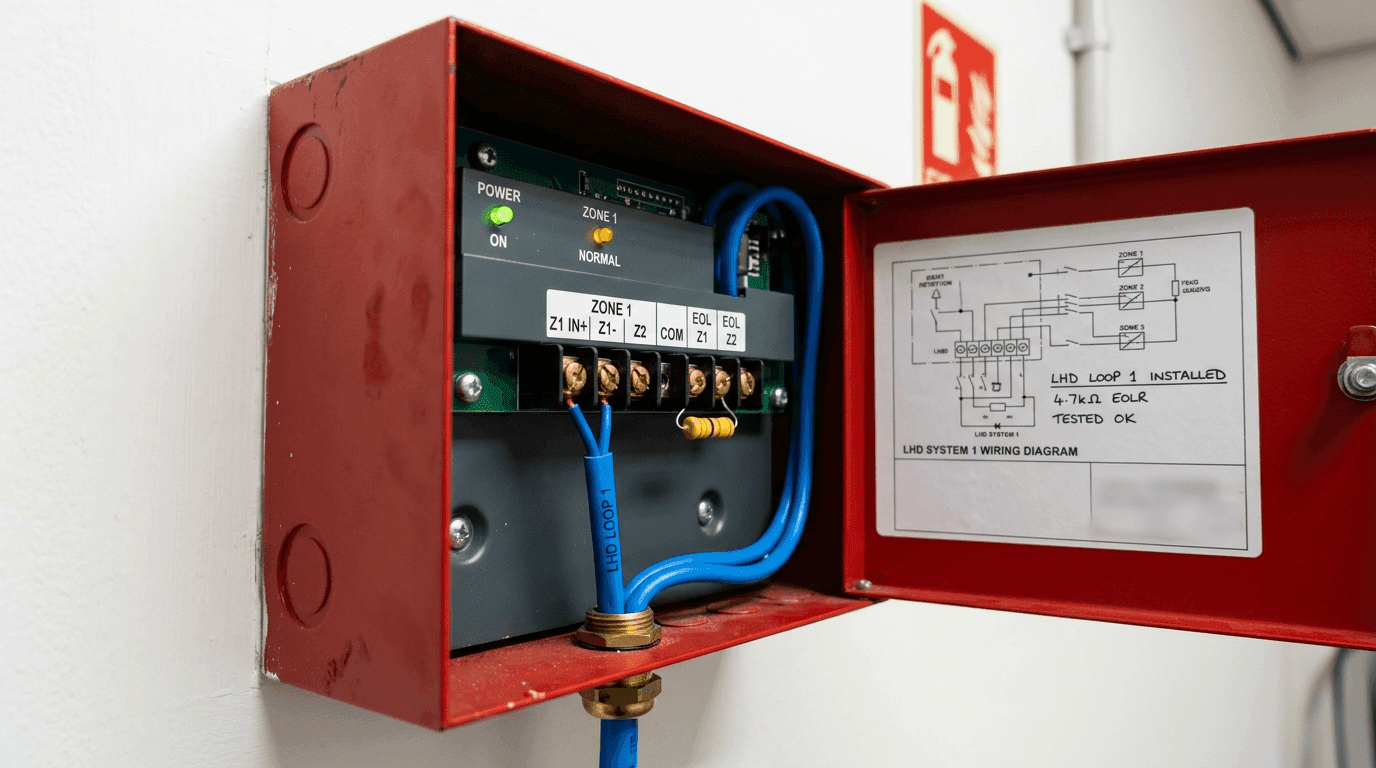
On the RFQ, that translates into naming the class explicitly rather than leaving it implied: point heat detectors or line-type heat detection; for linear, the architecture (fusible, addressable or fibre) and the set point; the coverage basis you expect (the spacing grid for points, or the routed length and zoning for a line); and, separately, the product approval you expect the paperwork to carry (the EN 54 part, or the UL 521 listing / FM 3210 approval) alongside the installation code the layout is designed to (typically NFPA 72), since those are different documents that a single logo does not combine. Where a linear cable terminates into a panel, the class and architecture also have to match what the panel is built to read — the interface side of that is covered in why panel compatibility is four separate matches, not a yes-or-no.
A point detector asks “is it hot here?” at each spot on a grid; a linear cable asks “is it hot anywhere along this line?”. Match the sensor's shape to the risk's shape — a scatter of rooms wants dots, a line or a large harsh space wants a line.
Closing Note
If you are weighing a point-detector grid against a linear run and are not sure which the geometry actually calls for, send us the picture — the space and its shape, whether the risk follows a line or fills an area, how reachable the ceiling is, the environment, the panel and the standard you are held to. We will come back with a recommended class, and where linear fits, an architecture, a set point and a draft spec line — turnaround scheduled subject to project scope and engineering review. Start a conversation.
FAQ — Linear vs Spot / Point Heat Detectors
What is the difference between a linear heat detector and a spot (point) heat detector?
A spot or point heat detector senses temperature at one fixed location — the ceiling position where the device is mounted — and protects a limited circular area around it, so a space is covered by an array of them spaced on a grid. A linear heat detector is a continuous cable that senses along its entire length, so every centimetre of the run is a sensing point and it reacts to the hottest point anywhere the cable passes. In short, a point detector answers where I am mounted, is it hot here; a linear detector answers is it hot anywhere along this line. The practical consequence is coverage geometry: point detectors are laid out on a spacing grid sized so their coverage overlaps and fills the ceiling, while a linear run senses continuously along the cable but only covers the path it is routed along.
When should I use LHD cable instead of point heat detectors?
Linear heat detection usually earns its place over point detectors when the risk follows a line or a large continuous area rather than sitting in a discrete room: cable trays, conveyors, tunnels, warehouses, hangars, car-park decks and transformer bays. It is also the stronger choice where the ceiling is hard to reach for maintenance, where dust, vibration, moisture or corrosive vapour would derate a point sensor, and where you want continuous sensing along the routed path rather than a point-detector spacing grid. Point detectors tend to remain the better answer in small, compartmented rooms with accessible ceilings, in clean office-type spaces, and where you need each device individually addressed for exact point location. The deciding questions are the shape of the risk, how reachable the ceiling is, and how harsh the environment is.
How many spot heat detectors does one run of LHD cable replace?
There is no fixed ratio, because it depends on the geometry — a point detector protects a limited circular area set by code spacing, while a cable run covers a line of any length. In a large open space or a long linear asset the arithmetic can be dramatic: a warehouse, hangar or long cable tray that would need a large number of spacing-critical point detectors plus their zone wiring can often be covered by a single continuous cable run. For a small room the comparison inverts and one or two point detectors are cheaper and simpler than routing and terminating a cable. The honest answer is to compare the installed cost of a compliant point-detector grid against one cable run for your specific geometry rather than assume a ratio.
Can linear heat detection tell you where along the cable the fire is?
It depends on the linear architecture. A fusible cable reports at zone level — the panel sees a short somewhere on that zone loop, so the resolution is the length of the zone, not a metre. A digital addressable cable divides the run into addressable segments and can report which segment activated. A fibre-optic distributed system (DTS) measures temperature continuously and can typically locate a hotspot to within about a metre — a configurable figure — along kilometres of cable. So if pinpoint location is a project requirement, that requirement points toward addressable or fibre architecture rather than plain fusible cable — which is a separate specification choice from point-versus-linear. An addressable point detector, by contrast, gives you the exact device address by design, which is one of the reasons point detectors survive where per-location identification matters.
Does using LHD cable remove the need for detector spacing or layout design?
No. Linear heat detection replaces the spacing grid of a point-detector array, but it does not remove the design work. The cable still has to be routed to cover the protected object or area, kept within the maximum monitored length per zone, mounted at the right distance from the ceiling or hazard, and laid out to the manufacturer's listed instructions and the applicable code such as NFPA 72. The design question simply changes from where to place each device to how to route and zone the cable. Point detectors are laid out on a spacing grid sized so their coverage overlaps and fills the space; a linear cable is laid out as a route. Both are engineered to cover the space fully — neither is a layout you can skip.
Which standards cover linear versus spot heat detectors?
They sit under different parts of the fire-detection standards, which is a common source of confusion at specification time. In Europe, point heat detectors are covered by EN 54-5, while line-type (linear) heat detection is split across EN 54-22 for resettable line detectors and EN 54-28 for non-resettable line detectors — fusible cable sits in the non-resettable part. In North American practice, UL 521 lists heat detectors and NFPA 72 governs spacing and application for both point and linear devices, with FM 3210 as a widely referenced approval for heat detectors. The buyer-side point is to make sure a certificate actually covers the device class and construction you are buying: a point-detector approval does not transfer to a length of cable, and reading which standard applies to which class is part of a proper document review.