You ask a prospective supplier for proof, and a few hours later a polished PDF arrives — a test report or a certificate, an authoritative-looking logo across the top, a serial number, a stamp. It feels like the end of the diligence. It is closer to the start. The logo is the easiest thing on the page to reproduce; the number printed under it is the part that can actually be checked. A document that looks official and a document that is official differ by exactly one lookup most buyers never do.
This note is about what to do once a third-party document is in your hands: confirm it is genuine, confirm the body that issued it is accredited to issue it, and confirm its scope covers the cable you are buying — not a sister product, an old edition, or a different plant. It comes after the wider supplier-evaluation decision path, after you know how to read the standards themselves, and after you know which documents to request. Those decide what to ask for; this decides whether to trust what comes back. Reading what a report actually measured is a different skill again — an accelerated aging report, for instance, is only interpretable once you can see its soak temperature and endpoint criteria.
A Report, a Certificate and a Mark Are Not the Same Claim
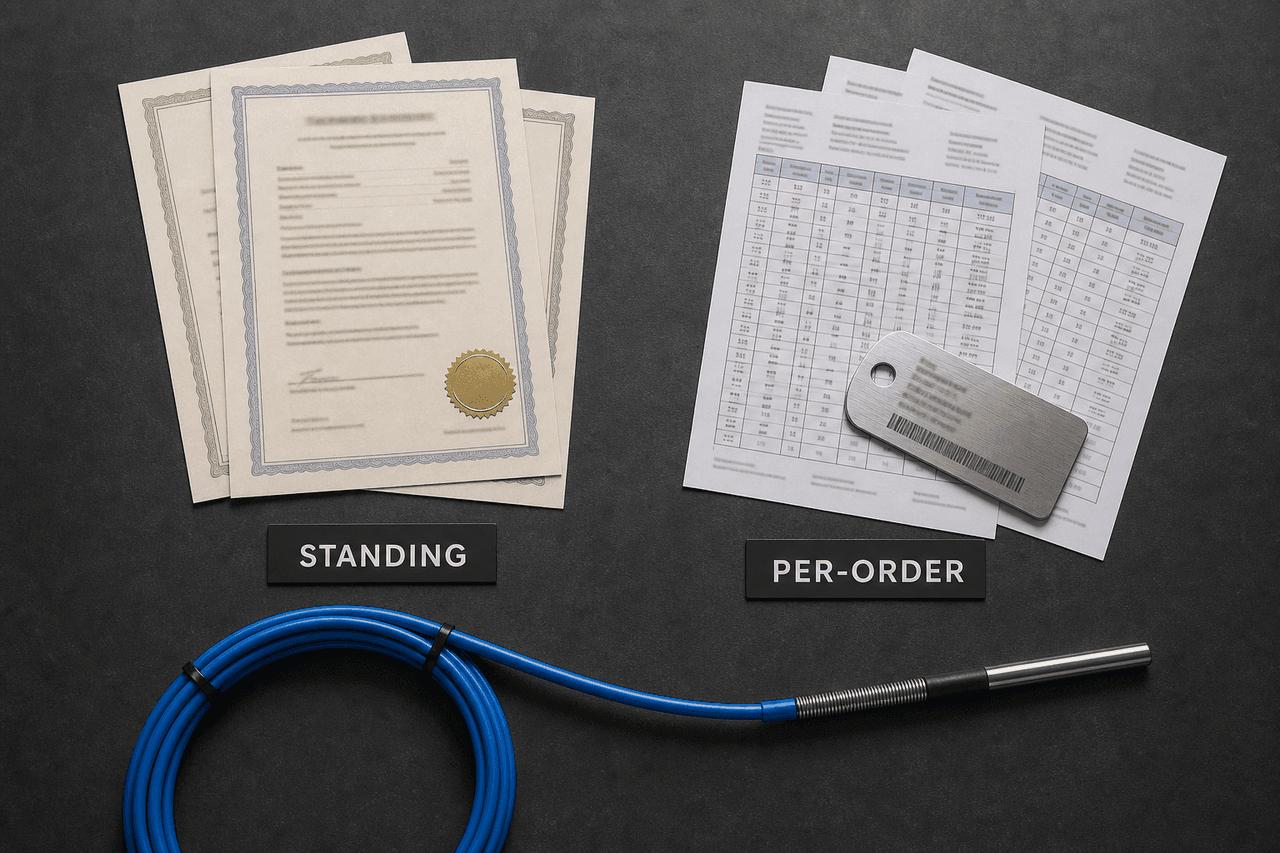
Before verifying a document it helps to know which of three claims it is making, because each is checked differently and each is worth a different amount.
A laboratory measured these samples against a stated method on a stated date. It is a snapshot of the specimens that were tested — strong evidence about those samples, but it says nothing on its own about the production you will receive next quarter. Its value rests on which lab ran it and whether that lab is accredited.
An accredited body has assessed that a defined product meets a standard, and in most schemes keeps it under periodic factory surveillance. That is a stronger, ongoing claim — but only inside the exact scope the certificate defines. Outside that scope it proves nothing.
An ISO 9001 certificate attests to the quality management system, not to any single product's performance. It tells you the supplier runs a documented process; it does not tell you a given cable passed a given test.
The most frequent over-reading is treating a report as a certification, or a system mark as product evidence. The distinction between designed against, tested, listed and approved is the language for this, and it is set out in full in the compliance-map note; the point here is simply that you verify a snapshot, an ongoing scope and a system claim in three different ways.
Who Issued It — and Are They Accredited?
The weight of a third-party document comes from the body behind it, not from the graphic at the top. Names such as UL, SGS, TÜV and Intertek carry authority because they may operate accredited laboratories or recognised certification schemes in specific scopes — but the name is not the proof. The proof is the accreditation reference the document should carry, and which a copied logo almost never reproduces correctly.
For a test report, look for an ISO/IEC 17025 accreditation: the report should name the accreditation body and an accreditation number, and state the scope the lab is accredited for. For a certification, look for the scheme and, where the applicable EU route uses a notified body, its number. A result on plain letterhead with no accreditation reference is a measurement someone took — it may be honest and competent, but it is a self-declared test, not an independent attestation, and it sits a clear step below an accredited-lab report in evidence weight. Knowing that difference is part of the broader set of supplier qualification signals worth reading before an order.
Verifying the Document Is Genuine
Once you know what kind of claim the document makes, confirming it is real is mostly a matter of going around the PDF to the source. Five checks catch the great majority of problems. How far you take them scales with the stakes: when a project, an authority having jurisdiction or a customer calls for third-party evidence — or when a supplier volunteers a certificate to win the order — the full set is worth running, while a low-risk enquiry or an early sample screen may only need the claim type and the issuing body confirmed, with the source lookup held back until a third-party document actually bears on the decision.
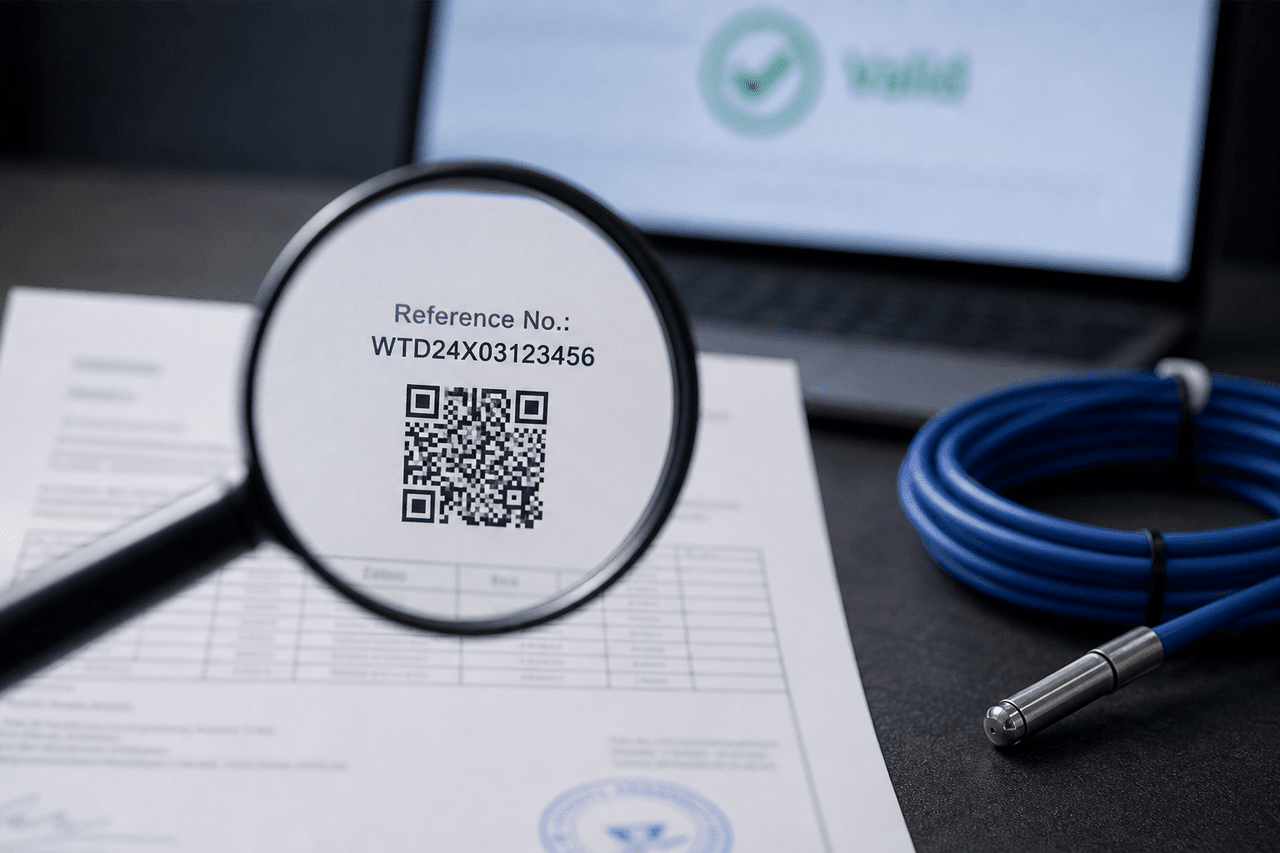
- Look the number up at the source. Many bodies publish an online lookup for certificate and report numbers; where one exists, enter the number and confirm the product, the standard and the named holder all match the document. Where no public lookup is offered — common for individual test reports — confirm the reference with the issuing office instead. A number that returns nothing — or returns a different product — is the single most telling result you can get.
- Check the QR code resolves to the issuing body. If a QR code or short URL is printed, scan it and read the domain it lands on. It should be the issuing body's own site, not a look-alike domain or a link hosted by the supplier. A code that points back to the seller verifies nothing.
- Confirm the holder is the factory you are buying from. Read the name the document is issued to. It should be the manufacturing entity supplying you, not a sister company, a parent brand or a trading house that resells several factories' output. A genuine certificate held by the wrong legal entity does not cover your order.
- Email the issuing office directly when in doubt. If the lookup is inconclusive, contact the issuing office — using contact details from the body's website, never the phone number or address printed on the document being checked. It is a short message and it closes the loop on anything a database cannot.
- Reconcile dates and standard editions. Check the issue date, any expiry, and the edition of the standard cited. A certificate against a withdrawn edition, or one past its validity window presented as current, fails this check even if the document itself is authentic.
Reading the Scope — A Mark Is Not a Match
The harder problem is usually not a forged document. It is a perfectly genuine one whose scope does not cover the cable in front of you. A supplier that truthfully “has a UL mark” may hold it for one construction, while quoting you another. The mark is real; the match is not. Scope is read field by field, and each field has to line up with your line item.
| Scope field | What to confirm against your order |
|---|---|
| Model / construction | The exact cable construction is named — conductor pair, compound, jacket. A different jacket or activation class is a different product, even under the same family name. |
| Standard and edition | The standard and its year/edition match the one your project requires. An older edition may no longer be accepted by the authority having jurisdiction. |
| Validity window | The issue date is in the past and any expiry is in the future. Surveillance-based listings can be suspended or withdrawn between renewals. |
| Named manufacturing site | The site on the certificate is the plant that will make your cable. A listing tied to one factory does not travel to a second site producing the same model. |
| Series vs sample | The document covers ongoing production of a series, not only the specific samples submitted for a one-off test. A type-test report and a series listing are not interchangeable. |
When every field matches, the document is evidence for your purchase. When one field drifts — a sister model, a lapsed date, a second plant — the document is still real, but it is evidence for something other than what you are buying, and it should be treated that way rather than waved through because the logo is reassuring.
Red Flags on a Third-Party Document
A handful of patterns account for most of the documents that do not hold up. None is proof of bad faith on its own — some are honest filing errors — but each is a reason to slow down and verify at the source before the document counts toward a decision.
| Red flag | Why it matters |
|---|---|
| No accreditation, scheme/listing or notified-body reference | An attestation with nothing to trace back to is, at best, a self-declared measurement. |
| Number returns nothing in the issuing body's database | Either the document is fabricated or the number is mistyped — both block the order until resolved. |
| Holder is a trading company, not the factory | A real certificate against the wrong legal entity does not cover the plant making your cable. |
| Scope names a sister product, not the model quoted | The most common honest mismatch — and the easiest to over-read in the supplier's favour. |
| Expired or withdrawn certificate shown as current | Surveillance schemes lapse; a date past its window is not present-tense evidence. |
| A test report presented as a certification | Upgrades a sample snapshot into an ongoing claim it was never meant to support. |
| QR or URL points to a look-alike domain | Verification routed through the seller rather than the issuer verifies nothing. |
Writing Verification Into the Purchasing Process
Verification works best as a defined step, not a one-off favour you remember to ask for. The cheapest place to build it in is the RFQ: ask for the reference number and issuing body up front so you can look the document up yourself, and require that any third-party attestation name the exact model and manufacturing site in its scope. Then make scope agreement a condition of acceptance, so a mismatch surfaces before the order ships rather than after a panel rejects the cable on site.
Third-party documents: for any test report or certificate provided, state the
issuing body, the reference/certificate number and the accreditation reference,
so the document can be confirmed at source.
Scope: the document must name the exact model/construction, the standard edition
and the manufacturing site supplying this order.
Acceptance: scope of any third-party attestation must match the purchase-order
line item; a mismatch is grounds to hold the order pending clarification.
This is also where an honest supplier and a careful buyer meet. A supplier that expects to be verified makes it easy: at our own engineering desk we provide test reports and compliance statements for a given model and point buyers to the issuing body for anything held externally — with a clear line between what we have measured in-house and what an independent listing or approval would require as a separate assessment that the buyer or the standard commissions. Verification is not an accusation; it is the step that lets a real document do its job, and it protects the suppliers with genuine paper as much as it screens out the ones without.
A third-party logo is a claim, not a conclusion. The work is small and almost always the same: decide which kind of claim the document makes, confirm the body behind it is accredited, look the number up at the source rather than trusting the page, and read the scope until every field matches the order. A document that survives those four steps is worth what its logo suggests. One that does not is worth no more than the toner it was printed with.
FAQ — Verifying a Third-Party Thermal Sensor Cable Certificate
How do I verify a third-party test report or certificate for a thermal sensor cable is genuine?
Start from the number, not the logo. A genuine third-party report or certificate carries a reference number that the issuing body can confirm, so look that number up in the body's own public database or verification portal and check that the product, the standard and the named holder all match the PDF in front of you. Confirm the document cites an accreditation reference — an ISO/IEC 17025 accreditation for a test lab, and for a certification the scheme it runs under (with a notified-body number where the applicable EU route uses one) — because the logo alone is not the proof. If a QR code is printed, check that it resolves to the issuing body's own domain rather than a look-alike, and when anything does not reconcile, email the issuing office using contact details taken from the body's website, not from the document. A doctored PDF often survives a glance but rarely survives a database lookup.
What is the difference between a test report, a certification and a factory mark?
They are three different claims and each is verified differently. A test report says a laboratory measured specific samples against a stated method on a stated date — it is a snapshot of those specimens, not a statement about ongoing production. A certification or listing says an accredited body has assessed that a product meets a standard and, in most schemes, keeps it under periodic surveillance — a stronger and ongoing claim tied to a defined scope. A factory or system mark such as ISO 9001 attests to the quality management system, not to any single product's performance. Reading a report as if it were a certification, or a system mark as if it covered the product, is the most common way a buyer over-reads a document.
A supplier has a UL or TÜV mark — does that mean my cable is covered?
Not on its own. A mark held by a company applies only to the specific construction, standard edition and manufacturing site named in its scope, so the question is never whether the supplier has a mark but whether the scope of that mark covers the exact model you are buying. A listing for one jacket, one activation class or one plant does not automatically extend to a different jacket, a different class or a different site. Read the scope fields — model and construction, standard and edition, validity dates, named site, and whether it covers a series or only the samples tested — and match each one against your line item before treating the mark as evidence for your order.
How do I write third-party verification into my purchasing process?
Make verification a defined step rather than an afterthought. On the RFQ, ask for the certificate or report number and the issuing body so you can look it up yourself, and ask that any third-party document name the exact model and manufacturing site in its scope. Make “the document scope matches the purchase-order line” a condition of acceptance, so a mismatch is caught before the order ships rather than after. A responsible supplier expects this and makes it easy — it can provide test reports and compliance statements for a given model and point you to the issuing body for any external attestation, with a clear line between what has been tested in-house and what an independent listing or approval would require as a separate assessment.