A thermal sensor cable data sheet that claims a fifteen-year service life is making a promise about something none of its tests actually watched happen. Nobody left a sample in a drawer for fifteen years to find out. That number comes — or should come — from an accelerated aging test: a sample held in an oven at a temperature well above its working ambient, with its properties measured as the hours add up, so the slow chemistry of a decade plays out in a few weeks. A thousand hours in that oven is the most common run length you will see quoted. The trap is reading those thousand hours as if they were the decade itself.
This note is about how to read an accelerated aging report on a thermal sensor cable, and what an oven soak can and cannot tell you. It is specifically about steady-state thermal endurance — the cable held at one elevated temperature, not swung up and down. The heat-cool story, where repeated cycling rather than constant heat walks the activation point out of band, is the subject of the cycling fatigue note; the conductor-side chemistry of oxidation is covered in the rapid-oxidation note; and the four aging families together are surveyed in the engineering reference. Here the focus is narrower: the oven, the report it produces, and the extrapolation printed at the bottom of it.
What an Accelerated Aging Test Actually Does
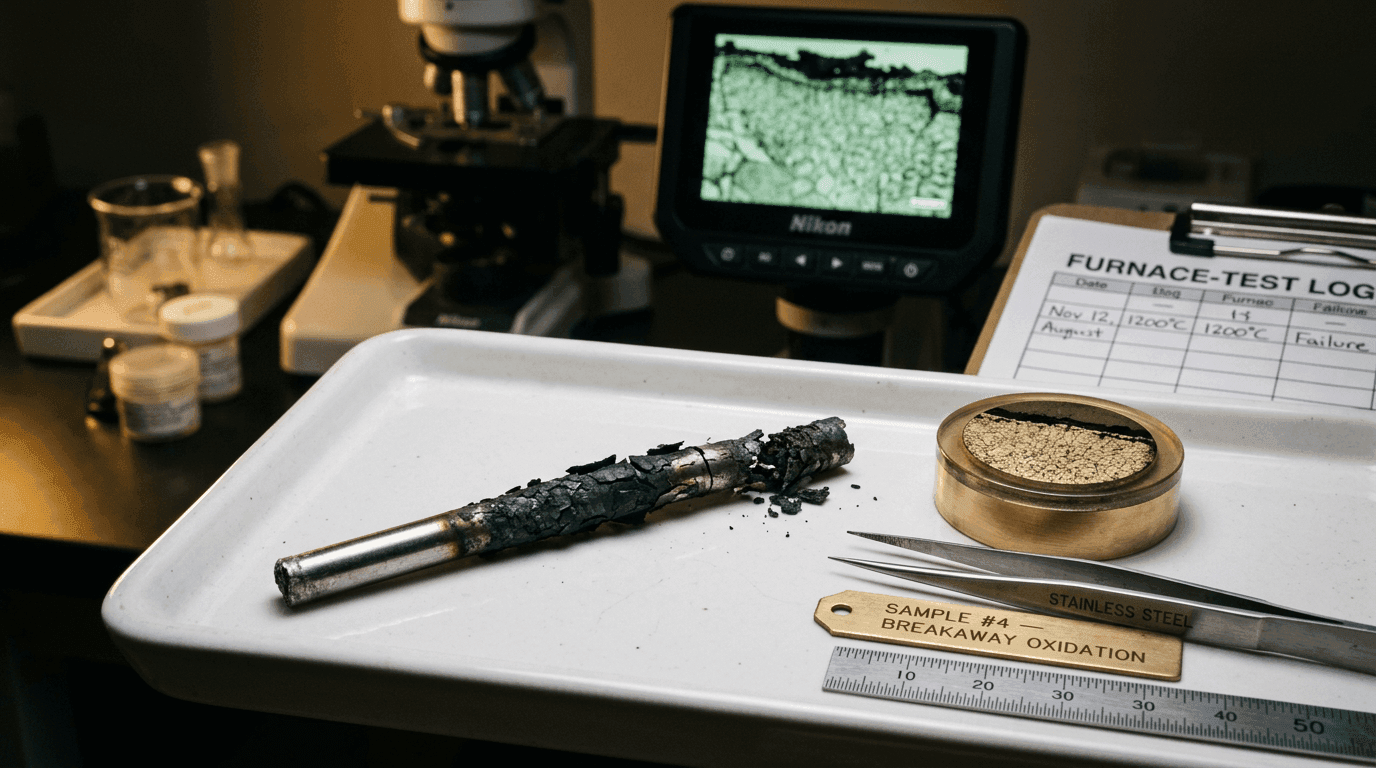
An accelerated aging test rests on one idea: the chemical and physical changes that retire a polymer over years at its working temperature happen faster — but in the same way — at a higher one. Hold a thermosensitive compound, an insulation layer or a jacket at a temperature above its service ambient and the reactions that embrittle it, drive off plasticiser or shift its dielectric behaviour all speed up. So instead of waiting a decade, a lab keeps samples in an oven at an elevated temperature and pulls them at intervals — 200 hours, 500, 1,000 — measuring how far a chosen property has fallen each time.
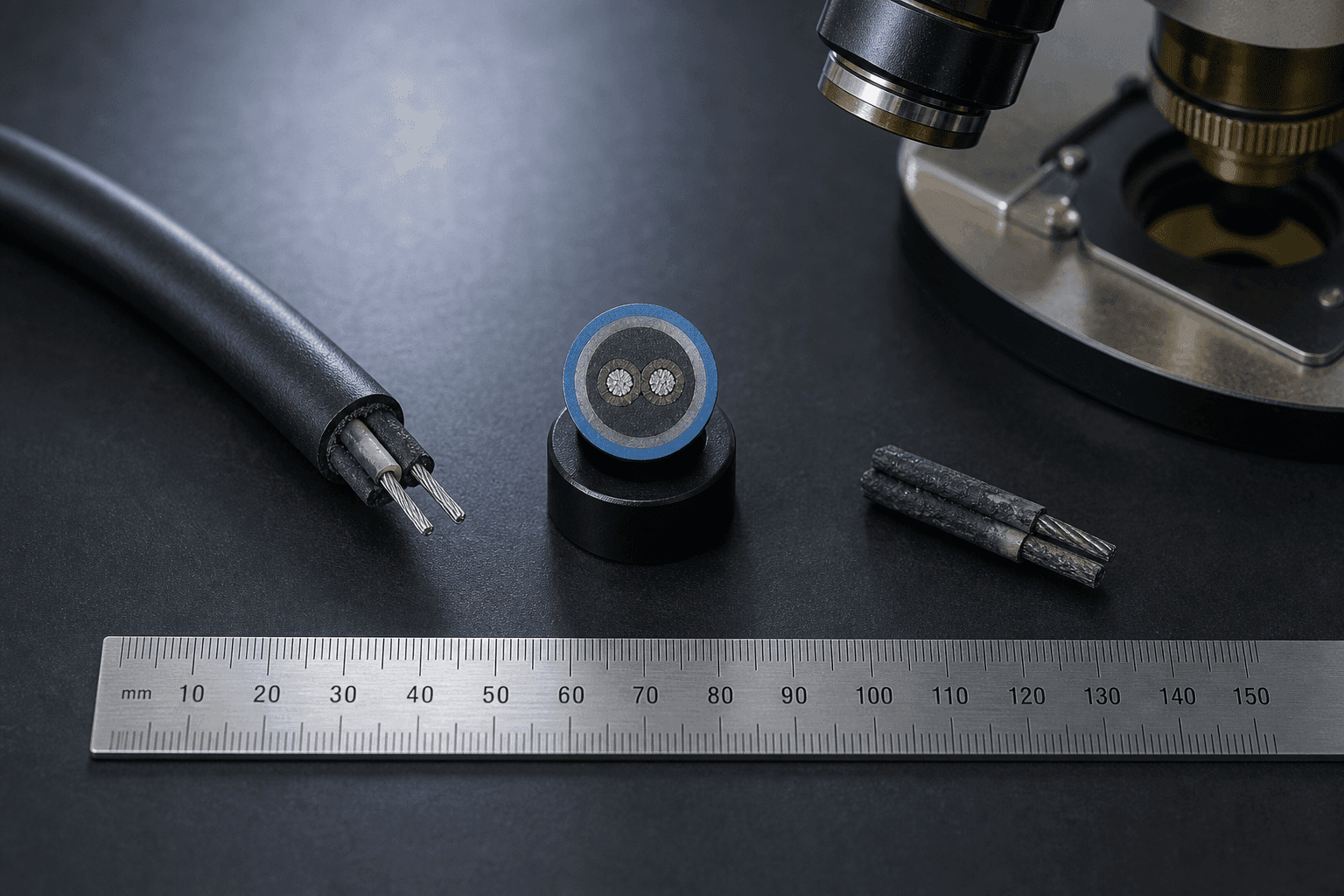
The end of life is not when the cable disintegrates; it is when a defined property drops to a defined threshold. For cable insulation the classic endpoint is elongation at break falling to half its original value: a material that has lost half its stretch has embrittled enough to crack under handling or thermal movement, and that is treated as the end of useful life. On a thermal sensor cable the properties worth tracking are the ones that change what the panel reads — the activation point itself, the insulation resistance, and the mechanical condition of the jacket and compound. A report that only records “sample intact at 1,000 hours” has measured the wrong thing.
Why a Thousand Hours Is Not Automatically a Decade
The link between oven hours and field years is the acceleration factor, and it comes from the Arrhenius relationship: reaction rate climbs exponentially with temperature. A rule of thumb that engineers carry around is that aging roughly doubles for every 10 °C of extra temperature — equivalently, every 10 °C you raise the oven roughly halves the time to the same endpoint. Stack a few of those tens of degrees between the field temperature — the route's actual working ambient — and the oven temperature and the multiplier grows quickly.
Rule of thumb: aging rate doubles per ~10 °C  (Arrhenius, material-dependent)

Assumed field temperature ........ 90 °C
Oven soak temperature ............ 150 °C
Difference ....................... 60 °C  →  ~2^6 = ~64x acceleration

1,000 oven hours  x  ~64  ≈  64,000 field hours  ≈  ~7.3 years  (estimate)

Re-assume the field temperature at 110 °C and the same 1,000 hours
models roughly 2 years, not 7. The assumption moves the answer.
Two things in that little calculation decide everything, and both are assumptions rather than measurements. The first is the activation energy of the actual degradation — the “doubles per 10 °C” figure is a convenient average, but the real number depends on the specific compound and on which reaction is doing the damage, so it has to be established for the material rather than borrowed. The second is the field temperature you extrapolate down to: the same oven run maps to roughly seven years at 90 °C or to two at 110 °C. This is why a single soak temperature is never enough to draw a real life line — with one oven temperature you have one point and no slope. A defensible extrapolation reaches the same endpoint at two or three temperatures, so the slope is measured rather than assumed. A 1,000-hour number from one oven temperature is a data point, not a service life.
Reading the Report — What It Has to State
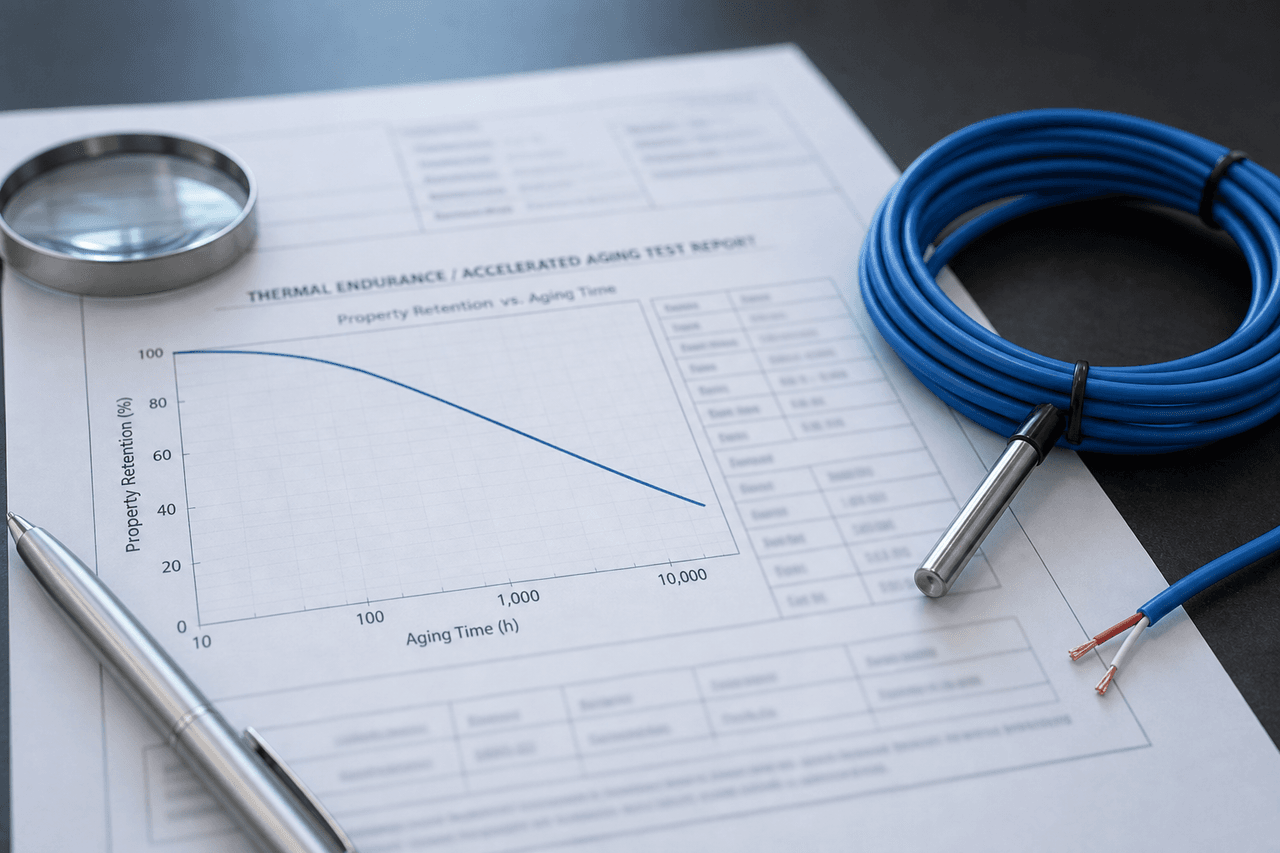
Most of the value of an aging report is in whether it states its own conditions. A figure like “1,000 hours” or “passed” means nothing until you can see the temperature it was run at, the property that was tracked, and the field condition the result is extrapolated to. Four things have to be on the page.
The temperature the oven was held at, and crucially whether there was more than one. A single elevated temperature can show a sample survived that temperature for that long; it cannot establish the slope needed to convert hours into years. Two or three temperatures, each run to the same endpoint, are what a real thermal-endurance line is built from.
How long the run was and how often samples were measured along the way. Properties read only at the start and the end hide the shape of the curve — a cable that drops steeply between 500 and 800 hours and only just scrapes past the threshold at 1,000 is a very different risk from one aging gently and evenly to the same endpoint. Intermediate pull points at, say, 200, 500 and 1,000 hours are what turn a pass/fail into a trend.
Which property defines end of life, and the threshold it has to cross — elongation at break to 50% of initial, insulation resistance below a stated floor, or activation point drifting more than a stated number of kelvin. Without a named criterion, “pass” is just an opinion about a sample that happened to survive.
The properties that matter for a sensor cable are the ones that change what the panel sees: the activation point, the insulation resistance and the mechanical state of the jacket and compound. A report that tracks only jacket tensile strength has told you about the sheath and nothing about whether the cable still trips where it should.
Those four are the core. A careful report adds three quality details that decide how much the curve is worth — how many samples were aged, the oven's temperature tolerance, and the measurement uncertainty on each reading — the difference between a single line and a line you can put a confidence on. They sit on the RFQ checklist further down rather than in the four essentials, but a report that volunteers them is one that expects to be read closely.
What an Oven Soak Does Not Prove
An accelerated aging test is a steady-state test, and that is its blind spot. The sample sits at one temperature; it is not swung, flexed, wetted or vibrated. So a clean 1,000-hour result says nothing about three real-world stresses that retire cables in service.
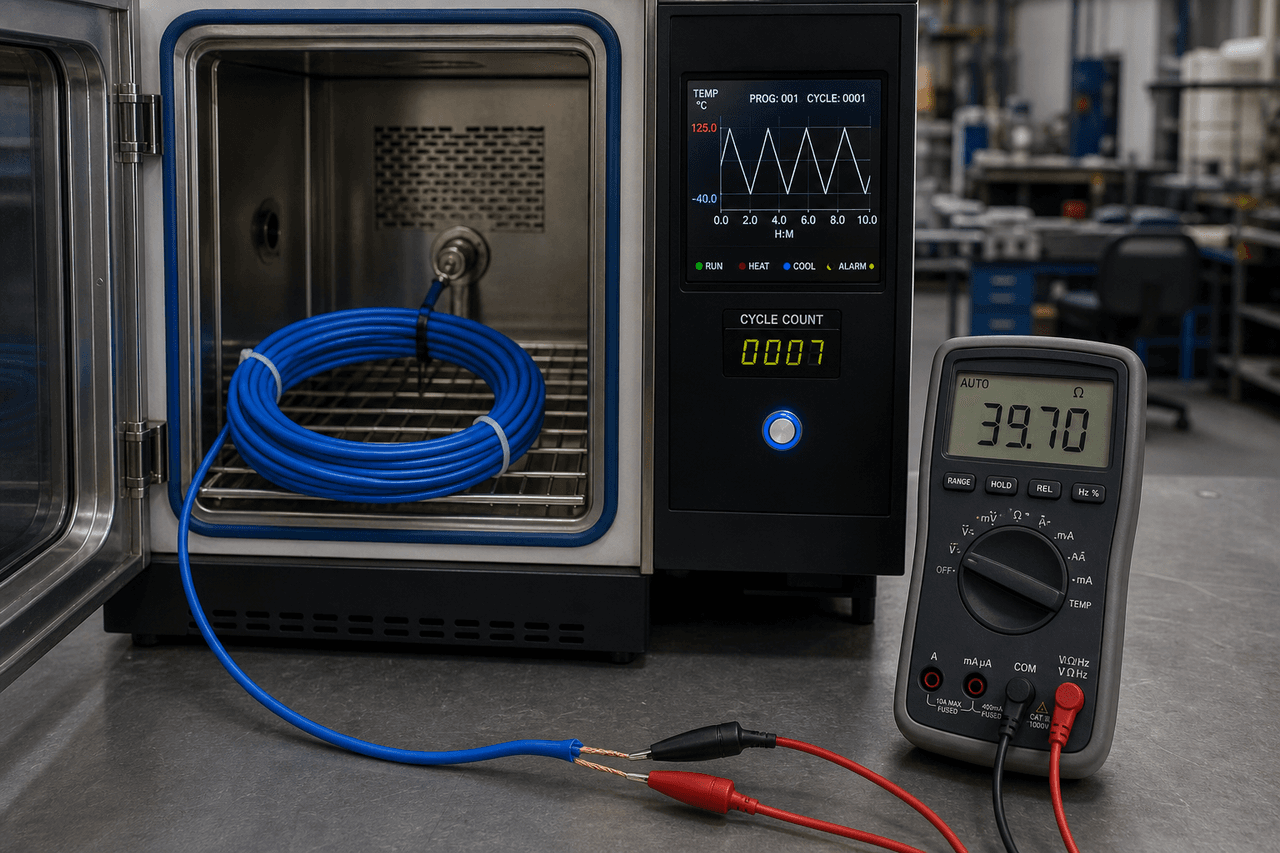
It does not cover thermal cycling — the repeated heat-cool movement that drifts the activation point through mechanical fatigue rather than steady chemistry, which is a separate test and a separate mechanism set out in the cycling fatigue note. It does not cover moisture: a soak in a dry oven cannot reveal the slow dielectric drift that water ingress at a joint causes, which is why IP rating is specified and verified separately. And it does not cover mechanical abuse, flexing or installation damage. A cable can pass a thermal-endurance soak and still fail early on a cyclic, wet or badly handled route. The soak earns the cable one thing — a credible answer on steady heat — and the other stresses have to be answered by their own tests.
When the Soak Result Earns Its Weight
Because the soak only answers the steady-heat question, how heavily it should count in a buying decision depends on what actually threatens the cable on the route in front of you.
The route holds the cable near a steady elevated temperature for years; a supplier quotes a service-life figure you will have to defend at a later inspection; or two constructions have to be ranked on thermal endurance before a long-life run is committed. In those cases the soak temperature, the endpoint and the assumed service temperature are the evidence that settles the order.
The dominant risk is not constant heat. A route that swings hard belongs to the cycling test; one that gets wet to the IP specification; one that flexes or is dragged through conduit to the mechanical and handling checks. And on a short-life or modest-temperature run, where the polymer never comes near its endurance limit, a clean soak number is reassuring but rarely the figure the decision turns on.
Asking for It, and Trusting It
On the RFQ, an aging claim is only useful if it arrives with its conditions attached. Ask for the soak temperature (and how many), the duration and pull points, the endpoint criterion, and the field temperature the life estimate assumes. A bare “designed for 15 years” with none of that behind it is a marketing line, not a test result.
Accelerated aging / thermal endurance data for the supplied construction:
  - soak temperature(s) and number of temperature points tested
  - test duration and intermediate pull points (hours)
  - endpoint criterion (e.g. elongation at break to 50% of initial)
  - properties measured (activation point, insulation resistance, mechanical)
  - sample count (n) and how the samples were conditioned
  - oven temperature tolerance and measurement uncertainty
  - assumed service temperature behind any quoted "service life"
On the supply side, this is data a manufacturer can provide rather than a promise it should make. A thermal-endurance result for a given construction — with the soak temperature, the hours, the endpoint and the assumed service temperature stated — is evidence; a guaranteed number of field years is not, because the service life a cable actually reaches depends on the route's real temperature, which is assessed for the deployment rather than printed on a label. And reading an aging report's technical content is a different job from confirming the document is genuine and accredited — that lookup, the one that checks the issuing lab and the scope, is the subject of the third-party verification note. Read the conditions first; confirm the source second.
An accelerated aging test compresses years of steady heat into weeks of oven time — but only the conditions printed on the report tell you how many years, and only at the temperature it assumed. A thousand hours is a measurement; a service life is an extrapolation. Read the soak temperature, the endpoint and the assumed field condition before you read the headline number.
FAQ — Thermal Sensor Cable Accelerated Aging Tests
What is an accelerated aging test for a thermal sensor cable?
It is a test that holds cable samples in an oven at a temperature well above their working ambient and measures how their properties change as the hours add up, so the slow degradation that would take years at service temperature is reproduced in weeks. The principle is that the chemistry which embrittles a compound, jacket or insulation runs in the same way but faster at a higher temperature. End of life is defined as a chosen property reaching a set threshold — commonly elongation at break falling to half its original value — rather than the cable physically failing. On a thermal sensor cable the properties worth tracking are the ones that change what the panel reads: the activation point, the insulation resistance and the mechanical state of the jacket and compound.
Does a 1,000-hour oven soak mean the cable will last that many years in service?
No. A thousand hours of soak converts to field years only through an acceleration factor based on the Arrhenius relationship, and that factor depends on two assumptions: the activation energy of the actual degradation and the field temperature you extrapolate down to. A rule of thumb is that aging roughly doubles for every 10 degrees Celsius of extra temperature, so a large gap between the oven and the field multiplies the hours considerably, but the same 1,000 hours can model around seven years at one assumed field temperature and two at a higher one. A single soak temperature gives one data point and no slope; a defensible life estimate needs the same endpoint reached at two or three temperatures so the slope is measured. The hours are a measurement; the service life is an extrapolation, not a guarantee.
What should an accelerated aging report state?
It should state the soak temperature and whether more than one temperature was tested, the test duration and the intermediate pull points where samples were measured, the endpoint criterion that defines end of life and the threshold it has to cross, the properties that were actually measured on the cable, and the field temperature the life estimate is extrapolated to. A report that gives only a duration and a pass tick has hidden the information that makes the result interpretable. Intermediate pull points matter because they show the shape of the aging curve rather than just its endpoint, and a named endpoint criterion is what turns a pass from an opinion into a measurement.
What does an accelerated aging test not cover?
It is a steady-state test, so it does not reveal anything about stresses that are not constant heat. It does not cover thermal cycling, where repeated heat-cool movement drifts the activation point through mechanical fatigue rather than steady chemistry; that is a separate cycling test. It does not cover moisture ingress, which causes dielectric drift that a dry oven cannot reproduce and which is specified and verified through the IP rating instead. And it does not cover mechanical flexing, crushing or installation damage. A cable can pass a thermal-endurance soak and still fail early on a route that cycles, gets wet or is handled badly, so the soak result has to be read alongside the tests that cover those other stresses rather than as a complete picture of service life.